Sunday, 23 December 2018

HQ Trivia launches HQ Words as reinstalled CEO seeks a game-changer

HQ’s expansion beyond trivia is emerging from beta, but the question is whether it’s different and accessible enough to revive the startup’s growth. HQ Words opens to everyone today with games at 6:30pm PT within the HQ Trivia app after several weeks of closed beta testing of the Wheel Of Fortune-style game. The launch will be the first big move of Rus Yusupov now that he’s been officially renamed CEO a week after the tragic death of fellow co-founder and former CEO Colin Kroll, HQ confirms to TechCrunch.
“Intermedia Labs introduced the world to a category defining product, HQ Trivia. Once again, with HQ Words, Intermedia Labs is poised to captivate the world with a revolutionary experience that will bring people together in new ways around live mobile video” Yusupov tells us. “HQ Words is the most interactive experience we’ve ever made.”

Kroll’s passing comes at a tough time for HQ. Its daily player count has declined since it became a phenomenon a year ago. The novelty has begun to wear off, and with so many experienced trivia whizzes, cash jackpots are often split between enough people that winners only get a few bucks. Interrupting your days or nights to play at a particular time can be inconvenient compared to the legions of always-available other games. Yusupov, who was HQ’s CEO until Kroll took over in September, will have to figure out what will attract casual crosswords players and those who flocked to Zynga’s Words With Friends — the kind of disruptive thinking Kroll excelled at.

“Colin and I shared many incredible life moments over the last 7 years. We embarked on an incredible journey co-founding two breakthrough companies together – and the lessons we learned at Vine and HQ will continue to have a big impact on me. Like many relationships, we’ve also had our challenges – but it was during these challenging times that Colin’s kind soul and big heart would truly shine” Yusupov wrote in a statement about his co-founder that was originally published by Digiday in a touching memorial post. Between building Vine and HQ together, the pair have reimagined mobile entertainment, giving millions a chance to show off their wits and creativity. “He had this incredible ability to make everyone feel special. He listened well. He thought deeply. But above all, he cared about people more than work. The driving force behind his innovations was the positive impact they would have on people and world. Colin’s innovations and inventions have changed many people’s lives for the better and will continue to impact the world for years to come.”

HQ Trivia’s co-founder and former CEO Colin Kroll passed away earlier this month

How To Play HQ Words

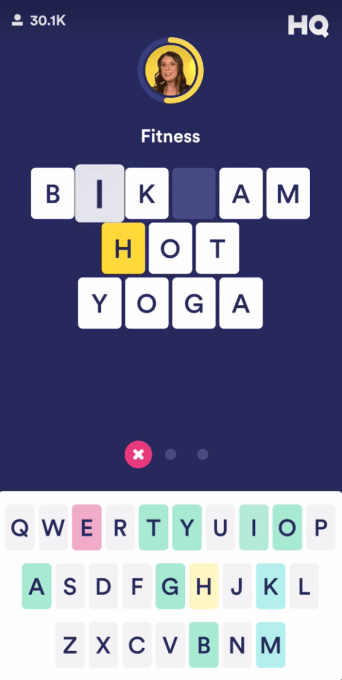
In HQ Words, players compete live to solve word puzzles by correctly choosing what letters are hidden. You can find the game inside the existing HQ Trivia iOS and Android apps. Host Anna Roisman pluckily provides a clue and then dispenses hints as the 25-second timer for each puzzle counts down. If the clue is “gemstone” and you’re shown “_ _ _ m _ _ _”, you’ll have to tap D, I, A, O, and N in any order. Choose three wrong letters or fail to fill out the words and you lose. You’ll spin a wheel before the game starts to get one letter that’s automatically revealed each round.

Make it through ten rounds and you and other winners get a cut of the cash prize, with the three who solved the puzzles fastest scoring a bigger chunk of the jackpot. The startup earns money through selling you extra lives inside Words, though it will probably feature sponsored games and product placement like Trivia does to pull in marketing dollars. Words will go live daily at 6:30pm pacific after Trivia’s 6:00 game, so you can turn it into HQ hour with family and friends.
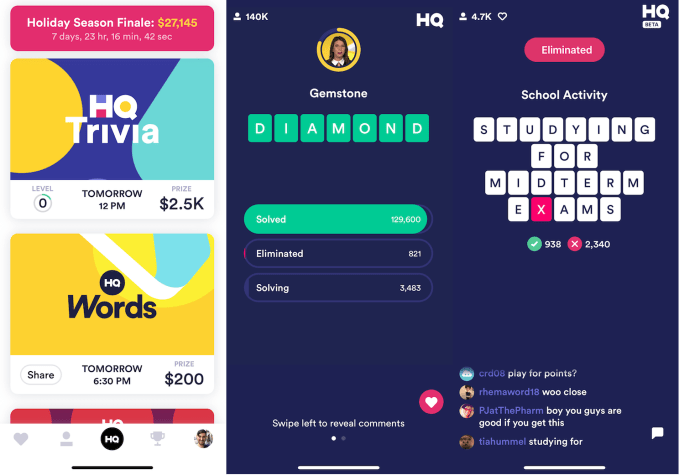
HQ Words is much more frenetic than Trivia. Rather than picking a single answer, you have to rapidly tap letters through a combination of educated and uneducated guesses. That means it really does feel more interactive since you’re not sitting for minutes with just a sole answer tap to keep you awake. And because it doesn’t require deep and broad trivia knowledge, Words could appeal to a wider audience. The spinner also adds an element of pure luck, as a weaker player who gets to auto-reveal a vowel might fare better than a wiser player who gets stuck with a “Z” like I always seem to.

Fill In The Blank

The concern is that at its core, Words is still quite similar to Trivia. They’re both real-time, elimination round-based knowledge games played against everyone for money. Both at times feel like they use cheap tricks to eliminate you. A recent Words puzzle asked you to name a noisy instrument, but the answer wasn’t “kazoo” but “buzzing kazoo” — something I’m not sure anyone has ever formally called it. Given the faster pace of interaction, even tiny glitches or moments of lag can be enough to make you lose a round. An HQ Words beta game earlier this week failed to show some users the keyboard, causing mass elimination. The pressure to get HQ’s engineering working flawlessly has never been higher.
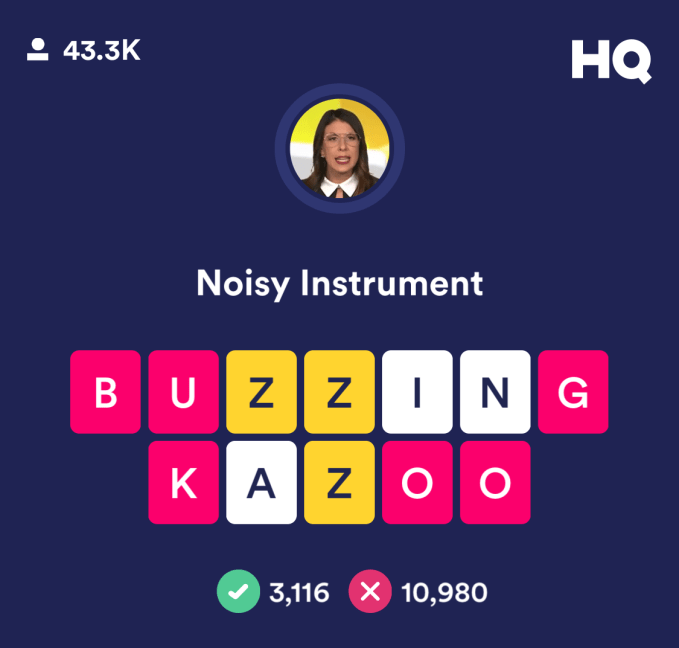
The phrasing of some HQ Words answers seems like a stretch

HQ originally agreed to let TechCrunch interview Kroll about what makes Words different enough to change the startup’s momentum. Yusupov was supposed to fill in after Kroll was sadly found dead last Friday of an apparent drug overdose. He later declined to talk or provide written responses. That’s understandable during this time of mourning and transition. But HQ will still need to build an answer into its app. Meanwhile, Chinese clones and US competitors have begun co-opting the live video quiz idea. Facebook has even built a game show platform for content makers to create their own.

HQ could benefit from a better onboarding experience that lets people play a sample game solo to get them hooked and tide them over until the next scheduled broadcast. Mini-games or ways to play along after you’re eliminated could boost total view time and the value of brand sponsorships. A “quiet mode” that silences the between-round chatter and distills HQ to just the questions and puzzles might make it easier to play while multi-tasking. Head-to-head versions of Trivia and Words might help HQ feel more intimate, and there’s an opportunity to integrate peer-to-peer gambling like ProveIt trivia.  And branching out beyond knowledge games into more social or arcade-style titles would counter the idea that HQ is just for brainiacs.

Around the height of HQ’s popularity it raised a $15 million funding round at a $100 million valuation. That seems justified given HQ will reportedly earn around $10 million in revenue this year. Gamers are fickle, though, and today’s Fortnite can wind up tomorrow’s Pokemon Go — a flash in the pan that fizzles out. Words is a great bridge to a world outside of Trivia, but HQ must evolve not just iterate.


source https://techcrunch.com/2018/12/23/how-to-play-hq-words/

The year social networks were no longer social

The term “social network” has become a meaningless association of words. Pair those two words and it becomes a tech category, the equivalent of a single term to define a group of products.

But are social networks even social anymore? If you have a feeling of tech fatigue when you open the Facebook app, you’re not alone. Watching distant cousins fight about politics in a comment thread is no longer fun.

Chances are you have dozens, hundreds or maybe thousands of friends and followers across multiple platforms. But those crowded places have never felt so empty.

It doesn’t mean that you should move to the woods and talk with animals. And Facebook, Twitter or LinkedIn won’t collapse overnight. They have intrinsic value with other features — social graphs, digital CVs, organizing events…

But the concept of wide networks of social ties with an element of broadcasting is dead.

From interest-based communities to your lousy neighbor

If you’ve been active on the web for long enough, you may have fond memories of internet forums. Maybe you were a fan of video games, Harry Potter or painting.

Fragmentation was key. You could be active on multiple forums and you didn’t have to mention your other passions. Over time, you’d see the same names come up again and again on your favorite forum. You’d create your own running jokes, discover things together, laugh, cry and feel something.

When I was a teenager, I was active on multiple forums. I remember posting thousands of messages a year and getting to know new people. It felt like hanging out with a welcoming group of friends because you shared the same passions.

It wasn’t just fake internet relationships. I met “IRL” with fellow internet friends quite a few times. One day, I remember browsing the list of threads and learning about someone’s passing. Their significant other posted a short message because the forum meant a lot to this person.

Most of the time, I didn’t know the identities of the persons talking with me. We were all using nicknames and put tidbits of information in bios — “Stuttgart, Germany” or “train ticket inspector.”

And then, Facebook happened. At first, it was also all about interest-based communities — attending the same college is a shared interest, after all. Then, they opened it up to everyone to scale beyond universities.

When you look at your list of friends, they are your Facebook friends not because you share a hobby, but because you’ve know them for a while.

Facebook constantly pushes you to add more friends with the infamous “People you may know” feature. Knowing someone is one thing, but having things to talk about is another.

So here we are, with your lousy neighbor sharing a sexist joke in your Facebook feed.

As social networks become bigger, content becomes garbage.

Facebook’s social graph is broken by design. Putting names and faces on people made friend requests emotionally charged. You can’t say no to your high school best friend, even if you haven’t seen her in five years.

It used to be okay to leave friends behind. It used to be okay to forget about people. But the fact that it’s possible to stay in touch with social networks have made those things socially unacceptable.

Too big to succeed

One of the key pillars of social networks is the broadcasting feature. You can write a message, share a photo, make a story and broadcast them to your friends and followers.

But broadcasting isn’t scalable.

Most social networks are now publicly traded companies — they’re always chasing growth. Growth means more revenue and revenue means that users need to see more ads.

The best way to shove more ads down your throat is to make you spend more time on a service. If you watch multiple YouTube videos, you’re going to see more pre-roll ads. And there are two ways to make you spend more time on a social network — making you come back more often and making you stay longer each time you visit.

And 2018 has been the year of cheap tricks and dark pattern design. In order to make you come more often, companies now send you FOMO-driven notifications with incomplete, disproportionate information.

This isn’t just about opening an app. Social networks now want to direct you to other parts of the service. Why don’t you click on this bright orange banner to open IGTV? Look at this shiny button! Look! Look!

HQ Trivia launches HQ Words tonight under reinstalled CEO

HQ’s expansion beyond trivia emerges from beta tonight, but the question is whether it’s different and accessible enough to revive the startup’s growth. HQ Words opens to everyone with today’s 6:30pm pacific broadcast within the HQ Trivia app after several weeks of closed beta testing of the Wheel Of Fortune-style game. The launch will be the first big move of Rus Yusupov now that’s been officially renamed CEO a week after the tragic death of fellow co-founder and former CEO Colin Kroll, HQ confirms to TechCrunch.

“Intermedia Labs introduced the world to a category defining product, HQ Trivia. Once again, with HQ Words, Intermedia Labs is poised to captivate the world with a revolutionary experience that will bring people together in new ways around live mobile video” Yusupov tells us. “HQ Words is the most interactive experience we’ve ever made.”

Kroll’s passing comes at a tough time for HQ. Its daily player count has declined since it became a phenomenon a year ago. The novelty has begun to wear off, and with so many experienced trivia whizzes, cash jackpots are often split between enough people that winners only get a few bucks. Interrupting your days or nights to play at a particular time can be inconvenient compared to the legions of always-available other games. Yusupov, who was HQ’s CEO until Kroll took over in September, will have to figure out what will attract casual crosswords players and those who flocked to Zynga’s Words With Friends — the kind of disruptive thinking Kroll excelled at.

“Colin and I shared many incredible life moments over the last 7 years. We embarked on an incredible journey co-founding two breakthrough companies together – and the lessons we learned at Vine and HQ will continue to have a big impact on me. Like many relationships, we’ve also had our challenges – but it was during these challenging times that Colin’s kind soul and big heart would truly shine” Yusupov wrote in a statement about his co-founder that was originally published by Digiday in a touching memorial post. Between building Vine and HQ together, the pair have reimagined mobile entertainment, giving millions a chance to show off their wits and creativity. “He had this incredible ability to make everyone feel special. He listened well. He thought deeply. But above all, he cared about people more than work. The driving force behind his innovations was the positive impact they would have on people and world. Colin’s innovations and inventions have changed many people’s lives for the better and will continue to impact the world for years to come.”

HQ Trivia’s co-founder and former CEO Colin Kroll passed away earlier this month

How To Play HQ Words

In HQ Words, players compete live to solve word puzzles by correctly choosing what letters are hidden. You can find the game inside the existing HQ Trivia iOS and Android apps. Host Anna Roisman pluckily provides a clue and then dispenses hints as the 25-second timer for each puzzle counts down. If the clue is “gemstone” and you’re shown “_ _ _ m _ _ _”, you’ll have to tap D, I, A, O, and N in any order. Choose three wrong letters or fail to fill out the words and you lose. You’ll spin a wheel before the game starts to get one letter that’s automatically revealed each round.

Make it through ten rounds and you and other winners get a cut of the cash prize, with the three who solved the puzzles fastest scoring a bigger chunk of the jackpot. The startup earns money through selling you extra lives inside Words, though it will probably feature sponsored games and product placement like Trivia does to pull in marketing dollars. Words will go live daily at 6:30pm pacific after Trivia’s 6:00 game, so you can turn it into HQ hour with family and friends.

HQ Words is much more frenetic than Trivia. Rather than picking a single answer, you have to rapidly tap letters through a combination of educated and uneducated guesses. That means it really does feel more interactive since you’re not sitting for minutes with just a sole answer tap to keep you awake. And because it doesn’t require deep and broad trivia knowledge, Words could appeal to a wider audience. The spinner also adds an element of pure luck, as a weaker player who gets to auto-reveal a vowel might fare better than a wiser player who gets stuck with a “Z” like I always seem to.

Fill In The Blank

The concern is that at its core, Words is still quite similar to Trivia. They’re both real-time, elimination round-based knowledge games played against everyone for money. Both at times feel like they use cheap tricks to eliminate you. A recent Words puzzle asked you to name a noisy instrument, but the answer wasn’t “kazoo” but “buzzing kazoo” — something I’m not sure anyone has ever formally called it. Given the faster pace of interaction, even tiny glitches or moments of lag can be enough to make you lose a round. An HQ Words beta game earlier this week failed to show some users the keyboard, causing mass elimination. The pressure to get HQ’s engineering working flawlessly has never been higher.

The phrasing of some HQ Words answers seems like a stretch

HQ originally agreed to let TechCrunch interview Kroll about what makes Words different enough to change the startup’s momentum. Yusupov was supposed to fill in after Kroll was sadly found dead last Friday of an apparent drug overdose. He later declined to talk or provide written responses. That’s understandable during this time of mourning and transition. But HQ will still need to build an answer into its app. Meanwhile, Chinese clones and US competitors have begun co-opting the live video quiz idea. Facebook has even built a game show platform for content makers to create their own.

HQ could benefit from a better onboarding experience that lets people play a sample game solo to get them hooked and tide them over until the next scheduled broadcast. Mini-games or ways to play along after you’re eliminated could boost total view time and the value of brand sponsorships. A “quiet mode” that silences the between-round chatter and distills HQ to just the questions and puzzles might make it easier to play while multi-tasking. Head-to-head versions of Trivia and Words might help HQ feel more intimate, and there’s an opportunity to integrate peer-to-peer gambling like ProveIt trivia.  And branching out beyond knowledge games into more social or arcade-style titles would counter the idea that HQ is just for brainiacs.

Around the height of HQ’s popularity it raised a $15 million funding round at a $100 million valuation. That seems justified given HQ will reportedly earn around $10 million in revenue this year. Gamers are fickle, though, and today’s Fortnite can wind up tomorrow’s Pokemon Go — a flash in the pan that fizzles out. Words is a great bridge to a world outside of Trivia, but HQ must evolve not just iterate.


source https://techcrunch.com/2018/12/23/how-to-play-hq-words/

Saturday, 22 December 2018

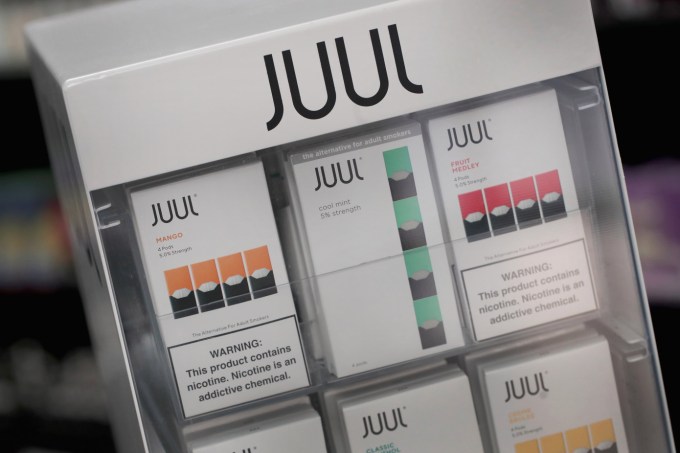
How Juul made vaping viral to become worth a dirty $38 billion

A Juul is not a cigarette. It’s much easier than that. Through devilishly slick product design I’ll discuss here, the startup has massively lowered the barrier to getting hooked on nicotine. Juul has dismantled every deterrent to taking a puff.

The result is both a new $38 billion valuation thanks to a $12.8 billion investment from Marlboro Cigarettes-maker Altria this week, and an explosion in popularity of vaping amongst teenagers and the rest of the population. Game recognize game, and Altria’s game is nicotine addiction. It knows it’s been one-upped by Juul’s tactics, so it’s hedged its own success by handing the startup over a tenth of the public corporation’s market cap in cash.

Juul argues it can help people switch from obviously dangerous smoking to supposedly healthier vaping. But in reality, the tiny aluminum device helps people switch from nothing to vaping…which can lead some to start smoking the real thing. A study found it causes more people to pick up cigarettes than put them down.

Photographer: Gabby Jones/Bloomberg via Getty Images

How fast has Juul swept the nation? Nielsen says it controls 75 percent of the U.S. e-cigarette market up from 27 percent in September last year. In the year since then, the CDC says the percentage of high school students who’ve used an e-cigarette in the last 30 days has grown 75 percent. That’s 3 million teens or roughly 20 percent of all high school kids. CNBC reports that Juul 2018 revenue could be around $1.5 billion.

The health consequences aside, Juul makes it radically simple to pick up a lifelong vice. Parents, regulators, and potential vapers need to understand why Juul works so well if they’ll have any hope of suppressing its temptations.

Shareable

It’s tough to try a cigarette for the first time. The heat and smoke burn your throat. The taste is harsh and overwhelming. The smell coats your fingers and clothes, marking you as smoker. There’s pressure to smoke a whole one lest you waste the tobacco. Even if you want to try a friend’s, they have to ignite one first. And unlike bigger box mod vaporizers where you customize the temperature and e-juice, Juul doesn’t make you look like some dorky hardcore vapelord.

Juul is much more gentle on your throat. The taste is more mild and can be masked with flavors. The vapor doesn’t stain you with a smell as quickly. You can try just a single puff from a friend’s at a bar or during a smoking break with no pressure to inhale more. The elegant, discrete form factor doesn’t brand you as a serious vape users. It’s casual. Yet the public gesture and clouds people exhale are still eye catching to trigger the questions, “Whats that? Can I try?”

And perhaps most insidiously, vaping seems healthier. A lifetime of anti-smoking ads and warning labels drilled the dangers into our heads. But how much harm could a little vapor do?

A friend who had never smoked tells me they burn through a full Juul pod per day now. Someone got him to try a single puff at a nightclub. Soon he was asking for drag off of strangers’ Juuls. Then he bought one and never looked back. He’d been around cigarettes at parties his whole life but never got into them. Juul made it too effortless to resist.

Concealable

Lighting up a cigarette is a garish activity prohibited in many places. Not so with discretely sipping from a Juul.

Cigarettes often aren’t allowed to be smoked inside. Hiding it is no easy feat and can get you kicked out. You need to have a lighter and play with fire to get one started. They can get crushed or damp in your pocket. The burning tip makes them unruly in tight quarters, and the bud or falling ash can damage clothing and make a mess. You smoke a cigarette because you really want to smoke a cigarette.

Public establishments are still figuring out how to handle Juuls and other vaporizers. Many places that ban smoking don’t explicitly do the same for vaping. The less stinky vapor and more discrete motion makes it easy to hide. Beyond airplanes, you could probably play dumb and say you didn’t know the rules if you did get caught. The metal stick is hard to break. You won’t singe anyone. There’s no mess, need for an ashtray, or holes in your jackets or couches.

As long as your battery is charged, there’s no need for extra equipment and you won’t draw attention like with a lighter. Battery life is a major concern for heavy Juulers that smokers don’t have worry about, but I know people who now carry a giant portable charger just to keep their Juul alive. But there’s also a network effect that’s developing. Similar to iPhone cords, Juuls are becoming common enough that you can often conveniently borrow a battery stick or charger from another user. 

And again, the modular ability to take as few or as many puffs as you want lets you absent-mindedly Juul at any moment. At your desk, on the dance floor, as you drive, or even in bed. A friend’s nieces and nephews say that they see fellow teens Juul in class by concealing it in the cuff of their sleeve. No kid would be so brazen as to try smoke in cigarette in the middle of a math lesson.

Distributable

Gillette pioneered the brilliant razor and blade business model. Buy the sometimes-discounted razor, and you’re compelled to keep buying the expensive proprietary blades. Dollar Shave Club leveled up the strategy by offering a subscription that delivers the consumable blades to your door. Juul combines both with a product that’s physically addictive.

When you finish a pack of cigarettes, you could be done smoking. There’s nothing left. But with Juul you’ve still got the $35 battery pack when you finish vaping a pod. There’s a sunk cost fallacy goading you to keep buying the pods to get the most out of your investment and stay locked into the Juul ecosystem.

(Photo by Scott Olson/Getty Images)

One of Juul’s sole virality disadvantages compared to cigarettes is that they’re not as ubiquitously available. Some stores that sells cigs just don’t carry them yet. But more and more shops are picking them up, which will continue with Altria’s help. And Juul offers an “auto-ship” delivery option that knocks $2 off the $16 pack of four pods so you don’t even have to think about buying more. Catch the urge to quit? Well you’ve got pods on the way so you might as well use them. Whether due to regulation or a lack of innovation, I couldn’t find subscription delivery options for traditional cigarettes.

And for minors that want to buy Juuls or Juul pods illegally, their tiny size makes them easy to smuggle and resell. A recent South Park episode featured warring syndicates of fourth-graders selling Juul pods to even younger kids.

Dishonorable

Juul co-founder James Monsees told the San Jose Mercury News that “The first phase is proving the value and creating a product that makes cigarettes obsolete.” But notice he didn’t say Juul wants to make nicotine obsolete or reduce the number of people addicted to it.

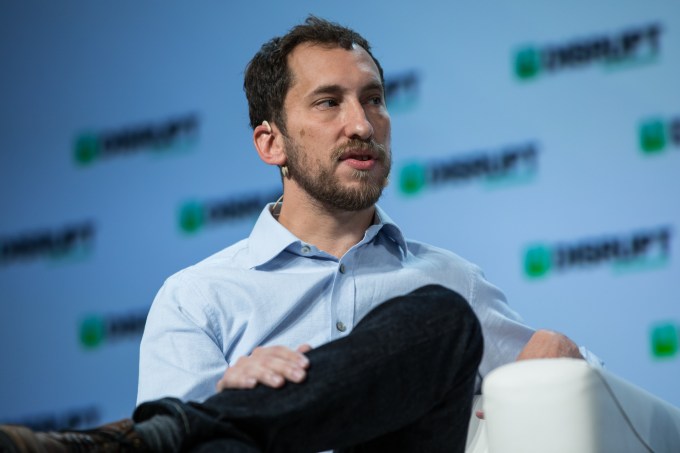
Juul co-founder James Monsees

If Juul actually cared about fighting addiction, it’d offer a regimen for weaning yourself off of nicotine. Yet it doesn’t sell low-dose or no-dose pods that could help people quit entirely. In the US it only sells 5% and 3% nicotine versions. It does make 1.7% pods for foreign markets like Israel where that’s the maximum legal strengths, though refuses to sell them in the States. Along with taking over $12 billion from one of the largest cigarette companies, that makes the mission statement ring hollow.

Juul is the death stick business as usual, but strengthened by the product design and virality typically reserved for Apple and Facebook.


source https://techcrunch.com/2018/12/22/juul-me-twice-shame-on-you/

Facebook’s fact-checkers toil on

Facebook is fielding so many problems, oversights, scandals, and other miscellaneous ills that it wouldn’t surprise anyone to hear that its fact-checking program, undertaken last year after the network was confronted with its inaction in controlling disinformation, is falling apart. But in this case the reason you haven’t heard much about it isn’t because it’s a failure, but because fact-checking is boring and thankless — and being done quietly and systematically by people who are just fine with that.

The “falling apart” narrative was advanced in a recent article at The Guardian, and some of the problems noted in that piece are certainly real. But I was curious at the lack of documentation of the fact-checking process itself, so I talked with a couple of the people involved to get a better sense of it.

I definitely didn’t get the impression of a program in crisis at all, but rather one where the necessity of remaining hands-off with the editorial process and teams involved has created both apparent and real apathy when it comes to making real changes.

No bells, no whistles

Facebook likes to pretend that its research into AI will solve just about every problem it has. Unfortunately not only is that AI hugely dependent on human intelligence to work in the first place, but the best it can generally do is forward things on to human agents for final calls. Nowhere is that more obvious than in the process of fact-checking, in which it is trivial for machine learning agents to surface possibly dubious links or articles, but at this stage pretty much impossible for them to do any kind of real evaluation of them.

That’s where the company’s network of independent fact-checkers comes in. No longer among their number are two former Snopes staffers who left to work at another fact-checking concern — pointedly not involved with Facebook — and who clearly had major problems with the way the program worked. Most explosive was the accusation that Facebook had seemingly tried to prioritize fact checks that concerned an advertiser.

But it wasn’t clear from their complaints just how the program does work. I chatted with Snopes head David Mikkelson and checked in with Politifact editor Angie Drobnic Holan. They emphatically denied allegations of Facebook shenanigans, though they had their own reservations, and while they couldn’t provide exact details of the system they used, it sounds pretty straightforward.

“For the most part it’s literally just data entry,” explained Mikkelson. “When we fact-check something, we enter its URL into a database. You could probably dress it up in all kinds of bells and whistles, but we don’t really need or expect much more than that. We haven’t changed what we do or how we do it.”

Mikkelson described the Facebook system in broad terms. It’s a dashboard of links that are surfaced, as Facebook has explained before, primarily through machine learning systems that know what sort of thing to look for: weird URLs, bot promotion, scammy headlines, etc. They appear on the dashboard in some semblance of order, for instance based on traffic or engagement.

“It lists a thumbnail of what the item is, like is it an article or a video; there’s a column for estimated shares, first published date, etc,” said Mikkelson. “They’ve never given us any instructions on like, ‘please do the one with the most shares,’ or ‘do the most recent entry and work your way down,’ or whatever.”

In fact there’s no need to even use the dashboard that way at all.

“There’s no requirement that we undertake anything that’s in their database. If there’s something that isn’t in there, which honestly is most of what we do, we just add it,” Mikkelson said.

Passive partner or puppet master?

I asked whether there was any kind of pushback or interference at all from Facebook, as described by Brooks Binkowski in the Guardian story, who mentioned several such occasions that occurred during her time at Snopes.

Politifact’s Holan said she thought the suggestion was “very misleading.” In a statement, the organization said that “As with all our work, we decide what to fact-check and arrive at our conclusions without input from Facebook or any third party. Any claim suggesting otherwise is misinformed and baseless.”

“I realize Facebook’s reputation is kind of in the dumpster right now already,” Mikkelson said, “but this is damaging to all the fact-checking partners, including us. We would never have continued a working relationship with Facebook or any other partner that told us to couch fact checks in service of advertisers. It’s insulting to suggest.”

The question of receiving compensation for fact-checking was another of Binkowski’s qualms. On the one hand, it could be seen as a conflict of interest for Facebook to be paying for the service, since that opens all kinds of cans of worms — but on the other, it’s ridiculous to suggest this critical work can or should be done for free. Though at first, it was.

When the fact-checking team was first assembled in late 2016, Snopes wrote that it expects “to derive no direct financial benefit from this arrangement.” But eventually it did.

“When we published that, the partnership was in its earliest, embryonic stages — an experiment they’d like our help with,” Mikkelson said. Money “didn’t come up at all.” It wasn’t until the next year that Facebook mentioned paying fact checkers, though it hadn’t announced this publicly, and Snopes eventually did earn and disclose $100,000 coming from the company. Facebook had put bounties on high-profile political stories that were already on Snopes’s radar, as well as others in the fact-checking group.

The money came despite the fact that Snopes never asked for it or billed Facebook — a check arrived at the end of the year, he recalled, “with a note that said ‘vendor refuses to invoice.’ ”

Partners, but not pals

As for the mere concept of working for a company whose slippery methods and unlikeable leadership have been repeatedly pilloried over the last few years, it’s a legitimate concern. But Facebook is too important of a platform to ignore on account of ethical lapses by higher-ups who are not involved in the day-to-day fact-checking operation. Millions of people still look to Facebook for their news.

To abandon the company because (for instance) Sheryl Sandberg hired a dirty PR firm to sling mud at critics would be antithetical to the mission that drove these fact-checking companies to the platform to begin with. After all, it’s not like Facebook had a sterling reputation in 2016, either.

Both Politifact and Snopes indicated that their discontent with the company was more focused on the lack of transparency within the fact-checking program itself. The tools are basic and feedback is nil. Questions like the following have gone unanswered for years:

What constitutes falsity? What criteria should and shouldn’t be considered? How should satire be treated if it is spreading as if it were fact? What about state-sponsored propaganda and disinformation? Have other fact checkers looked at a given story, and could or should their judgments inform the other’s? What is the immediate effect of marking a story false — does it stop spreading? Is there pushback from the community? Is the outlet penalized in other ways? What about protesting an erroneous decision?

The problem with Facebook’s fact-checking operation, as so often is the case with this company, is a lack of transparency with both users and partners. The actual fact-checking happens outside Facebook, and rightly so; it’s not likely to be affected or compromised by the company, and in fact if it tried, it might find the whole thing blowing up in its face. But while the checking itself is tamper-resistant, it’s not clear at all what if any effect it’s having, and how it will be improved or implemented in the future. Surely that’s relevant to everyone with a stake in this process?

Over a year and a half or more of the program, little has been communicated and little has been changed, and that not fast enough. But at the same time, thousands of articles have been checked by experts who are used to having their work go largely unrewarded — and despite Facebook’s lack of transparency with them and us, it seems unlikely that that work has also been ineffective.

For years Facebook was a rat’s nest of trash content and systematically organized disinformation. In many ways, it still is, but an organized fact-checking campaign works like constant friction acting against the momentum of this heap. It’s not flashy and the work will never be done, but it’s no less important for all that.

As with so many other Facebook initiatives, we hear a lot of promises and seldom much in the way of results. The establishment of a group of third parties contributing independently to a fact-checking database was a good step, and it would be surprising to hear it has had no positive affect.

Users and partners deserve to know how it works, whether it’s working, and how it’s being changed. That information would disarm critics and hearten allies. If Facebook continues to defy these basic expectations, however, it only further justifies and intensifies the claims of its worst enemies.


source https://techcrunch.com/2018/12/22/facebooks-fact-checkers-toil-on/

Thursday, 20 December 2018

Twitter stock down after analyst calls it “Harvey Weinstein of Social Media”

Twitter was down 11 percent today after a Citron Research report called the platform, the “Harvey Weinstein of social media” and set a low target price of $20. As of publishing today, the stock was down over 11 percent at $29.29 a share.

In their report Citron did not mince words, basing their conclusions on an Amnesty International Report on abuse on the Twitter platform. “Citron has been following Twitter for years and when we read the just published piece from Amnesty International, we immediately knew the stock had become uninvestable and advertisers will soon be forced to take a hard look at all sponsorships with Twitter,” Citron wrote.

Citron was reacting to an Amnesty International report which took Twitter to task for not doing more to curb abusive behavior. “We have built the world’s largest crowdsourced data set about online abuse against women… Twitter is a place where racism, misogyny and homophobia are allowed to flourish basically unchecked,” the Amnesty report stated.

The report went on to call out Twitter for not doing more. “To be clear: it is NOT our job as a human rights organization to be analyzing abusive tweets on this platform – it’s Twitter’s. “But [the company’s] refusal to make public this information, while allowing abuse to flourish basically unchecked, meant we had to do this study for them,” the report said.


source https://techcrunch.com/2018/12/20/twitter-stock-down-after-analyst-calls-it-harvey-weinstein-of-social-media/

Twitter stock down after analyst calls it ‘Harvey Weinstein of Social Media’

Twitter was down 11 percent today after a Citron Research report called the platform, the “Harvey Weinstein of social media” and set a low target price of $20. As of publishing today, the stock was down more than 11 percent at $29.29 a share.

In their report Citron did not mince words, basing their conclusions on an Amnesty International Report on abuse on the Twitter platform. “Citron has been following Twitter for years and when we read the just published piece from Amnesty International, we immediately knew the stock had become uninvestable and advertisers will soon be forced to take a hard look at all sponsorships with Twitter,” Citron wrote.

Citron was reacting to an Amnesty International report which took Twitter to task for not doing more to curb abusive behavior. “We have built the world’s largest crowdsourced data set about online abuse against women… Twitter is a place where racism, misogyny and homophobia are allowed to flourish basically unchecked,” the Amnesty report stated.

The report went on to call out Twitter for not doing more. “To be clear: it is NOT our job as a human rights organization to be analyzing abusive tweets on this platform – it’s Twitter’s. “But [the company’s] refusal to make public this information, while allowing abuse to flourish basically unchecked, meant we had to do this study for them,” the report said.

We emailed Twitter press relations for a reaction to this story. We will update it should we hear back from them.


source https://techcrunch.com/2018/12/20/twitter-stock-down-after-analyst-calls-it-harvey-weinstein-of-social-media/