Tuesday, 27 November 2018

Social music app Playlist lets you listen to music with others in real time

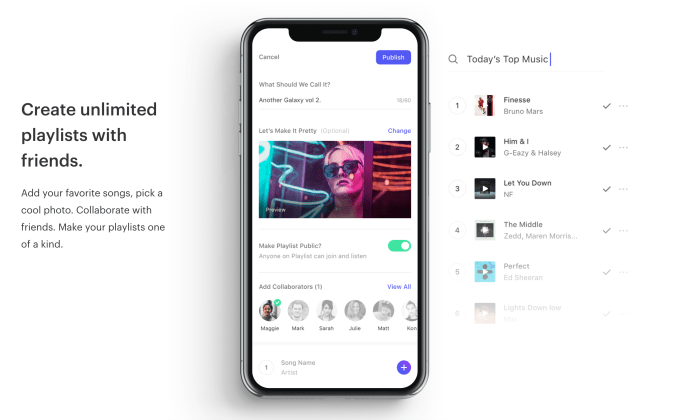
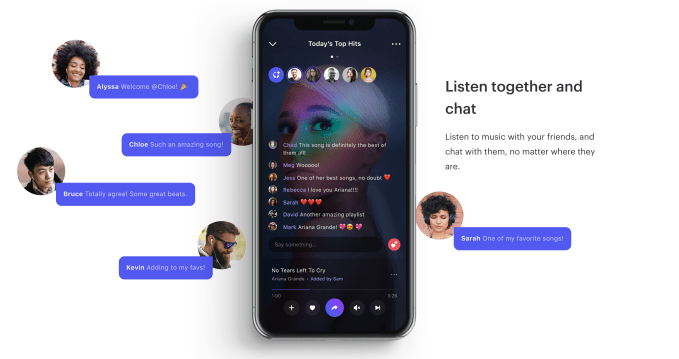
A new app called Playlist aims to make music a more social experience than what’s offered today by the major music platforms like Apple Music, Pandora or Spotify, for example. In Playlist, you can find others who share your musical tastes and join group chats where you listen to playlists together in real time. You can collaborate on playlists, too.

The app, backed by investment from Stanford’s StartX fund, was founded by Karen Katz and Steve Petersen, both Stanford engineers and serial entrepreneurs. Katz previously co-founded AdSpace Networks and another social music platform, Jam Music. She also was a founding executive team member at Photobucket, and founded a company called Project Playlist, which was like a Google search for music back in the Myspace era.

Peterson, meanwhile, has 35 patents and more than a decade of experience in digital music. In the early 2000s he created the software architecture and ran the team at PortalPlayer Inc., which powered the iPod’s music player and was later sold to Nvidia for $357 million. Afterwards, he was CTO at Concert Technology, a technology incubator and intellectual property company with a focus on mobile, social and digital music services.

“The world has gone social, but music has been largely left behind. That’s a real gap,” explains Katz, as to why the founders wanted to build Playlist in the first place.

“Ever since we started listening to music from our mobile phones, it’s become an isolated experience. And music is the number one thing we do on our phones,” she says.

The idea they came up with was to unite music and messaging by synchronizing streams, so people could listen to songs together at the same time and chat while they do so.

During last year’s beta testing period, Playlist (which was listed under a different name on the App Store), saw a huge number of engagements as a result of its real-time nature.

“Out of the gate, we saw 10 times the engagement of Pandora. People have, on average, 60 interactions per hour — like chats, likes, follows, joins, adds and creates,” Katz says. 

Under the hood, the app uses a lot of technology beyond just its synchronized streaming. It also leverages machine learning for its social recommendations, as well as collaborative playlists, large-scale group chat, and behavior-based music programming, and has “Music Match” algorithms to help you find people who listen to the same sort of things you do.

The social aspects of the app involves a following/follower model, and presents playlists from the people you follow in your home feed, much like a music-focused version of Instagram. A separate Discover section lets you find more people to follow or join in other popular listening and chat sessions.

At launch, the app has a catalog of more than 45 million songs and has a music license for the U.S. It plans to monetize through advertising.

The core idea here — real-time music listening and chat — is interesting. It’s like a Turntable.fm for the Instagram age. But the app sometimes overcomplicates things, it seems. For example, importing a playlist from another music app involves switching over to that app, finding the playlist and copying its sharing URL, then switching back to Playlist to paste it in a pop-up box. It then offers a way for you to add your own custom photo to the playlist, which feels a little unnecessary as the default is album art.

Another odd choice is that it’s difficult to figure out how to leave a group chat once you’ve joined. You can mute the playlist that’s streaming or you can minimize the player, but the option to “leave” is tucked away under another menu, making it harder to find.

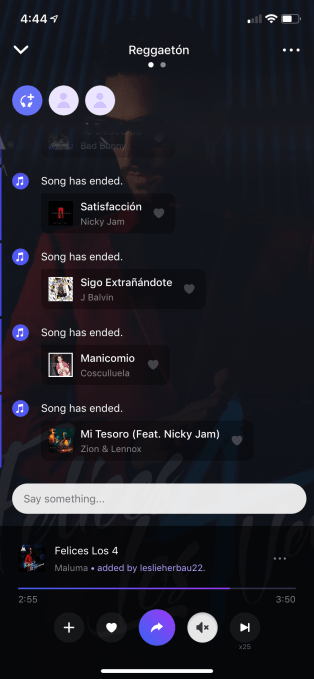
The player interface also offers a heart, a plus (+), a share button, a mute button and a skip button all on the bottom row. It’s… well… it’s a lot.

But Katz says that the design choices they’ve made here are based on extensive user testing and feedback. Plus, the app’s younger users — often high schoolers, and not much older than 21 — are the ones demanding all the buttons and options.

It’s hard to argue with the results. The beta app acquired more than 500,000 users during last year’s test period, and those users are being switched over to the now publicly available Playlist app, which has some 80K installs as of last week, according to Sensor Tower data.

The company also plans to leverage the assets it acquired from the old Project Playlist, which includes some 30 million emails, 21 million Facebook IDs and 14 million Twitter IDs. A “Throwback Thursday” marketing campaign will reach out to those users to offer them a way to listen to their old playlists.

The startup has raised $5 million in funding (convertible notes) from Stanford StartX Fund, Garage Technology Ventures, Miramar Ventures, IT-Farm, Dixon Doll (DCM founder), Stanford Farmers & Angels, Zapis Capital and Amino Capital.

The Palo Alto-based company is a team of six full-time.

Playlist is a free download for iOS. An Android version is in the works.


source https://techcrunch.com/2018/11/27/social-music-app-playlist-lets-you-listen-to-music-with-others-in-real-time/

‘The problem is Facebook,’ lawmakers from nine countries tell Zuckerberg’s accountability stand-in

A grand committee of international parliamentarians empty-chaired Mark Zuckerberg at a hearing earlier today, after the Facebook founder snubbed repeat invitations to face questions about malicious, abusive and improper uses of his social media platform — including the democracy-denting impacts of so-called “fake news.”

The U.K.’s DCMS committee has been leading the charge to hold Facebook to account for data misuse scandals and election interference — now joined in the effort by international lawmakers from around the world. But still not by Zuckerberg himself.

In all, parliamentarians from nine countries were in the room to put awkward questions to Zuckerberg’s stand-in, policy VP Richard Allan — including asking what Facebook is doing to stop WhatsApp being used as a vector to spread political disinformation in South America; why Facebook refused to remove a piece of highly inflammatory anti-Muslim hate speech in Sri Lanka until the country blocked access to its platform; how Facebook continues to track non-users in Belgium and how it justifies doing so under Europe’s tough new GDPR framework; and, more generally, why anyone should have any trust in anything the company says at this point — with the company neck-deep in privacy and trust scandals.

The elected representatives were collectively speaking up for close to 450 million people across the U.K., Argentina, Belgium, Brazil, Canada, France, Ireland, Latvia and Singapore. The most oft-repeated question on their lips was why wasn’t Zuckerberg there?

Allan looked uncomfortable on his absentee boss’ behalf and spent the best part of three hours running the gamut of placative hand gestures as he talked about wanting to work with regulators to find “the right regulation” to rein in social media’s antisocial, anti-democratic impacts.

Canadian MP Bob Zimmer spoke for the room, cutting into another bit of Allan’s defensive pabulum with: “Here we are again hearing another apology from Facebook — ‘look trust us, y’all regulate us etc but we really don’t have that much influence in the global scheme of things.’ In this room we regulate over 400 million people and to not have your CEO sit in that chair there is an offence to all of us in this room and really our citizens as well.”

“[BlackBerry co-founder] Jim Balsille said, when I asked him on our committee, is our democracy at risk if we don’t change the laws in Canada to deal with surveillance capitalism?” Zimmer continued. “He said without a doubt. What do you think?” — which Allan took as a cue to ummm his way into another series of “we need tos” and talk of “a number of problematic vectors” Facebook is trying to address with a number of “tools.”

The session was largely filled up with such frustratingly reframed waffle, as Allan sought to deflect, defang and defuse the committee’s questions — leading it to accuse him more than once of repeating the “delay, deny, deflect” tactics recently reported on by The New York Times.

Allan claimed not — claiming to be there “acknowledging” problems. But that empty chair beside him sure looked awkward.

At the close, Canada’s Charlie Angus sought to sweep Facebook’s hot air away by accusing Allan of distracting with symptoms — to draw the regulatory eye away from the root cause of the problem which he sharply defined as Facebook itself.

“The problem we have with Facebook is there’s never accountability — so I would put it to you when we talk about regulation that perhaps the best regulation would be antitrust,” he said. “Because people who don’t like Facebook — oh they could go to WhatsApp. But oh we have some problems in South America, we have problems in Africa, we have to go back to Mr Zuckerberg who’s not here.

“My daughters could get off Facebook. But they’d go to Instagram. But that’s now controlled by Facebook. Perhaps the simplest form of regulation would be to break Facebook up — or treat it as a utility so that we could all then feel that when we talk about regulation we’re talking about allowing competition, counting metrics that are actually honest and true, and that Facebook has broken so much trust to allow you to simply gobble up every form of competition is probably not in the public interest.

“So when we’re talking about regulation would you be interested in asking your friend Mr Zuckerberg if we could have a discussion about antitrust?”

Allan’s reached for an “it depends upon the problem we’re trying to solve” reply.

“The problem is Facebook,” retorted Angus. “We’re talking about symptoms but the problem is the unprecedented economic control of every form of social discourse and communication. That it’s Facebook. That that is the problem that we need to address.”

Committee chair Damian Collins also gave short shrift to Allan’s attempt to muddily reframe this line of questioning — as regulators advocating “turning off the internet” (instead of what Angus was actually advocating: A way to get “credible democratic responses from a corporation”) — by interjecting: “I think we would also distinguish between the internet and Facebook to say they’re not necessarily the same thing.”

The room affirmed its accord with that.

At the start of the session Collins revealed the committee would not — at least for now — be publishing the cache of documents it dramatically seized this weekend from the founder of a startup that’s been suing Facebook since 2015, saying it was “not in a position to do that.”

Although at several points during the session DCMS committee members appeared to tease some new details derived from these documents, asking for example whether Facebook had ever made API decisions for developers contingent on them taking advertising on its platform.

Allan said it had not — and appeared to be attempting to suggest that the emails the committee might have been reading were the result of “normal” internal business discussions about how to evolve Facebook’s original desktop-based business model for the mobile-first era.

Collins did detail one piece of new information that he categorically identified as having been sourced from the seized documents — and specifically from an internal email sent by a Facebook engineer, dating from October 2014 — describing this to be of significant public interest.

“An engineer at Facebook notified the company in October 2014 that entities with Russian IP addresses had been using a Pinterest API key to pull over 3 billion data points a day through the ordered friends API,” he revealed, asking Allan whether “that reported to any external body at the time.”

The Facebook VP responded by characterizing the information contained in the seized documents as “partial,” on account of being sourced via a “hostile litigant.”

“I don’t want you to use this opportunity just to attack the litigant,” retorted Collins. “I want you to address the question… what internal process [Facebook] ran when this was reported to the company by an engineer? And did they notify external agencies of this activity? Because if Russian IP addresses were pulling down a huge amount of data from the platform — was that reported or was that just kept, as so often seems to be the case, just kept within the family and not talked about.”

“Any information you have seen that’s contained within that cache of emails is at best partial and at worst potentially misleading,” responded Allan.

“On the specific question of whether or not we believe, based on our subsequent investigations, that there was activity by Russians at that time I will come back to you.”

We reached out to Pinterest to ask whether Facebook ever informed it about such an abuse of its API key. At the time of writing it had not responded to our request for comment.


source https://techcrunch.com/2018/11/27/the-problem-is-facebook-lawmakers-from-nine-countries-tell-zuckerbergs-accountability-stand-in/

WhatsApp’s chief business officer is leaving

Roughly one year after WhatsApp co-founder Brian Acton made his highly publicized exit from Facebook, another executive and early employee of the messaging platform is doing the same. Neeraj Arora, WhatsApp’s chief business officer, announced today that he would be “taking some time off to recharge and spend time with family.”

Facebook acquired WhatsApp for $19 billion in 2014 and pledged to allow the messaging giant to continue to operate independently under Acton and co-founder Jan Koum, who served as its chief executive officer until abruptly quitting over privacy and data concerns in April. Arora, who joined WhatsApp in 2011 from Google, was rumored to be the frontrunner to replace Koum as CEO. With him out the door, it’s unclear who will be tapped to lead WhatsApp.

In today’s announcement, Arora said he was “deeply indebted” to both Acton and Koum, “who entrusted me to be their business companion for so many years.”

Facebook subsidiaries WhatsApp and Instagram are both in periods of flux following the exits of their original founders, which are believed to be caused by quarrels with the social media giant’s CEO Mark Zuckerberg.

In what was one of the largest tech stories of 2018, Instagram co-founders Kevin Systrom and Mike Krieger announced they were leaving Facebook years after the company acquired their photo-sharing app for $1 billion. They shared the news in September, just a few months after Koum stepped down from WhatsApp.

According to The New York Times, Zuckerberg, over the course of the last year, had begun to assert more and more control over Instagram, upsetting its leaders.

Koum, for his part, reportedly wrote in a since-removed WhatsApp blog post that Zuckerberg and Facebook no longer had respect for privacy: “These days companies know literally everything about you, your friends, your interests, and they use it all to sell ads. At every company that sells ads, a significant portion of their engineering team spends they day tuning data mining, writing better code to collect your personal data… remember, when advertising is involved, you the user are the product.”

According to TechCrunch’s Josh Constine, Koum was unhappy “about how Facebook would monetize his app and the impact of that on privacy.” Both Acton and Koum departed Facebook before they fully vested from the multi-billion acquisition, meaning the pair chose to lose hundreds of millions of dollars over continued employment at Facebook.

Arora’s exit is further evidence that Facebook has entered a new era, one in which the company’s acquisition strategy may be in serious danger of long-term damage.

You can read Arora’s full post below.


source https://techcrunch.com/2018/11/26/whatsapps-chief-business-officer-is-leaving/

“The problem is Facebook,” lawmakers from nine countries tell Zuckerberg’s accountability stand-in

A grand committee of international parliamentarians empty-chaired Mark Zuckerberg at a hearing earlier today, after the Facebook founder snubbed repeat invitations to face questions about malicious, abusive and improper uses of his social media platform — including the democracy-denting impacts of so-called ‘fake news’.

The UK’s DCMS committee has been leading the charge to hold Facebook to account for data misuse scandals and election interference — now joined in the effort by international lawmakers from around the world. But still not by Zuckerberg himself.

In all parliamentarians from nine countries were in the room to put awkward questions to Zuckerberg’s stand in, policy VP Richard Allan — including asking what Facebook is doing to stop WhatsApp being used as a vector to spread political disinformation in South America; why Facebook refused to remove a piece of highly inflammatory anti-Muslim hate speech in Sri Lanka until the country blocked access to its platform; how Facebook continues to track non-users in Belgium and how it justifies doing so under Europe’s tough new GDPR framework; and, more generally, why anyone should have any trust in anything the company says at this point — with company neck-deep in privacy and trust scandals.

The elected representatives were collectively speaking up for close to 450 million people across the UK, Argentina, Belgium, Brazil, Canada, France, Ireland, Latvia and Singapore. The most oft repeated question on their lips was why wasn’t Zuckerberg there?

Allan looked uncomfortable on his absentee boss’ behalf and spent the best part of three hours running the gamut of placative hand gestures as he talked about wanting to work with regulators to find “the right regulation” to rein in social media’s antisocial, anti-democratic impacts.

Canadian MP Bob Zimmer spoke for the room, cutting into another bit of Allan’s defensive pablum with: “Here we are again hearing another apology from Facebook — ‘look trust us, y’all regulate us etc but we really don’t have that much influence in the global scheme of things’. In this room we regulate over 400M people and to not have your CEO sit in that chair there is an offence to all of us in this room and really our citizens as well.”

“[Blackberry co-founder] Jim Balsille said, when I asked him on our committee, is our democracy at risk if we don’t change the laws in Canada to deal with surveillance capitalism?” Zimmer continued. “He said without a doubt. What do you think?” — which Allan took as a cue to ummm his way into another series of “we need tos”, and talk of “a number of problematic vectors” Facebook is trying to address with a number of “tools”.

The session was largely filled up such frustratingly reframed waffle, as Allan sought to deflect, defang and defuse the committee’s questions — leading it to accuse him more than once of repeating the ‘delay, deny, deflect’ tactics recently reported on by the New York Times.

Allan claimed not — claiming to be there “acknowledging” problems. But that empty chair beside him sure looked awkward.

At the close, Canada’s Charlie Angus sought to sweep Facebook’s hot air away by accusing Allan of distracting with symptoms — to draw the regulatory eye away from the root cause of the problem which he sharply defined as Facebook itself.

“The problem we have with Facebook is there’s never accountability — so I would put it to you when we talk about regulation that perhaps the best regulation would be antitrust,” he said. “Because people who don’t like Facebook — oh they could go to WhatsApp. But oh we have some problems in South America, we have problems in Africa, we have to go back to Mr Zuckerberg who’s not here.

“My daughters could get off Facebook. But they’d go to Instagram. But that’s now controlled by Facebook. Perhaps the simplest form of regulation would be to break Facebook up — or treat it as a utility so that we could all then feel that when we talk about regulation we’re talking about allowing competition, counting metrics that are actually honest and true, and that Facebook has broken so much trust to allow you to simply gobble up every form of competition is probably not in the public interest.

“So when we’re talking about regulation would you be interested in asking your friend Mr Zuckerberg if we could have a discussion about antitrust?”

Allan’s reached for an “it depends upon the problem we’re trying to solve” reply.

“The problem is Facebook,” retorted Angus. “We’re talking about symptoms but the problem is the unprecedented economic control of every form of social discourse and communication. That it’s Facebook. That that is the problem that we need to address.”

Committee chair Damian Collins also gave short shrift to Allan’s attempt to muddily reframe this line of questioning — as regulators advocating “turning off the Internet” (instead of what Angus was actually advocating: A way to get “credible democratic responses from a corporation”) — by interjecting: “I think we would also distinguish between the Internet and Facebook to say they’re not necessarily the same thing.”

The room affirmed its accord with that.

At the start of the session Collins revealed the committee would not — at least for now — be publishing the cache of documents it dramatically seized this weekend from the founder of a startup that’s been suing Facebook since 2015, saying it was “not in a position to do that”.

Although at several points during the session DCMS committee members appeared to tease some new details derived from these documents, asking for example whether Facebook had ever made API decisions for developers contingent on them taking advertising on its platform.

Allan said it had not — and appeared to be attempting to suggest that the emails the committee might have been reading were the result of ‘normal’ internal business discussions about how to evolve Facebook’s original desktop-based business model for the mobile-first era.

Collins did detail one piece of new information that he categorically identified as having been sourced from the seized documents — and specifically from an internal email sent by a Facebook engineer, dating from October 2014 — describing this to be of significant public interest.

“An engineer at Facebook notified the company in October 2014 that entities with Russian IP addresses had been using a Pinterest API key to pull over 3BN data points a day through the ordered friends API,” he revealed, asking Allan whether “that reported to any external body at the time”.

The Facebook VP responded by characterizing the information contained in the seized documents as “partial”, on account of being sourced via a “hostile litigant”.

“I don’t want you to use this opportunity just to attack the litigant,” retorted Collins. “I want you to address the question… what internal process [Facebook] ran when this was reported to the company by an engineer? And did they notify external agencies of this activity? Because if Russian IP addresses were pulling down a huge amount of data from the platform — was that reported or was that just kept, as so often seems to be the case, just kept within the family and not talked about.”

“Any information you have seen that’s contained within that cache of emails is at best partial and at worst potentially misleading,” responded Allan.

“On the specific question of whether or not we believe, based on our subsequent investigations, that there was activity by Russians at that time I will come back to you.”

We reached out to Pinterest to ask whether Facebook ever informed it about such an abuse of its API key. At the time of writing it had not responded to our request for comment.


source https://techcrunch.com/2018/11/27/the-problem-is-facebook-lawmakers-from-nine-countries-tell-zuckerbergs-accountability-stand-in/

Facebook launches Watch Party for all, tests Live PiP commentating

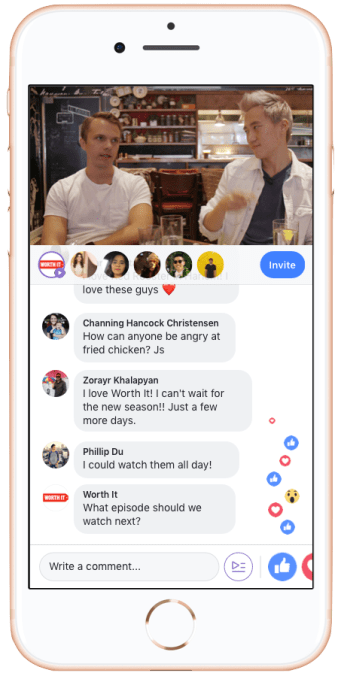
Facebook Watch has failed to capture viewers with its content, so it’s hoping to differentiate through the company’s core strength: social. Today Facebook fully launches Watch Party, its co-viewing feature where users can see and comment on the same video at the same time, to all profiles and Pages around the world.

Watch Party had previously launched in Groups and been in testing with other types of accounts. But now any profile or business can post a Watch party invite to sync up with other users and simultaneously view videos they’ve discovered on Facebook.

Watch’s content lineup is still lackluster compared to YouTube, Netflix, or even Snapchat Discover. CNBC reports Facebook is giving up on younger teens that are already ditching its app, and pivoting the video hub towards an older audience. Facebook is hoping a shared experience with users commenting together on clips could make Watch more appealing, but it’s a genuinely new behavior that may prove difficult to instill.

Facebook is also testing a few other tricks to breathe life into Watch. Pages and Groups will be able to schedule a Watch Party to draw more viewers, maybe by setting up a nightly gathering. Watch Parties with lots of activity will have their comments threaded so it’s easier to follow discussions.

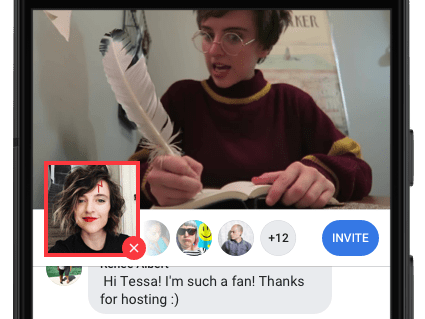
And most interestingly, Facebook will try allowing Watch Party hosts to go Live picture-in-picture so they can commentate in real-time. This could be a hit with celebrities, as it will make users feel like they’re sitting beside them watching TV together. Basketball star Shaq will test out the Live Commentating feature through his Page tomorrow.

Watch Party’s statistics sound impressive, with 12 million started from Groups so far, 7X more daily Watch Parties in Groups per day since its launch in July, and 8X more commenting than on non-Live/synced videos. Pages are using it to let fans binge watch playlists of their old videos, replay their TV content for users in different time zones, and let fans ask each other and the hosts questions about recipes as they cook.

But given Facebook’s 2.2 billion total monthly users, billion-plus Groups users, and the fact that measuring growth in multiples is easy when you start with a low number, the feature clearly hasn’t reached the zeitgeist yet.

Perhaps the best hope for Watch and Watch Party is a feature TechCrunch broke the news on last week. Facebook is now internally testing a Watch Party-like co-viewing feature inside Messenger. Baking the option into chat might be a lot more natural, especially in group texts. 

Facebook has been desperately trying to shift video consumption behavior from passive zombie viewing to interactive and social engagement with fellow viewers. But that only works if the content is compelling.

Beyond a reboot of MTV’s The Real World, nothing on Watch truly stands out. Facebook may need to open up its wallet and pay big for more tent pole shows to pull in users and hope they get lost commenting on clips with friends and like-minds.


source https://techcrunch.com/2018/11/27/watch-party-commentating/

If I Had to Start a Blog From Scratch, I Would…

neil patel

You’ve seen me and thousands of other marketers talk about how to make a blog popular. But if you don’t set up your blog correctly, you won’t do well no matter what kind of marketing you do.

And no, I am not talking about the technical setup of your blog. I am talking about the foundation. From what you are blogging about, to how you structure your content… there are a lot of basics people get wrong.

And if you get them wrong, it’s going to be that much harder to get more traffic (and more importantly monetize the traffic).

So, if I had to start a blog from scratch again, here are the principles I would follow before even writing my first blog post:

Principle #1: Pick a big enough niche

Unless you are well funded, you have to pick a niche. It’s too hard to compete on a broad level with sites like Huffington Post and Business Insider. They well funded and are able to produce huge amounts of content from contributors big and small.

And if your niche is too small, it will be hard for you to grow your traffic and monetize your blog as there just won’t be enough people interested in what you are blogging about.

When trying to find a niche, use Google Trends. Make sure to pick a niche that is bigger than “digital marketing” but smaller than “nutrition.”

Principle #2: Don’t stick with one platform

I know I’ve told you that you need to use WordPress as your blogging platform, but it shouldn’t stop there. Why not also use Medium, Tumblr, LinkedIn, and even Facebook?

These are all platforms where you can repurpose your content.

Blogging is competitive, so you’ll need to push your content out on as many platforms to ensure that you’ll get the most eyeballs.

Setting up social accounts across the different platforms is really important. Make sure the branding and imagery are the same across all of them and try to generate some followers by following these steps so that when you start producing unique content you’ll have places to promote.

Principle #3: Control your destiny

Google doesn’t penalize for duplicate content. But that doesn’t mean you should just post your content on every platform without thinking of it.

The only platform that doesn’t have an algorithm that you need to worry about is your own blog. Facebook, Medium, Tumblr, and LinkedIn all have algorithms you can’t fully control.

Always link back out to your site when posting on these other platforms. The more people you can get back to your site, the better chance you will have of growing your traffic and monetizing.

Other platforms like Facebook don’t make it easy for you to generate revenue if you keep your readers on their platform.

Principle #4: Blogging is both about “you” and “I”

Blogging is something that is supposed to be informal. No one wants to read an essay or a white paper.

People want to read stories. They want to be involved in a conversation, and the easiest way to do this is to use the words “you” and “I” within your blog posts.

This one simple change will help you build a deeper connection with your readers. A deeper connection means better monetization in the future.

Principle #5: Always ask questions

At the end of every blog post, always ask a question. If you don’t ask a question, people won’t know what to do next.

By asking a question, a portion of your readers will answer it by leaving a comment. This will increase engagement, which again will make monetization easier in the long run.

Principle #6: You have to stand out

There are over a billion blogs on the web, and that number is continually rising. This just means blogging is going to get even more competitive over time.

So how do you stand out in a crowded marketplace?

You have to go above and beyond. Sadly, there is no single answer as every industry is different, but typically infographics, visuals, and doing the opposite of everyone else in your space will help you stand out.

For example, if everyone in your space writes 1000-word blog posts, test out writing 10,000-word posts. Or if everyone is using text-based content, test out visual based content like infographics or video.

Principle #7: Your content needs to be portable

People are always on the go these days. Your content needs to be easy to digest.

And no, I am not talking about making your content mobile compatible or leveraging AMP framework (although those are good ideas). I am talking about making your content portable.

For example, creating video-based content or audio-based content (podcasts) are simple ways to make your content portable. For example, it is easier to watch video-based content on your mobile phone when on the bus or listen to podcasts while you are driving.

Principle #8: Content isn’t king unless it’s good

You’ve heard the saying that content is king. But is it really?

The Washington Post publishes over 500 pieces of content per day. The Wall Street Journal is at 240, the New York Times is at 230, and Buzzfeed is around 222.

The list keeps going on and on as there are over 2 million blog posts published daily.

In other words, writing mediocre content isn’t good enough. It won’t do well for and you will just be wasting time. So, don’t write content unless it is really, really, really good.

Principle #9: You have to produce quality and quantity

It’s sad, but it is true. Not only does your content have to be amazing, but you have to publish amazing content in quantity.

Just because you are writing an amazing blog post, it doesn’t mean you will do well. Content marketing is a hit or miss game in which your posts will do well or they won’t. And in most cases, your content won’t do as well as you want no matter how good you are at marketing.

To increase your odds of success, you need to be willing to produce amazing content in quantity.

Principle #10: Your blog isn’t always the best place to blog

Especially early on, you need to save your best content for other blogs. From industry blogs to large sites like Entrepreneur and Business Insider… consider placing your best content elsewhere.

Once you’ve been blogging for a year and you have built up an audience, you’ll want to keep your best content for yourself. But in the beginning, placing your best content on more popular blogs will help you increase your brand recognition and audience.

If you aren’t sure on how to craft a guest posting proposal, read this.

Principle #11: Useful content beats viral content

We all dream about viral content, but it’s not easy to produce.

The chances of your content going viral are slim to none. And when your content goes viral it will die down… the question just becomes when.

Instead of focusing on creating viral content (when you have less than a 1% chance of producing it), focus on creating useful content. Useful content tends to be evergreen, which means it can generate steady traffic over time.

Principle #12: It’s easier to build a personal blog than a corporate one

I know I’ve mentioned that I wouldn’t build a personal brand if I started all over again, and I wouldn’t.

But that doesn’t mean that you shouldn’t leverage one. People connect with people more than they connect with corporate brands.

It’s not like you have conversations with Coca-Cola or Nike like you have with a friend.

If you want your blog to be popular faster than go with a personal brand. If you want to build something big and potentially even sell it one day, consider a corporate brand for your blog (even though it will take longer for it become popular).

Principle #13: A blog won’t work without a community

Blogging is about creating conversations. But without readers and community, there is no conversation.

It would just be you talking…

For this reason, you can’t expect to build a popular blog without building up your social profiles.

From running Facebook and Twitter ads, to manually growing your follower counts, you need to focus on your social media game.

The bigger your social following the more people you’ll have to drive to your blog, and the easier it will be to create a community.

Principle #14: No man is an island

As you are building up a community, people will engage with you through comments.

If you don’t respond to every comment, then your community will slowly die down.

Just think of it this way… if you continually talked to someone and they ignored you each and every time, what would you do? Eventually, you would stop talking to them.

Don’t be rude to your community, help them out. Make sure you respond to each and every comment. Not just on your blog, but even when people comment on your social profiles, make sure you respond back.

Principle #15: People don’t read, they skim

Most of the people that come to your website won’t read. Blogs tend to have an average time on site of less than 1 minute.

There is no way your average visitor is going to read your 2,000-word blog post in under a minute. That means people skim.

Make sure you write your content with the assumption people skim. From leveraging headings to even writing a conclusion at the end of each post, this will help your readers get value out of your content even when they don’t fully read it.

Principle #16: It’s all about the headline

Some people spend 80% of their time writing the content and only 20% promoting it. Others spend 80% on marketing and 20% on the content creation. And some spend 50% of their time writing and 50% promoting.

But what about the headline? Why don’t people spend time crafting and testing amazing headlines?

What most people don’t know is that 8 out of 10 people will read your headline, but only 2 out of 10 will click through and read the rest. So focus on creating amazing headlines or else you won’t get tons of traffic.

Principle #17: Reveal your cards, all of them

Because the blogosphere is competitive, you have no choice but to reveal your cards. From your secrets to the “good stuff”… you’ll have to share it all.

If you don’t share it, you won’t be giving people a reason to read your blog over the billion other ones out there.

When revealing your cards, make sure you do it early on in each blog post. It is a great way to hook your readers and to get them to read the rest of your content.

Principle #18: Consistency will make or break you

When you continually blog, do you know what happens? Your traffic typically stays flat or slowly goes up.

But when you stop or take a break, your traffic will tank. And then when you start up again, your traffic won’t just go back to where it was, you’ll have to fight to gain your traffic back.

I once took a month break from blogging and it took me 3 months to recover my traffic. Literally 3 months.

Don’t start a blog unless you are willing to be consistent. Not just for a few months or a year, but I am talking years (3 plus).

Principle #19: Don’t ever rely on 1 traffic channel

You hear blogs exploding with Facebook traffic or Google traffic. But do you know what happens when those sites change their algorithms?

Your traffic drops.

It’s just a question of when, so expect your traffic to drop. So, don’t rely on only one traffic channel.

Before you write your first post, think about which channels you are going to leverage for traffic generation. You need to have an omnichannel approach in which you are leveraging all of the feasible channels out there that work for your niche.

Principle #20: Don’t forget about Google

You should always write for humans and not search engines. But that doesn’t mean you should ignore Google.

Whatever you are considering writing about, make sure you do some basic keyword research. Head over to Ubersuggest first. Then type in a few keywords related to your article and it will show you a list of other popular phrases.

If they are relevant, make sure you blend them into your content.

This one simple thing will help ensure that your content gets the most search traffic that it can possibly generate.

Principle #21: Be willing to kill your baby

When you start a blog, people only talk about writing and marketing. But as your blog gets older your responsibilities will grow.

One of them is the willingness to kill some of your content.

Not all of your content will be relevant a year or two from now. For example, if you write about Vine, which was a company Twitter bought and then shut down, it won’t be relevant anymore. Especially if the article focuses on “Vine marketing tips.”

Eventually, you want to delete it. There is no point in keeping useless content on your blog.

Principle #22: You can’t set it and forget it

Similar to killing some of your irrelevant content, you’ll also have to update your older content.

As your content gets outdated, you’ll want to keep it fresh or people will find that it’s useless and bounce away.

This, in turn, will screw up your user metrics (bounce rate, time on site, page views per visitor) and reduce your credibility and traffic.

If you are going to blog, be willing to put resources into updating your older content as well. It’s something that most bloggers don’t take into account when starting.

Principle #23: People won’t come back to your blog unless you ask them to

The best visitors are repeat visitors. They are more likely to comment, link to your site, share your content on the social web, and convert into a customer.

No matter how good your content is, people won’t just come back unless you ask them to.

The easiest way to do this is through emails and push notifications.

By using tools like Hello Bar you can easily collect emails and send out a blast every time you have a new post. And tools like Subscribers will allow you to build a push notification list.

Don’t start a blog without building an email list or push notification list. You’ll find that people who opt-in to them are much more likely to convert into customers. So, build this from day 1.

Principle #24: Don’t wait too long to monetize

A lot of bloggers (including me) have made this mistake. We all wait till we have tons of traffic to monetize. But if you go years before trying to monetize, people will assume everything on your blog is free.

In other words, you are training your readers that they shouldn’t pay for anything. And that’s fine if you have no plan on selling anything.

But you should train them early on that not everything is free. This will make your revenue numbers better as you grow.

Principle #25: Have multiple monetization strategies

You can’t rely on one monetization strategy such as affiliate marketing or AdSense. Sometimes things happen that aren’t in your control such as an offer gets shut down or AdSense bans you and they don’t give you a reason.

Not only is it a safer strategy to have multiple monetization methods you’ll also make more money.

For example, some people won’t click on ads, while others may prefer buying an e-book from you.

When you start your blog, think about all of the monetization methods you want to try out and plan out how you are going to test them out (as not all of them will work).

Principle #26: Always include a personal touch

If you can’t write with a personal touch, then don’t write. Whatever you decide to blog about, make sure you can tie in a personal story.

People prefer reading content that has stories versus content with just facts and data.

If you don’t have personal stories that you can tie in, that means you are probably blogging on the wrong subject.

Principle #27: Be willing to pay the price

Blogging isn’t easy. It’s no longer a hobby where you can just write whenever you want and do well.

If you want to succeed, you have to be willing to put in the time and energy. And if you can’t, then you have to be willing to put in money.

If you don’t then you won’t do well, no matter how brilliant of a writer or marketer you are.

Really think about if you are willing to put in hours each day into making your blog successful. And are you willing to do that for a few years? Or are you willing to hire someone from day 1 to help out?

This isn’t a principle you need to take lightly, and it is the biggest reason most bloggers don’t make it.

Conclusion

Everyone talks about blogging from a tactical standpoint. From how you write content to even how to market it, but very few people talk about strategy.

If you don’t follow the above principles, you’ll find yourself spinning your wheels and creating a blog that doesn’t get any traction.

And if you happen to be lucky to gain visitors without taking into account the above principles, you’ll find that they won’t convert into customers.

So what other principles should bloggers follow? Just leave a comment below with some of the principles you follow.

The post If I Had to Start a Blog From Scratch, I Would… appeared first on Neil Patel.


source https://neilpatel.com/blog/blogging-principles/
Monday, 26 November 2018

What to Do with Your Old Blog Posts

Posted by -LaurelTaylor-

Around 2005 or so, corporate blogs became the thing to do. Big players in the business world touted that such platforms could “drive swarms of traffic to your main website, generate more product sales” and even “create an additional stream of advertising income” (Entrepreneur Magazine circa 2006). With promises like that, what marketer or exec wouldn’t jump on the blog bandwagon?

Unfortunately, initial forays into branded content did not always dwell on minor issues like “quality” or “entertainment,” instead focusing on sheer bulk and, of course, all the keywords. Now we have learned better, and many corporate blogs are less prolific and offer more value. But on some sites, behind many, many “next page” clicks, this old content can still be found lurking in the background.

This active company blog still features over 900 pages of posts dating back to 2006

This situation leaves current SEOs and content teams in a bit of a pickle. What should you do if your site has excessive quantities of old blog posts? Are they okay just sitting there? Do you need to do something about them?

Why bother addressing old blog posts?

On many sites, the sheer number of pages are the biggest reason to consider improving or scaling back old content. If past content managers chose quantity over quality, heaps of old posts eventually get buried, all evergreen topics have been written about before, and it becomes increasingly harder to keep inventory of your content.

From a technical perspective, depending on the scale of the old content you're dealing with, pruning back the number of pages that you put forward can help increase your crawl efficiency. If Google has to crawl 1,000 URLs to find 100 good pieces of content, they are going to take note and not spend as much time combing through your content in the future.

From a marketing perspective, your content represents your brand, and improving the set of content that you put forward helps shape the way customers see you as an authority in your space. Optimizing and curating your existing content can give your collection of content a clearer topical focus, makes it more easily discoverable, and ensures that it provides value for users and the business.

Zooming out for a second to look at this from a higher level: If you've already decided that it's worth investing in blog content for your company, it’s worth getting the most from your existing resources and ensuring that they aren’t holding you back.

Decide what to keep: Inventory and assessment

Inventory

The first thing to do before accessing your blog posts is to make sure you know what you have. A full list of URLs and coordinating metadata is incredibly helpful in both evaluating and documenting.

Depending on the content management system that you use, obtaining this list can be as simple as exporting a database field. Alternatively, URLs can be gleaned from a combination of Google Analytics data, Webmaster Tools, and a comprehensive crawl with a tool such as Screaming Frog. This post gives a good outline of how to get the data you need from these sources.

Regardless of whether you have a list of URLs yet, it’s also good to do a full crawl of your blog to see what the linking structure looks like at this point, and how that may differ from what you see in the CMS.

Assessment

Once you know what you have, it’s time to assess the content and decide if it's worth holding on to. When I do this, I like to ask these 5 questions:

1. Is it beneficial for users?

Content that's beneficial for users is helpful, informative, or entertaining. It answers questions, helps them solve problems, or keeps them interested. This could be anything from a walkthrough for troubleshooting to a collection of inspirational photos.

Screenshots of old real estate articles: one is about how to select a location, and the other is about how to deal with the undead

These 5-year-old blog posts from different real estate blogs illustrate past content that still offers value to current users, and past content that may be less beneficial for a user

2. Is it beneficial for us?

Content that is beneficial to us is earning organic rankings, traffic, or backlinks, or is providing business value by helping drive conversions. Additionally, content that can help establish branding or effectively build topical authority is great to have on any site.

3. Is it good?

While this may be a bit of a subjective question to ask about any content, it’s obvious when you read content that isn’t good. This is about fundamental things such as if content doesn’t make sense, has tons of grammatical errors, is organized poorly, or doesn’t seem to have a point to it.

4. Is it relevant?

If content isn’t at least tangentially relevant to your site, industry, or customers, you should have a really good reason to keep it. If it doesn’t meet any of the former qualifications already, it probably isn’t worth holding on to.

These musings from a blog of a major hotel brand may not be the most relevant to their industry

5. Is it causing any issues?

Problematic content may include duplicate content, duplicate targeting, plagiarized text, content that is a legal liability, or any other number of issues that you probably don’t want to deal with on your site. I find that the assessment phase is a particularly good opportunity to identify posts that target the same topic, so that you can consolidate them.

Using these criteria, you can divide your old blog posts into buckets of “keep” and “don’t keep.” The “don’t keep” can be 301 redirected to either the most relevant related post or the blog homepage. Then it’s time to further address the others.

What to do with the posts you keep

So now you have a pile of “keep” posts to sort out! All the posts that made it this far have already been established to have value of some kind. Now we want to make the most of that value by improving, expanding, updating, and promoting the content.

Improve

When setting out to improve an old post that has good bones, it can be good to start with improvements on targeting and general writing and grammar. You want to make sure that your blog post has a clear point, is targeting a specific topic and terms, and is doing so in proper English (or whatever language your blog may be in).

Once the content itself is in good shape, make sure to add any technical improvements that the piece may need, such as relevant interlinking, alt text, or schema markup.

Then it’s time to make sure it’s pretty. Visual improvements such as adding line breaks, pull quotes, and imagery impact user experience and can keep people on the page longer.

Expand or update

Not all old blog posts are necessarily in poor shape, which can offer a great opportunity. Another way to get more value out of them is to repurpose or update the information that they contain to make old content fresh again. Data says that this is well worth the effort, with business bloggers that update older posts being 74% more likely to report strong results.

A few ways to expand or update a post are to explore a different take on the initial thesis, add newer data, or integrate more recent developments or changed opinions. Alternatively, you could expand on a piece of content by reinterpreting it in another medium, such as new imagery, engaging video, or even as audio content.

Promote

If you’ve invested resources in content creation and optimization, it only makes sense to try to get as many eyes as possible on the finished product. This can be done in a few different ways, such assharing and re-sharing on branded social channels, resurfacing posts to the front page of your blog, or even a bit of external promotion through outreach.

The follow-up

Once your blog has been pruned and you’re working on getting the most value out of your existing content, an important final step is to keep tabs on the effect these changes are having.

The most significant measure of success is organic organic traffic; even if your blog is designed for lead generation or other specific goals, the number of eyes on the page should have a strong correlation to the content’s success by other measures as well. For the best representation of traffic totals, I monitor organic sessions by landing page in Google Analytics.

I also like to keep an eye on organic rankings, as you can get an early glimpse of whether a piece is gaining traction around a particular topic before it's successful enough to earn organic traffic with those terms.

Remember that regardless of what changes you’ve made, it will usually take Google a few months to sort out the relevance and rankings of the updated content. So be patient, monitor, and keep expanding, updating, and promoting!


Sign up for The Moz Top 10, a semimonthly mailer updating you on the top ten hottest pieces of SEO news, tips, and rad links uncovered by the Moz team. Think of it as your exclusive digest of stuff you don't have time to hunt down but want to read!


source https://moz.com/blog/what-to-do-with-old-blog-posts