
Tuesday, 8 January 2019

7 Marketing Mistakes That Nearly Broke Me… Literally

neil patel sad

When you look at me, what do you see?

Someone who is a marketer… maybe even an entrepreneur.

As you may already know, I’ve co-founded a handful of companies. I’ve received a handful of awards from people like President Obama and the United Nations. And I am a New York Times bestselling author. The list keeps going on and on.

In other words, most people see me as successful.

But what if I told you that behind that success is a bunch of failures?

Sure, overall, I’m up, and my successes have more than made up for my failures. But just like everyone else, I have failed many times.

And many of the failures were so big that they cost me a lot of money

In other words, I’ve screwed up a lot. But what helped me do so well was that I was able to learn from my mistakes and avoided making the same ones over and over again.

Today, I thought I would do something a bit different. I want to share with you the biggest marketing mistakes I have made. Hopefully, you will learn from them and avoid making the same mistakes as me.

Here we go…

Mistake #1: Spending $400,000 on Facebook fan page likes

I used to have the philosophy with social networks that the best thing you could do was build up your following.

If you have more followers, then whenever you have a message that you want to put out there then, hopefully, thousands of people will see it.

But you know what’s common with all social networks… not just the ones Facebook owns?

They all have a pattern or restricting your reach. And by doing that, it leaves you no choice but to spend money on ads.

But me, being a smart aleck, I thought I would outsmart Facebook by continually growing my fan page. That way after I built up a good user base, I wouldn’t have to spend money on ads.

Boy was I silly.

I am not saying you shouldn’t spend money on ads, but with any social network, you should avoid spending money to build up a community. Just think of it this way…

Why would you spend money to build up a community when you can’t control if they will see your message?

This is one of the biggest and silliest marketing mistakes I have ever made. History has proven that social networks continually change their algorithms and restrict your reach, yet I still blew money trying to build up a community.

The two big lessons I want you to take away from this first mistake are:

  1. Have a direct ROI – If you are going to spend any money on ads, make sure it is cash flow positive. Trying to get an indirect ROI on your ad dollars is silly unless you are willing to experiment and potentially lose a lot of money.
  2. Be cautious, not slow – Every major marketing channel has algorithms. Start off small and as long as the numbers work out, scale up as fast as possible.

Mistake #2: Picking too small of a niche

In business, we call it total addressable market (TAM)… you want to go after a big TAM.

It’s really hard to own 100% of a market no matter how small or big it is. It’s much easier to own 1% of a market. So you should go after a huge market so your 1% is worth something meaningful.

In marketing, everyone talks about how you need to pick a niche. But here is what people don’t tell you… it takes almost the same amount of effort to market a business in a small niche as it does to market a business in a much bigger market.

So, why not go after a big market as it will help you make more money?

With one of my earlier startups, Crazy Egg, we created a heatmap solution that helps show you where people clicked on your site.

Eventually, we added mouse tracking, A/B testing, and a handful of other features.

But we should have done that years before. If we had done it sooner, the company would have easily been double the size, just like how Optimizely generates over 100 million a year in revenue.

What’s crazy is that there isn’t much more work to expand our marketing to include keywords like A/B testing from an organic or even paid perspective. It also isn’t hard for us to write blog posts on these new areas.

Sadly, this mistake is one I’ve made one too many times. I kid you not, my net worth would have an extra 0 at the end if I just chose big enough markets from day 1.

Now there are a few ways to figure out if the market you are going after is large enough:

  1. Google Trends – type in the space you want to go after. Look for verticals that are bigger than “digital marketing” as a rule of thumb.
  2. CrunchBase – look to see if there are any venture funded competitors. If someone has raised over 10 million dollars, the chances are it is a big enough market.
  3. Publicly traded companies – if you have any competitors that are public, look at their market cap. The bigger the number, the better. Keep in mind that most publicly traded companies offer multiple products and services, so this number is usually inflated.

Mistake #3: Not all search traffic is the same

NeilPatel.com isn’t my first blog. Technically it’s my third.

And because it was the last marketing blog I created I was able to do things a bit differently because I was able to learn from my previous blogging experiences (I had more money).

The way I grew NeilPatel.com was simple… type in a competitor URL into SEMrush, see what their top pages where, and then write better versions of it.

Once I did that, I would then go to tools like Ubersuggest, find popular keywords that I wasn’t going after, and then create content focusing on all of those terms.

That strategy has helped me get over 3 million monthly visitors of which 1.8 million of them are unique.

But what’s wrong with that strategy?

Well, first of all, not all traffic is equal. But that wasn’t my mistake because I was smart enough to look for keywords that had a high cost per click, as that is a leading indicator that the keyword is more valuable.

The big mistake I made was not focusing on regions. When doing keyword research and competitive analysis using tools like SEMrush I focused on creating content that would generate traffic from the right keywords… but I never looked at regions.

I am Indian, and I love India. But traffic from India doesn’t generate me anywhere near the amount of revenue as traffic from the United States.

Now here are my traffic stats per region:

regions

As you can see, the United States is my most popular region, but it is not the majority. Over time it has gotten better as now when I do keyword research, I focus all of my effort on the United States.

Even when I find popular articles written by my competitors, I plug them into Ahrefs, and I look at the traffic stats per region before deciding on whether or not I want to create something similar.

Mistake #4: Traffic doesn’t mean anything if it doesn’t convert

The last startup that I created was called KISSmetrics. It didn’t work out as well as I wanted, and I eventually bought some of their assets.

I raised over 17 million dollars and we were off to a fast start. We even had some Fortune 500 companies who were interested in potentially acquiring us early on.

When we started, our traffic was up and to the right.
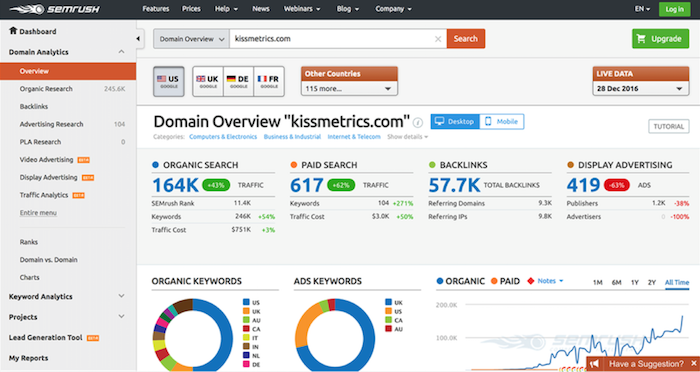
kissmetrics

And then came a competitor, Mixpanel, who copied a lot of our features and didn’t know marketing as well as me. Just look at their traffic stats:
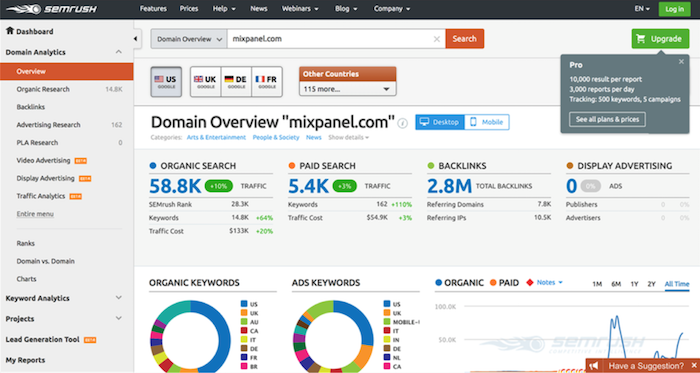
mixpanel

Considering that we had almost 3 times more traffic than them, how much do you think KISSmetrics was worth during our peak?

Let me give you a hint… Mixpanel’s last valuation that they announced was $865 million!
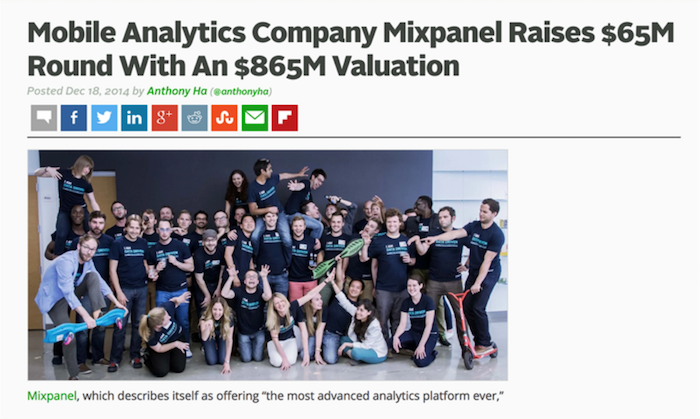
mixpanel value

So, what do you think? Maybe we were worth double them… or at least the same valuation.

Nope. Guess again.

We weren’t even worth 10% of their value.

That’s when I realized that the real formula to marketing isn’t just who is getting the most eyeballs, it’s about focusing on monetization.

Don’t just focus your efforts on traffic acquisition, focus on conversion optimization. It’s the area I didn’t spend enough time on early on.

And to give you an idea of how many companies are making this mistake… I interviewed 208 companies that generate over a million bucks in revenue. Here’s where they are spending their marketing dollars.
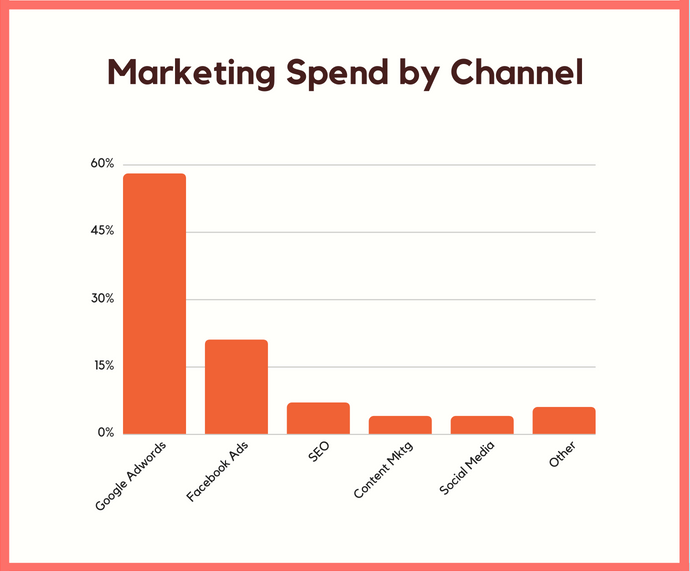
marketing spend

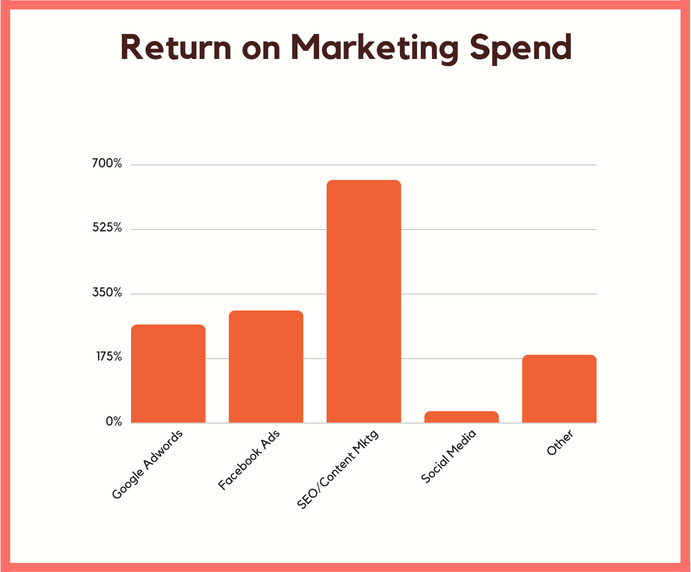
And here are the channels producing the biggest ROI.
roi

Do you see what’s wrong?

SEO produces a higher ROI than paid advertising for most businesses, yet very little budget gets allocated to it.

And what you don’t see in the chart, as it is classified in “other,” is conversion optimization produced the biggest return, yet very few companies spend money on it.

Mistake #5: Not monetizing early enough

Speaking of monetization, I also make this mistake too often.

I love giving everything away for free and then when it comes time to monetize, my numbers don’t look as good as they should.

It’s not that I don’t know how to monetize. It’s more so that I’ve trained my users to expect everything for free.

The moment you switch things up, the numbers never look as great.

I learned this lesson from Ramit Sethi. When I launched my first ebook course on Quick Sprout, I couldn’t generate more than $30,000 a month. Don’t get me wrong, that’s good money, but not when you are generating over 200,000 unique visitors a month.

On the flip side, I monetized NeilPatel.com much earlier than Quick Sprout and, of course, I got better at marketing and entrepreneurship at the same time.

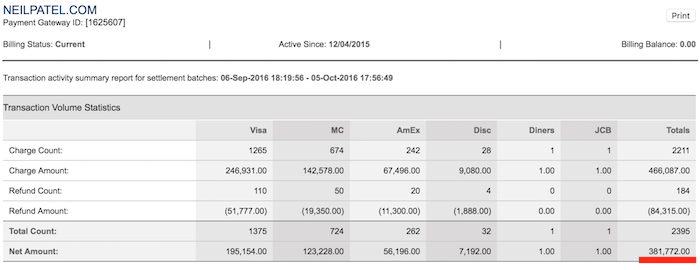
But when I released an ebook/training course (I no longer sell it), I was able to generate $650,000 a month from just 450,000 visitors during my peak.

As the course got older, my monthly revenue dropped but it stayed around $381,722.
revenue

The point I am trying to make is don’t wait too long before you monetize.

There is nothing wrong with charging for a product or a service. But if you wait too long before you start charging, people will have this notion that it will be free forever and they won’t be as likely to convert in the future no matter how good you are at marketing.

Mistake #6: Taking people for granted

I have a skill set that I have always been good at. Can you guess what it is?

It’s making websites popular.

source https://neilpatel.com/blog/marketing-mistakes-broke/

Monday, 7 January 2019

Taking Local Inventory Online: An Interview with Pointy’s Mark Cummins

Posted by MiriamEllis

Let’s go back in time 20 years so I can ask you the question, “How often do you look at a paper map every month?”

Unless you were a cartographer or a frequent traveler, chances are good that your answer would be, “Hmm, maybe less than once a month. Maybe once or twice a year.”

But in 2019, I’d wager there’s scarcely a day that goes by without you using Google Maps when planning to eat out, find a service provider, or find something fun to do. That web-based map in your hand has become a given.

And yet, there’s one thing you’re still not using the Internet for. And it’s something you likely wonder about almost daily. It starts with the question,

“I wonder who around here carries X?”

A real-world anecdote

After the tragic fires we’ve had this year in California, I wanted to wet mop all the floors in my house instead of vacuuming them, due to my concerns about particulate pollution in the air. My mother recommended I buy a Swiffer. I needed to know where I could find one locally, but I didn’t turn to the Internet for this, because the Internet doesn’t tell me this. Or at least, it hasn’t done so until now. Few, if any, of the local hardware stores, pharmacies, or big box retailers have reliable, live online inventory. At the same time, calling these places is often a huge hassle because staff isn’t always sure what’s in stock.

And so I ended up going to 3 different shops in search of this particular product. It wasn’t a convenient experience, and it was an all-too-common one.

The next big thing in local already exists

My real-world anecdote about a wet mop is exactly why I’m so pleased to be interviewing Mark Cummins, CEO of Pointy. 90% of purchases still take place in physical stores and it’s Mark who has seen this gap in available online knowledge about offline inventory and has now set out to bridge it.

I predict that within a few years, you’ll be using the Internet to find local inventory as frequently and easily as you’ve come to use its mapping capabilities. This chat with Mark explains why.

The real-world roots of an existing local need

Miriam: Mark, I understand that you were formerly a Google Search Team member, with a background in machine learning, but that your journey with Pointy began by walking into retail shops and talking face-to-face with owners. What did these owners tell you about their challenges in relation to offline/online inventory? A memorable real-world anecdote would be great here.

Mark: I started thinking about this problem because of an experience just like your story about trying to find a Swiffer. I’d recently moved to a new country and I had to buy lots of things to set up a new apartment, so I had that kind of experience all the time. It felt like there was a huge gap there that search engines could help with, but they weren’t.

I had been working at Google developing what became Google Lens (Google’s image recognition search feature). It felt strange that Google could do something so advanced, yet couldn’t answer very basic questions about where to buy things locally.

So I started thinking about ways to fix that. Initially I would just walk into retailers and talk to them about how they managed their inventory. I was trying to figure out if there was some uniform way to bring the inventory information online. I quickly learned that it was going to be hard. Almost every retailer I spoke to had a different method of tracking it. Some kept records on paper. Some didn’t count their inventory at all.

My first idea was a little crazy — I wanted to build a robot for retailers that would drive around the store every night and photograph all the shelves, and use image recognition to figure out the inventory and the prices. I spent some time seriously thinking about that, but then landed on the idea of the Pointy box, which is a much simpler solution.

Miriam: Can you briefly describe what a typical Point of Sale system is like for retailers these days, in light of this being technology most retailers already have in place?

Mark: Well, I would almost say that there isn’t a typical Point of Sale system. The market is really fragmented, it sometimes feels like no two retailers have the same system. There’s a huge range, from the old-style systems that are essentially a glorified calculator with a cash drawer, up to modern cloud-connected systems like Clover, Square, or Lightspeed. It’s very disruptive for retailers to change their POS system, so older systems tend to stay in use for a long time. The systems also differ by vertical — there are specialized systems for pharmacies, liquor stores, etc. Dealing with all of that variation is what makes it so hard to get uniform local inventory data.

A simple inventory solution is born

Miriam: So, you spoke with retailers, listened to their challenges and saw that they already have Point of Sale systems in place. And Pointy was born! Please, describe exactly what a Pointy device is, how it solves the problems you learned about, and fits right in with existing Point of Sales technology.

Mark: Right! It was pretty clear that we needed to find a solution that worked with retailers’ existing systems. So we developed the Pointy box. The Pointy box is a small device that attaches to a retailer’s barcode scanner. Basically it links the barcode scanner to a website we create for the retailer. Whenever the retailer scans a product with their barcode scanner, we recognize the barcode, and list the product on the website. The end result is live website listing everything in the store — here’s an example for Talbot’s Toyland, a toy store in San Mateo. They have over ten thousand products listed on their site, without any manual work.

The experience is pretty much seamless — just plug in Pointy, and watch your store website build itself. The Pointy box connects directly via the cell phone network, so there’s really nothing to set up. Just plug it in and it starts working. New products automatically get added to your store page, old products get removed when you no longer sell them, item stock status syncs automatically. We did quite a bit of machine learning to make that all automatic. Once the site is live, we also have some SEO and SEM tools to help retailers drive search traffic for the products they sell.

Miriam: My understanding is that the Pointy Team had to do a ton of legwork to put together various product catalogues from which data is pulled each time a product is scanned so that its information can be displayed on the web. I’m not familiar with this concept of product catalogues. What are they, what types of information do they contain, and what did you have to do to pull all of this together? Also, is it true that your team hand-reviews all the product data?

Mark: If you’re working in shopping search, then product catalogs are really important. Every mass-market product has a unique barcode number, but unfortunately there’s no master database where you can enter a barcode number and get back the product’s name, image, etc. So basically every retailer has to solve this problem for themselves, laboriously entering the product details into their systems. Pointy helps eliminate that work for retailers.

There are some product catalogs you can license, but each one only covers a fraction of products, and errors are common. We built a big data pipeline to pull together all of this product data into a single catalog and clean it up. We automate a lot of the work, but if you want the highest quality then machine learning alone isn’t enough. So every single product we display also gets approved by a human reviewer, to make sure it’s accurate. We’ve processed millions of products like this. The end result for the retailer is that they just plug in a Pointy box, scan a product, and their website starts populating itself, no data entry required. It’s a pretty magical feeling the first time you see it. Especially if you’ve spent countless hours of your life doing it the old way!

Where real-time local inventory appears on the web

Miriam: So, then, the products the retailer scans create the brand’s own inventory catalogue, which appears on their Pointy page. What tips would you offer to business owners to best integrate their Pointy page with their brand website? Linking to it from the main menu of the website? Something else? And do these Pointy pages feature SEO basics? Please describe.

Mark: Some retailers use Pointy as their main website. Others have it as an additional profile, in the same way that they might have a Facebook page or a Yelp page. The main thing Pointy brings is the full live inventory of the store, which generally isn’t listed anywhere else. To integrate with their other web presences, most just link across from their main sites or social media profiles. A few also embed Pointy into their sites via an iframe.

We work a lot on making these pages as SEO-friendly as possible. The queries we focus on ranking for are things like “product name near me” or “product name, location.” For example, a query like “rubber piggy bank san mateo” currently has the Pointy page for Talbot's Toyland in #1 position. We have an engineering team working on this all the time, and we’ve actually discovered a few interesting things.

Miriam: And how does this work when, for example, a product goes out of stock or goes on sale for a different price?

Mark: We keep that information updated live. The stock status is updated based on the information from the Pointy box. We also handle price data, though it depends on what features the retailers is using. Some retailers prefer not to display their prices online.

See What's In Store: Google totally sees the opportunity

Miriam: I was fascinated to learn that Pointy is the launch partner for Google’s See What’s In Store feature, and readers can see an example of this with Talbot’s Toyland. Can you explain what’s involved for retailers who want their inventory to appear in the SWIS area of the Google Business Profile (aka “Knowledge Panel”) and why this represents such an important opportunity? Also, does the business have to pay a commission to Google for inclusion/impressions/clicks?

Mark: This is a pretty exciting feature. It lets retailers display their full product catalogue and live inventory information in the Business Profile on the Google search page. It’s also visible from Google Maps. I’m guessing Google will probably start to surface the information in more ways over time.

It’s completely free for retailers, which is pretty interesting. Google Shopping has always been a paid service, so it’s notable that Google is now offering some organic exposure with this new feature.

I think that this is going to become table stakes for retailers in the next year or two, in the same way that having your opening hours online is now. Consumers are simply going to expect the convenience of finding local product information online. I think that’s a good thing, because it will help local businesses win back customers that might otherwise have gone to Amazon.

We’ve worked a lot with Google to make the setup experience for local retailers very simple. You just link your Pointy account to Google, and your live inventory appears in the Google Business Profile. Behind the scenes we do a lot of technical work to make that happen (including creating Merchant Center accounts, setting up feeds, etc). But the user experience is just a few clicks. We’ve seen a lot of uptake from Pointy users, it’s been a very popular feature. We have a bit more detail on it here.

What about special retail scenarios?

Miriam: So, basically, Pointy makes getting real-world inventory online for small and independent retailers who just don’t have the time to deal with a complicated e-commerce system. I understand that you have some different approaches to offer larger enterprises, involving their existing IT systems. Can you talk a bit about that, please?

Mark: Yes, some larger retailers may be able to send us a direct feed from their inventory systems, rather than installing Pointy boxes at every POS location. We aim to support whatever is easiest for the retailer. We are also directly integrated into modern cloud POS systems like Clover, Square, Lightspeed, Vend, and others. Users of those systems can download a free Pointy app from their system’s app store and integrate with us that way. And for retailers not using those systems, they can use a Pointy box.

Miriam: And what about retailers whose products lack labels/barcodes? Let’s say, a farm stand with constantly-changing seasonal produce, or a clothing boutique with hand-knit sweaters? Is there a Pointy solution for them?

Mark: Unfortunately we’re not a great fit for those kind of retailers. We designed the experience for retailers who sell barcoded products.

Miriam: You’re a former Google staffer, Mark. In local search, Google has become aggressive in taking a cut of an increasing number of local consumer actions and this is particularly hard on small businesses. We’ve got Local Service Ads, paid ads in local packs, booking buttons, etc, all of which struggling independent businesses are having to pay Google for. Right now, these retailers are eager for a competitive edge. How can they differentiate themselves? Please, share tips.

Mark: It’s true, lots of channels that used to be purely organic now have a mix of organic and paid. I think ultimately the paid ads still have to be ROI-positive or nobody will use them, but it’s definitely no fun to pay for traffic you used to get for free.

On the positive side, there are still plenty of openings to reach customers organically. If small businesses invest in staying ahead of the game, they can do very well. Lots of local product searches essentially have no answer, because most retailers haven’t been able to get their inventory online yet. It’s easy to rank well for a query when you’re the only one with the answer. There’s definitely still an opening there for early adopters.

“Pointing” the way to the future

Miriam: Finally, Pointy has only been available in the US since 2016, and in that short amount of time, you’re already serving 1% of the country’s retailers. Congratulations! What does the near future look like to you for retailers and for Pointy? What do you see as Pointy’s mission?

Mark: We want to bring the world’s brick-and-mortar retailers online and give them the tools they need to thrive. More than 90% of retail goes through brick and mortar stores, so there’s no reason they shouldn’t have an amazing technology platform to help them. The fragmentation and difficulty of accessing data has held everyone back, but I think Pointy has a shot at fixing that.

Miriam: Thank you, Mark. I believe Pointy has what it takes to be successful, but I’m going to wish you good luck, anyway!

Summing up

In doing this interview, I learned a ton from Mark and I hope you did, too. If a local retailer you market is seeking a competitive advantage in 2019, I’d seriously be considering early adoption of Google’s See What's In Store feature. It’s prime Google Business Profile (formerly Knowledge Panel) real estate, and so long as SWIS is free and Pointy is so affordable, there’s a pretty incredible opportunity to set yourself apart in these early days with a very modest investment.

I’m feeling confident about my prediction that we’re on the verge of a new threshold in user behavior, in terms of people using local search to find local inventory. We’ll all have the enjoyment of seeing how this plays out over the next couple of years. And if you heard it first at Moz, that will be extra fun!


Sign up for The Moz Top 10, a semimonthly mailer updating you on the top ten hottest pieces of SEO news, tips, and rad links uncovered by the Moz team. Think of it as your exclusive digest of stuff you don't have time to hunt down but want to read!


source https://moz.com/blog/taking-local-inventory-online

Friday, 4 January 2019

TikTok’s quietly launched ‘Lite’ app has reached over 12 million downloads since August

Short-form video app TikTok has been growing in popularity across international markets, including in the U.S. where a merger with Musical.ly has seen the app topping the App Store charts. Facebook and Snapchat have been hastily trying to copy TikTok’s features as a result. A part of TikTok’s ambitious global expansion plan has been its more recent targeting of emerging markets – like India and Indonesia – where the company’s quietly launched “TikTok Lite” app has been gaining ground in the latter half of 2018.

TikTok hasn’t yet made much fuss over its Lite version, which actually consists of two separate apps.

The first was launched on August 6, 2018 in Thailand, but is now available across other primarily Asian markets, including Indonesia where it’s most popular, as well as Vietnam, Malaysia, and the Philippines.

This version of TikTok Lite has grown to 5 million installs since its August debut. (It’s actually written with a lowercase “l” in “Lite” in the Play store, which is how you can tell the difference between this and the other app.)

This version was also briefly live in India, Brazil, and Russia, but now these countries are served by a separate Lite app (written as “Lite” with an uppercase “L”), which launched on November 1, 2018.

This second version of TikTok Lite has now become the larger of the two, thanks to India. It has around 7.1 million total downloads, according to Sensor Tower data.

It has also now been installed across 15 additional non-Asian countries, including Egypt, Brazil, Algeria, Tunisia, Russia, Ecuador, South Africa, Dominican Republic, Guatemala, Kenya, Costa Rica, El Salvador, Nigeria, Angola, and Ghana.

Combined, the two TikTok Lite apps have gained over 12 million downloads in around six months’ time, TechCrunch confirmed with Sensor Tower.

However, TikTok Lite is not being heavily promoted at this time – especially when compared with the outsize marketing that TikTok’s flagship app has been seeing as of late.

This advertising is courtesy of TikTok’s Chinese parent company, ByteDance, which has had an infusion of billions in outside capital recently. The company is valued at $78 billion, as of October.

And it’s spending, apparently:

E.g.:

On-Page SEO for 2019 - Whiteboard Friday

Posted by BritneyMuller

Whew! We made it through another year, and it seems like we're past due for taking a close look at the health of our on-page SEO practices. What better way to hit the ground running than with a checklist? In today's Whiteboard Friday, the fabulous Britney Muller shares her best tips for doing effective on-page SEO in 2019.

Click on the whiteboard image above to open a high-resolution version in a new tab!

Video Transcription

Hey, Moz fans. Welcome to another edition of Whiteboard Friday. Today we're going over all things on-page SEO, and I've divided it into three different sections:

  1. How are crawlers and Googlebot crawling through your site and your web pages?
  2. What is the UX of your on-page content?
  3. What is the value in the content of your on-page content?

So let's just jump right in, shall we?

Crawler/bot-accessible

☑ Meta robots tag allows crawling

Making sure your meta robots tag allows crawling is essential. If that's blocking Googlebot from crawling, your page will never be in search. You want to make sure that's all panned out.

☑ Robots.txt doesn't disallow crawling

You want to make sure that let's say this page that you're trying to get to rank in search engines, that you're not disallowing this URL from your robots.txt.

☑ URL is included in sitemap

Similarly you want to make sure that the URL is in your site map.

☑ Schema markup

You also want to add any schema markup, any relevant schema markup that you can. This is essentially spoon-feeding search engines what your page is about and what your content is about.

☑ Internal links pointing to your page with natural anchor text

So let's say I am trying to rank for chakra stones. Maybe I'm on a yoga website and I want to make sure that I have other internal pages linking to chakra stones with the anchor text "chakra crystals" or "chakra stones" and making sure that I'm showing Google that this is indeed an internally linked page and it's important and we want to give it some weight.

☑ HTTPS - SSL

You want to make sure that that is secure and that Google is taking that into consideration as well.

User experience

☑ Meets Web Content Accessibility Guidelines

Does it meet Web Content Accessibility Guidelines? Definitely look into that and make sure you check all the boxes.

☑ Responsive mobile design with same content and links

Is it responsive for mobile? Super important with the mobile-first indexing.

☑ Clear CTA

Is there one clear call to action? A lot of pages miss this. So, for this page, maybe I would have a big "Buy Chakra Crystals Here" button or link. That would be a clear CTA. It's important to have.

☑ Multimedia: Evaluate SERP and add desired media

Are you providing other desired media types? Are there images and video and different forms of content on your page?

☑ Page speed: utilize CDNs, compress images, use reliable hosting

Are you checking the page speed? Are you using CDNs? Are you compressing your images? You want to check all of that.

☑ Integrate social sharing buttons

It's the easiest thing. Make sure that people can easily share your content.

Content and value

This is where it gets really fun and strategic too.

☑ Unique, high-quality content

Are you providing high-quality content? So if you go to Google and you search "chakra stones" and you take a look at all of those results, are you including all of that good content into your page? Then are you making it even better? Because that should be the goal.

☑ Optimize for intent: Evaluate SERP and PPC, note which SERP features show up

You want to also optimize for intent. So you want to evaluate that SERP. If that search result page is showing tons of images or maybe videos, you should be incorporating that into your page as well, because clearly that's what people are looking for.

You also want to evaluate the PPC. They have done so much testing on what converts and what doesn't. So it's silly not to take that into consideration when optimizing your page.

☑ Title tags and meta descriptions

What are those titles? What are those descriptions? What's working? Title tags and meta description are still so important. This is the first impression to many of your visitors in Google. Are you enticing a click? Are you making that an enticing call to action to your site?

☑ Header tags

H1, H2, and H3 header tags are still super important. You want to make sure that the title of your page is the H1 and so forth. But just to check on all of that would be good.

☑ Optimize images: compress, title file names, add alt text

Images are the biggest source of bloat of on-page site speed. So you want to make sure that your images are compressed and optimized and keeping your page fast and easily accessible to your users.

☑ Review for freshness

You want to review for freshness. We want to make sure that this is up-to-date content. Maybe take a look at popular content the last year or two of your site and update that stuff. This should be a continual wash and repeat. You want to continue to update the content on your site.

☑ Include commonly asked questions

It's such an easy thing to do, but it's commonly overlooked. AnswerThePublic does a great job of surfacing questions. Moz Keyword Explorer has a really great filter that provides some of the most commonly asked questions for a keyword term. I highly suggest you check that out and start to incorporate some of that.

Find common questions now

These help to target featured snippets. So if you're incorporating some of that, not only do you get the extra traffic, but you find these opportunities of getting featured snippets, which is great. You're expanding your real estate in search. Awesome. PAA boxes are also a great way to find commonly asked questions for a particular keyword.

☑ Add summaries

Summaries are also hidden gems. We see Google seeking out summaries for content all of the time. They are providing summaries in featured snippets and in different SERP features to help sort of distill information for users. So if you can do that, not only will you make your content more easily scannable, but you're also making it more accessible for search, which is great.

☑ TF-IDF (term frequency-inverse document frequency)

TF-IDF stands for "term frequency-inverse document frequency." It sounds a little intimidating. It's actually pretty simple. What's the number of times that "chakra stones" is mentioned in this particular page divided by the number of times it's mentioned anywhere? This is basically just a calculation to determine relevance for the term "chakra stones." Really cool and commonly used by Google. So if you can do this on your on-page, it will just help you in the long term.

☑ LSI (latent semantic indexing) for relevance

Similarly LSI or LSA, it sometimes referred to, is latent semantic indexing, and it's also for relevance. This helps determine, okay, if I'm talking about chakra stones, it may also incorporate those other topics that are commonly related to this topic. Relevant.

☑ Flesch-Kincaid Readability Test

What is the readability of this page? The easier it is to read the better, but you just want to keep an eye on that in general.

Bonus tip!

One final tip that Kameron Jenkins put on Twitter, that I love so much, and Kameron is a world-class writer —she's one of the best I've ever had the privilege of working with — mentioned this on-page SEO trick. Find the top three ranking URLs for your target keyword.

So if I were to put in "chakra stones" in Google and pull the top three URLs, put them into Moz Keyword Explorer and I see what they're ranking for, I see what those three URLs are specifically ranking for, and I look at what they're commonly ranking for in the middle here. Then I use those keywords to optimize my page even better. It's genius. It's very similar to some of the relevant stuff we were talking about over here.

Discover new keyword ideas

So definitely try some of this stuff out. I hope this helps. I really look forward to any of your comments or questions down below in the comments section.

Thank you so much for joining me on this edition of Whiteboard Friday. I look forward to seeing you all again soon, so thanks. Have a good one.

Video transcription by Speechpad.com


Sign up for The Moz Top 10, a semimonthly mailer updating you on the top ten hottest pieces of SEO news, tips, and rad links uncovered by the Moz team. Think of it as your exclusive digest of stuff you don't have time to hunt down but want to read!


source https://moz.com/blog/on-page-seo-2019

Thursday, 3 January 2019

Workplace, Facebook’s enterprise platform, adds another major customer, Nestlé

While Facebook continues to repair its image with consumers disenchanted with the social network’s role in disseminating misleading or false information and mishandling their personal data, it’s ironically been finding some traction for its enterprise-focused service, Workplace. Today, the company announced that it has added another huge company to its books: Nestlé, the coffee, chocolate and FMCG giant with 2,000 brands and 240,000 employees, has signed up as its latest customer.

Facebook’s enterprise service competes against the likes of Microsoft Teams, Slack and smaller players like Crew and Zinc, among many others in a crowded market of mobile and desktop apps built to address a growing interest among organizations to have more user-friendly, modern ways for their employees to communicate.

Workplace positions itself as different from its competitors in a couple of ways: it says its communications platform is designed for all different employment demographics, covering so-called knowledge workers (the traditional IT customer) as well as waged and front-line employees; but it also claims to be the most democratic of the pack, by virtue of being a Facebook product, designed for mass market use from the ground up.

In the workplace, that translates to apps that do not require company email addresses or company devices to use; a strong proportion of employees at Workplace’s bigger customers, such as Walmart (2.2 million employees) and Starbucks (nearly 240,000 employees) do not sit at desks and, until relatively recently, would not have been using any kind of PC or phone on a regular basis on any average day.

But as smartphones have become as ubiquitous as having your keys and wallet, acceptance of having them and utilising them to communicate workplace-related information has changed, and that is the wave that services like Workplace are hoping to ride.

But despite the strong engine that is Facebook behind it, Workplace has a lot of challenges ahead.

The company has not updated its total number of customers in more than a year at this point — its last milestone was 30,000 customers, back in November 2017 — and today Facebook VP Julien Codorniou said the company might put out a more updated number later this year.

“We’re not using that metric to communicate our success,” he said, “but we have to communicate growth, I feel the demand from the market.” Slack claims 500,000 organizations, more than 70,000 of which pay; Teams from Microsoft has some 329,000 customers, the company says.

There also is the issue of how a customer win is actually translating to usage. Last month, a much smaller competitor, Crew, with 25,000 customers, noted that at least some of them were in fact those that Workplace was claiming to have secured.

“Starbucks is theoretically using Workplace, but it’s been deployed only to managers,” Crew CEO Danny Leffel told me. “We have almost 1,000 Starbucks locations using Crew. We knew we had a huge presence there, and we were worried when Facebook won them, but we haven’t seen even a dent in our business so far.”

Codorniou said that this also doesn’t tell the full story. He describes the approach that Crew and others take as “shadow IT,” in that the companies don’t talk to central HQ when winning the business. “You can’t give a voice to everyone by going in through the back,” he said. He also contends that it just takes time to deploy something across a massive business. “Workplace only works if you get 100 percent of the company using it,” he added. Notably, today Facebook announced that Nestlé has already onboarded 210,000 customers to Workplace.

There is also the bigger question of how these products will develop technically to further differentiate from the pack. For now, it feels like Slack still reigns supreme when it comes to desktop knowledge worker functionality — even without usefully threaded comments — because of the fact that you can integrate virtually any other app you might want to into its platform.

Crew, meanwhile, has differentiated by focusing on providing handy tools to help businesses managing scheduling for shift workers, which comprise the majority of its user base.

Others like Teams, and yes, Workplace, have also added integrations and their own functionality — Workplace’s most interesting features, I think, are how it has translated consumer-Facebook features like Live into the Workplace environment. But there is still a lot of space for apps to consider what other features and functionality will be most useful for the most employees and for the business customer at large.

It will be interesting to see how and if this is affected by way of a key leadership appointment. Last month, Facebook appointed a new “head” of Workplace, Karandeep Anand, who came to Facebook three years ago from Microsoft (and thus has a close understanding of enterprise software). Codorniou said Anand would be relocating to London, where Workplace is developed, and will focus on the technical development of the product while Codorniou focuses on sales, client relations and business development.

Technical leadership for Workplace had previously come straight from CTO Mike Schroepfer, Codorniou said. “We decided that we needed someone full time, here in London,” he said.

It’s not clear if Workplace’s win at Nestlé is replacing another product; it seems, however, that it is more likely a trend of how more businesses are making an investment in company-wide communications platforms where they may never have had one before, in hopes of it helping keep employees switched on, linked up and generally more happy and feeling less like expendable cogs.

“Nestlé is a people-first environment,” said EVP Chris Johnson, in a statement. “We really rely on our talented teams to manage more than 2,000 Nestlé brands worldwide. We help our employees develop and we give them the right tools, so Workplace is a perfect fit.”


source https://techcrunch.com/2019/01/03/workplace-facebooks-enterprise-platform-adds-another-major-customer-nestle/

PR management firm Cision is acquiring Falcon.io to expand into social media marketing

Social media has become a primary conduit for getting the word out, in some cases proving to be an even stronger force for publicity than more traditional media outlets and paid advertising, and so today, a company that has grown its business around public relations services has acquired a social media management company to make sure it has a foothold in the medium. Cision, which provides press release distribution, media monitoring, and other PR services to businesses and the media industry, has acquired Falcon.io, a startup founded in Denmark that lets companies post, manage and analyse their presence on social media platforms.

Terms of the deal are not being disclosed, the companies tell me, but the whole of the Falcon team, including CEO/founder Ulrik Bo Larsen, are joining the company, where they will continue to operate its existing product set as well as integrate it into Cision’s wider business. The last valuation noted in April 2017 at the Danish Companies House was about $52 million (€45 million) but they have been growing very rapidly, and one source tells us that the price paid was around $200-$225 million, while Danish publication Borsen says it’s 800 million Danish kroner, or around $122 million. I’m still trying to get more detail.

Falcon had raised around $25 million according to PitchBook, and it has never disclosed its valuation. Cision — well known to many journalists — is publicly traded and currently has a market cap of just under $1.6 billion. For some context, two other prominent social media management firms that compete with Falcon, Sprout Social and Hootsuite, are respectively valued at $800 million and anywhere between $750 million and $1 billion (depending on who you ask).

The latter two are bigger firms — Falcon has around 1,500 businesses as customers who use it to manage their social profiles and read social sentiment across platforms like Facebook, Twitter, and LinkedIn, while Sprout says it has around 25,000 and Hootsuite counts millions of individual users — and both have raised significantly more capital, but their valuations underscore the demand that we’re seeing for platforms and user-friendly tools to target the world’s social media users — estimated to number at upwards of 2.5 billion people globally.

Kevin Akeroyd, who came on as Cision’s CEO after long stints at both Oracle and Salesforce among other places, describes Falcon as a “top five” social media marketing and analytics firm, and in an interview he said that the new acquisition will form a key part of the “communications cloud” that Cision has been building.

As with Salesforce, Oracle and Adobe (who also use similar cloud-themed terminology to describe their product suites), Cision’s strategy is to build a one-stop shop for customers to manage all of their communications needs from one platform. Falcon itself may be smaller than its competitors, but idea is that it will be cross-sold to Cision’s customers, which currently number 75,000 businesses.

“We’re seeing too many of our customers using one application for content, another for something else, and so on. There are too many apps,” he said. “We have always believed in earned media” — that is, media mentions that are not in the form of paid advertising — “and the role of influencers alongside paid and owned marketing. We believe we could provide the first solution for businesses across earned, communications services and public relations, helping to build a better data stack to measure and attribute what you are doing in comms.”

As social networking companies like Facebook and Twitter build more of their own tools in-house to serve the social media needs of organizations who want to better manage their profiles and interactions on these platforms, this has led to some consolidation and shifts among social media management companies. Some are merging or getting acquired, and some are shopping themselves around.

And in that wider trend, it’s not too surprising to see public relations firms get in on the action. Social media has completely changed the landscape for how information is disseminated today, sometimes complementing what traditional media organizations do — there are many examples of how newspapers and other news outlets leverage, for example, Facebook to grow and communicate with their audiences — and often replacing traditional media altogether. (Pew last month said that social media outpaced newspapers for the first time as a news source in the US, although TV and radio are still bigger than social… for now.)

Given that public relations management has long been the connecting link between organisations and media outlets, they have had to take a bigger step into social media in order to provide a more complete picture of the media landscape to their clients. Cision is not the first to have done this: Last year, Meltwater, another media monitoring firm, acquired DataSift to add social signals and traffic to its platform mix.

“This consolidation has to come because there is just too much value for the user,” Akeroyd said. “CMOs and CCOs do not want their own islands, they want something bigger.”


source https://techcrunch.com/2019/01/03/pr-management-firm-cision-is-acquiring-falcon-io-to-expand-into-social-media-marketing/

Workplace, Facebook’s enterprise platform, adds another major customer, Nestle

While Facebook continues to repair its image with consumers disenchanted with the social network’s role in disseminating misleading or false information and mishandling their personal data, it’s ironically been finding some traction for its enterprise-focused service, Workplace. Today, the company announced that it has added another huge company to its books today: Nestle, the coffee, chocolate and FMCG giant with 2,000 brands and 240,000 employees, has signed up as its latest customer.

Facebook’s enterprise service competes against the likes of Microsoft Teams, Slack and smaller players like Crew and Zinc, among many others in a crowded market of mobile and desktop apps built to address a growing interest among organizations to have more user-friendly, modern ways for their employees to communicate.

Workplace positions itself as different from its competitors in a couple of different ways: it says its communications platform is designed for all different employment demographics, covering so-called knowledge workers (the traditional IT customer) as well as waged and front-line employees; but it also claims to be the most democratic of the pack, by virtue of being a Facebook product, designed for mass market use from the ground up.

In the workplace, that translates to apps that do not require company email addresses or company devices to use; a strong proportion of employees at Workplace’s bigger customers, such as Walmart (2.2 million employees) and Starbucks (nearly 240,000 employees) do not sit at desks and, until relatively recently, would not have been using any kind of PC or phone on a regular basis on any average day.

But as smartphones have become as ubiquitous as having your keys and wallet, acceptance of having them and utilising them to communicate workplace-related information has changed, and that is the wave that services like Workplace are hoping to ride.

But despite the strong engine that is Facebook behind it, Workplace has a lot of challenges up ahead.

The company has not updated its total number of customers in over a year at this point — its last milestone was 30,000 customers, back in November 2017 — and today Facebook VP Julien Codorniou said that the company might put out a more updated number later this year.

“We’re not using that metric to communicate our success,” he said, “but we have to communicate growth, I feel the demand from the market.” Slack claims 500,000 organizations, over 70,000 of which pay; Teams from Microsoft has some 329,000 customers, the company says.

There is also the issue of how a customer win is actually translating to usage. Last month, a much smaller competitor, Crew, with 25,000 customers, noted that at least some of them were in fact those that Workplace was claiming to have secured.

“Starbucks is theoretically using Workplace, but it’s been deployed only to managers,” Crew CEO Danny Leffel told me. “We have almost 1,000 Starbucks locations using Crew. We knew we had a huge presence there, and we were worried when Facebook won them, but we haven’t seen even a dent in our business so far.”

Codorniou said that this also doesn’t tell the full story. He describes the approach that Crew and others take as “shadow IT” in that the companies don’t talk to central HQ when winning the business. “You can’t give a voice to everyone by going in through the back,” he said. He also contends that it just takes time to deploy something across a massive business. “Workplace only works if you get 100 percent of the company using it,” he added. Notably, today Facebook announced that Nestle has already onboarded 210,000 customers to Workplace.

There is also the bigger question of how these products will develop technically to further differentiate from the pack. For now, it feels like Slack still reigns supreme when it comes to desktop knowledge worker functionality — even without usefully threaded comments — because of the fact that you can integrate virtually any other app you might want to into its platform.

Crew, meanwhile, has differentiated by focusing on providing handy tools to help businesses managing scheduling for shift workers, who comprise the majority of its user base.

While others like Teams, and yes, Workplace, have also added in integrations and their own functionality — Workplace’s most interesting features, I think, are how it has translated consumer-Facebook features like Live into the Workplace environment. But there is still a lot of space for apps to consider what other features and functionality will be most useful and stick for the most employees and for the business customer at large.

It will be interesting to see how and if this is affected by way of a key leadership appointment. Last month, Facebook appointed a new “head” of Workplace, Karandeep Anand, who came to Facebook three years ago from Microsoft (and thus has a close understanding of enterprise software). Codorniou said Anand be relocating to London, where Workplace is developed, and will focus on the technical development of the product while Codorniou focuses on sales, client relations and business development.

Technical leadership for Workplace had previously come straight from CTO Mike Schroepfer, Codorniou said. “We decided that we needed someone full time, here in London,” he said.

It’s not clear if Workplace’s win at Nestle is replacing another product: it seems, however, that it is more likely a trend of how more businesses are making an investment in company-wide communications platforms where they may never have had one before, in hopes of it helping keep employees switched on, linked up, and generally more happy and feeling less like expendable cogs.

“Nestlé is a people-first environment,” said EVP Chris Johnson, in a statement. “We really rely on our talented teams to manage more than 2,000 Nestlé brands worldwide. We help our employees develop and we give them the right tools, so Workplace is a perfect fit.”


source https://techcrunch.com/2019/01/03/workplace-facebooks-enterprise-platform-adds-another-major-customer-nestle/