Monday, 30 March 2020

Operating During COVID-19: Helpful Tips for Local Businesses

Posted by MiriamEllis

Local businesses know better than any other model what it means to fully participate in community life. You are the good neighbors who are there to serve, inspire, and sustain the people and traditions that make your town a unique and enjoyable place to call home.

As we explore this topic of what local businesses can do during the COVID-19 pandemic, I want to honor all that you have always done to take care of your community as a local business owner or marketer. Thank you.

In this article, you will find local SEO tips that could make a difference for your business in the coming weeks, innovative resources for support, advice from my own tight-knit community of some of the world’s best local SEOs, and some serious thinking about building a better local future.

Adhere to all regulations

First and foremost, start each day with a review of both local and national news to be sure you are complying with the evolving regulations for your city, county, and country. Policies designed to mitigate the harm of COVID-19 vary widely from region to region, and your business must keep informed of which forms of service you are allowed to offer in this dynamic scenario.

And, while social media can be a great connector within your community at any time, beware of misinformation and, sadly, scams in the days ahead. Get your news from sources you trust, and if you are not certain about interpreting a guideline, directly contact local authorities. This article does not take the place of laws and regulations specific to your community.

Communicate abundantly

The most helpful thing any local business can do right now, whether it’s deemed an essential or non-essential service, is to provide accurate information to its community. There are three key places to do this:

Google My Business

“More than ever, your Google Business Profile is a critical communication nexus with your customers”. —Mike Blumenthal, GatherUp

Local businesses know just how big a role Google plays as intermediary between brands and the public. This remains true during this difficult time however, Google’s local product is not running at full strength. Joy Hawkins’ article for Local University on March 23 details the limited support for or complete discontinuation of Google Q&As, posts, descriptions, reviews, and owner responses. It’s an evolving scenario, with local SEOs reporting different outcomes each day. For example, some practitioners have been able to get some, but not all, Google posts to publish.

As of writing this, there are four fields you can utilize to communicate current information to customers via GMB, but please be aware that some edits may take several days to go into effect:

Name

Google is allowing businesses to edit their business name field to reflect that they are offering curbside service, takeout, and delivery. For example, if your current name is “John’s Grill”, you are allowed to temporarily change your name to “John’s Grill — Delivery Available”.

Phone number

If regulations are keeping you at home but you still want customers to be able to reach you on your home or cell phone for information, update your work answering machine to reflect the changes and edit your GMB phone number to the appropriate new number.

Hours of operation

The discussion on how best to show that your business either has no hours or limited new hours is ongoing. I believe the best route for the present is to use Google’s method of setting special hours. This option should be especially useful for multi-location enterprises who can set special hours via the API.

Be advised, however, that there are some instances of agencies setting special hours for clients and then clients receiving emails from Google asking if the business has closed. This can alarm those clients. However, to date, it appears that when Google receives responses to this prompt that yes, the business is closed, they simply put a message about this on the listing rather than remove the listing entirely.

On March 25, Google implemented a “temporarily closed” button inside the “Info” tab of the GMB dashboard, as reported by Joy Hawkins. Utilizing this button may temporarily decrease your rankings, but you will be able to remove the label in the future and I strongly hope (but cannot guarantee) that this will remove any effects of suppression. I recommend using this button if it applies to your business because we must put safety first over any other consideration.

COVID-19 update posts

Google has newly created a Google posts type that you’ll see as an option in your GMB dashboard. While other post types have been published sporadically, I am seeing examples of the COVID-19 Update posts going live. Try to fit as much information as you can about the changed status of your business into one of these posts.

In addition to the edits you make to your GMB listing, update your most visible local business listings on other platforms to the best of your ability, including on:

  • Bing: A “Temporarily closed” business status is available in the Bing Places dashboard. This is currently not available in the API.
  • Yelp: Yelp has introduced a new field called “temporarily closed”. This is meant to be used by businesses which are or will be closed (but not on a permanent basis) due to the COVID-19 outbreak. Businesses need to indicate the “end date” for when this business status will end. Given the uncertainty surrounding timelines, Yelp is allowing users to provide an “estimate” for the end date which they can always update later. Special opening hours can be added on Yelp itself, too. Neither field is available in the API.

Website

Google My Business may be experiencing support issues right now, but thank goodness you still have full control of your website as a home base for conveying important information to the public. Here’s a quick checklist of suggested items to update on your site as soon as you can:

  • Put a site wide banner on all pages of the website with key information such as “temporarily closed”, “drive-up service available 9-5 Monday - Friday” or “storefront closed but we can still ship to you.”
  • Provide the most complete information about how your business has been affected by COVID-19, and detail any services that remain available to customers.
  • Edit location landing pages in bulk or individually to reflect closures, new hours, and new temporary offers.
  • Be sure hours of operation are accurate everywhere they are mentioned on the website, including the homepage, contact page, about page, and landing pages.
  • If your main contact phone number has changed due to the situation, update that number everywhere it exists on the website. Don’t overlook headers, footers, or sidebars as places your contact info may be.
  • If you have a blog, use it to keep the public updated about the availability of products and services.
  • Be sure your website contains highly visible links to any social media platforms you are using to provide updated information.
  • It would be a worthy public service right now to create new content about local resources in your community for all kinds of basic needs.

Social media and email

“Make it clear what you're doing, such as things like home delivery or curbside pickup. And mention it EVERYWHERE. The companies that are being successful with this are telling people non-stop how they can still support them. Additionally, don't be afraid to reach out to people who have supported you via social media in the past and ask them to mention what you're doing.” —Dana DiTomaso, Kick Point

Whether your customers’ social community is Facebook, Twitter, Instagram, YouTube, or another platform, there has never been a more vital time to make use of the instant communication these sites provide. It was Fred Rogers who famously said that in times of crisis, we should “look for the helpers.” People will be looking to your brand for help and, also, seeking ways that they can help, too.

If you can make the time to utilize social media to highlight not just your own services, but the services you discover are being provided by other businesses in your city, you will be strengthening your community. Ask your followers and customers to amplify information that can make life safer or better right now.

And, of course, email is one of the best tools presently at your disposal to message your entire base about changed conditions and special offers. My best practice advice for the present is to be sure you’re only communicating what is truly necessary. I’ve seen some examples of brands (which shall remain nameless) exploiting COVID-19 for senseless self-promotion instead of putting customers’ concerns and needs first. Don’t go that route. Be a helper!

Beyond your local business listing, websites, social media platforms, and email, don’t overlook offline media for making further, helpful informational contributions. Call into local radio shows and get in touch with local newspapers if you have facts or offers that can help the public.

Operate as fully as you can

“Find out what support is being made available for you at [the] government level, tap into this as soon as you can — it's likely there will be a lot of paperwork and many hoops through which you'll need to jump.” —Claire Carlile, Claire Carlile Marketing

While the social safety net differs widely from country to country, research any offers of support being made to your business and make use of them to remain as operational as possible for the duration of this pandemic. Here are six adjustments your business should carefully consider to determine whether implementation is possible:

1. Fulfill essentials

If your business meets local, state, or federal regulations that enable it to continue operating because it’s deemed “essential”, here are the ways different business models are adapting to current conditions:

  • Some healthcare appointments can be handled via phone or virtual meetings, and some medical facilities are offering drive-up testing.
  • Drivethrough, delivery, and curbside pickup are enabling some brands to offer takeout meals, groceries, prescriptions, and other necessary goods to customers.
  • Supermarkets and grocery stores without built-in delivery fleets are contracting with third parties for this service.
  • Farms and ranches can offer honor system roadside stands to allow customers to access fresh produce, dairy products, and meats with proper social distancing.
  • Companies that care for vulnerable populations, banking, laundry, and fuel can implement and communicate the extra steps they are taking to adhere to sanitation guidelines for the safety of customers and staff.
  • Brands and organizations that donate goods and services to fulfill essential needs are taking an active role in community support, too.

2. Evaluate e-commerce

If your local business already has an e-commerce component on its website, you’re many steps ahead in being well set up to keep selling via delivery. If you’ve not yet implemented any form of online selling, investigate the following options:

  • If you have a credit card processing machine, the most basic solution is to take orders over the phone and then ship them, allow curbside pickup, or deliver them.
  • If you lack a credit card processing service, PayPal invoicing can work in a pinch.
  • If your site is built on WordPress and you’re quite comfortable with that platform, Moz’s own Sha Menz highly recommends the ease of the WooCommerce plugin for getting online shopping set up with PayPal as a built-in payment option. It allows easy setup of flat rate or free shipping and local pickup options. WooCommerce automatically sends order confirmation emails to both owner and customer and even supports creation of discount coupons.
  • Pointy is a simple device that lets you scan product barcodes and have them catalogued online. Read my 2019 interview with the company’s CEO and determine whether Pointy plus shipping could be a solution to keep you in business in the coming months.
  • If you’ve determined that robust investing in e-commerce is a wise move for the present and future, I found this 2020 overview of options from Shopify to Volusion to Magento very useful. Don’t overlook the Moz blog’s e-commerce category for free, expert advice.

3. Connect virtually

In my very large family, one relative has transitioned her yoga studio to online classes, another is offering secure online psychotherapy appointments, and another is instructing his orchestra on the web. While nothing can replace in-person relationships, virtual meetings are the next-best-thing and could keep many business models operating at a significant level, despite the pandemic. Check out these resources:

4. Use downtime for education

If COVID-19 has somewhat or completely paused your business, it’s my strong hope that there will be better days ahead for you. If, like so many people, you find yourself with much more time on your hands than usual, consider using it to come out of this period of crisis with new business knowledge. Please make use of this list of resources, and I want to give special thanks to my friend, Claire Carlile, for contributing several of these suggestions:

Begin working towards a stronger local future

“I would say generally it's critical for business owners to connect with one another. To the extent they can join or form groups for support or to share ideas, they should. This is a terrible and scary time but there are also potential opportunities that may emerge with creative thinking. The 'silver lining', if there is one here, is the opportunity to reexamine business processes, try new things and think — out of necessity — very creatively about how to move forward. Employees are also a great source of ideas and inspiration.” —Greg Sterling, Search Engine Land

I’d like to close with some positive thinking. Local SEO isn’t just a career for me — it’s a personal belief system that well-resourced communities are the strongest. Every community, town, and city shares roughly the same needs, which we might depict like this:

In this simple chart, we see the framework of a functional, prepared, and healthy society. We see a plan for covering the basic needs of human existence, the cooperation required to run a stable community, contributive roles everyone can play to support life and culture, and relief from inevitable disasters. We see regenerative land and water stewardship, an abundance of skilled educators, medical professionals, artisans, and a peaceful platform for full human expression.

COVID-19 marks the third major disaster my community has lived through in three years. The pandemic and California’s wildfires have taught me to think about the areas in which my county is self-sustaining, and areas in which we are unprepared to take care of one another in both good times and bad. While state and national governments bear a serious responsibility for the well-being of citizens, my genuine belief as a local SEO is that local communities should be doing all they can to self-fulfill as many data points on the chart above as possible.

While it’s said that necessity is the mother of invention, and it certainly makes sense that the present moment would be driving us to invent new solutions to keep our communities safe and well, I find models for sane growth in the work others have already contributed. For me, these are sources of serious inspiration:

Saturday, 28 March 2020

This Week in Apps: Apple launches a COVID-19 app, the outbreak’s impact on social and video apps and more

Welcome back to This Week in Apps, the Extra Crunch series that recaps the latest OS news, the applications they support and the money that flows through it all.

The app industry saw a record 204 billion downloads and $120 billion in consumer spending in 2019, according to App Annie’s “State of Mobile” annual report. People are now spending 3 hours and 40 minutes per day using apps, rivaling TV. Apps aren’t just a way to pass idle hours — they’re a big business. In 2019, mobile-first companies had a combined $544 billion valuation, 6.5x higher than those without a mobile focus.

In this Extra Crunch series, we help you keep up with the latest news from the world of apps, delivered on a weekly basis.

This week, we’re continuing our special coverage of how the COVID-19 outbreak is impacting apps and the wider mobile app industry as more COVID-19 apps appear — including one from Apple built in partnership with the CDC, among others. We also take a look at the gains made by social and video apps in recent weeks as people struggle to stay connected while stuck at home in quarantine. In other headlines, we dig into Instagram’s co-watching feature, the Google for Games conference news, Apple’s latest releases and updates, Epic Games expansion into publishing and more.

Coronavirus Special Coverage

Social video apps are exploding due to the COVID-19 pandemic


source https://techcrunch.com/2020/03/28/this-week-in-apps-apple-launches-a-covid-19-app-the-outbreaks-impact-on-social-and-video-apps-and-more/

Friday, 27 March 2020

Social Bluebook was hacked, exposing 217,000 influencers’ accounts

A social media platform used to match advertisers with thousands of influencers has been hacked.

Social Bluebook, a Los Angeles-based company, allows advertisers to pay social media “influencers” for posts that promote their products and services. The company claims it has some 300,000 influencers on its books.

But at some point during October 2019, the company’s entire back-end database was taken in a data breach.

TechCrunch obtained the database, containing some 217,000 user accounts — including influencer names, email addresses, and passwords hashed, which had been scrambled using the strong SHA-2 hashing algorithm.

It’s not known how the database was exfiltrated from the company’s systems.

We contacted several users who, when presented with their information, confirmed it as accurate. We also provided a portion of the data to Social Bluebook co-founder Sam Michie, who confirmed the data breach.

“We have just now become aware of this data breach that occurred in October 2019,” he told TechCrunch in an email Thursday.

He said affected users will be informed of the breach by email. The company also informed the California attorney general’s office of the breach, per state law.

Social media influencers are a constant target for hackers, which target their accounts to hijack their online handles or follower count. Some influencers have relied on white-hat hackers to get their hijacked accounts back.

Last year, a social media firm left a database of Instagram influencers online, which included phone numbers and email addresses scraped from their profiles.


Got a tip? You can send tips securely over Signal and WhatsApp to +1 646-755–8849. 


source https://techcrunch.com/2020/03/27/social-bluebook-hacked/

Generating Local Content at Scale - Whiteboard Friday

Posted by rjonesx.

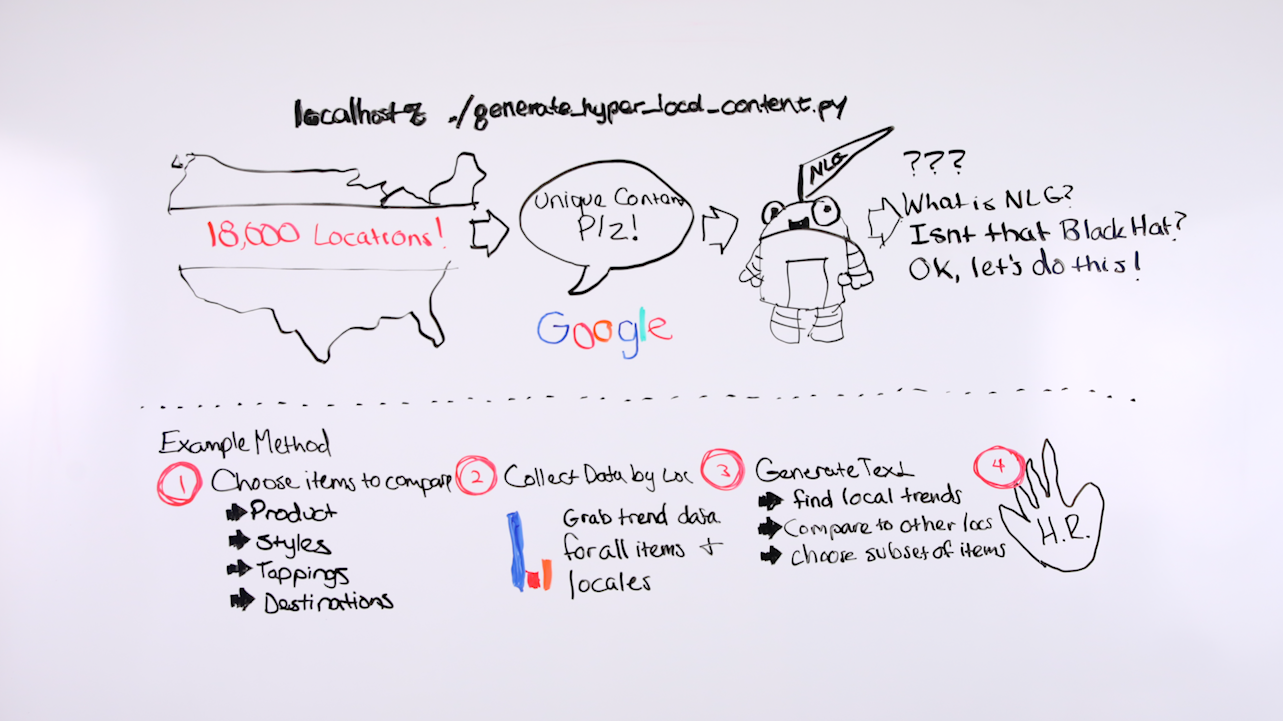
Building local pages in any amount can be a painful task. It's hard to strike the right mix of on-topic content, expertise, and location, and the temptation to take shortcuts has always been tempered by the fact that good, unique content is almost impossible to scale.

In this week's edition of Whiteboard Friday, Russ Jones shares his favorite white-hat technique using natural language generation to create local pages to your heart's content.

Click on the whiteboard image above to open a high-resolution version in a new tab!

Video Transcription

Hey, folks, this is Russ Jones here with Moz again to talk to you about important search engine optimization issues. Today I'm going to talk about one of my favorite techniques, something that I invented several years ago for a particular client and has just become more and more and more important over the years. 

Using natural language generation to create hyper-local content

I call this using natural language generation to create hyper-local content. Now I know that there's a bunch of long words in there. Some of you are familiar with them, some of you are not. 


So let me just kind of give you the scenario, which is probably one you've been familiar with at some point or another. Imagine you have a new client and that client has something like 18,000 locations across the United States.


Then you're told by Google you need to make unique content. Now, of course, it doesn't have to be 18,000. Even 100 locations can be difficult, not just to create unique content but to create uniquely valuable content that has some sort of relevance to that particular location. 


So what I want to do today is talk through one particular methodology that uses natural language generation in order to create these types of pages at scale.

What is natural language generation?

Now there might be a couple of questions that we need to just go ahead and get off of our plates at the beginning. So first, what is natural language generation? Well, natural language generation was actually originated for the purpose of generating weather warnings. You've actually probably seen this 100,000 times.

Whenever there's like a thunderstorm or let's say high wind warning or something, you've seen on the bottom of a television, if you're older like me, or you've gotten one on your cellphone and it says the National Weather Service has issued some sort of warning about some sort of weather alert that's dangerous and you need to take cover.

Well, the language that you see there is generated by a machine. It takes into account all of the data that they've arrived at regarding the weather, and then they put it into sentences that humans automatically understand. It's sort of like Mad Libs, but a lot more technical in the sense that what comes out of it, instead of being funny or silly, is actually really useful information.

That's our goal here. We want to use natural language generation to produce local pages for a business that has information that is very useful. 

Isn't that black hat?

Now the question we almost always get or I at least almost always get is: Is this black hat? One of the things that we're not supposed to do is just auto-generate content.

So I'm going to take a moment towards the end to discuss exactly how we differentiate this type of content creation from just the standard, Mad Libs-style, plugging in different city words into content generation and what we're doing here. What we're doing here is providing uniquely valuable content to our customers, and because of that it passes the test of being quality content.

Let's look at an example

So let's do this. Let's talk about probably what I believe to be the easiest methodology, and I call this the Google Trends method. 

1. Choose items to compare

So let's step back for a second and talk about this business that has 18,000 locations. Now what do we know about this business? Well, businesses have a couple of things that are in common regardless of what industry they're in.

They either have like products or services, and those products and services might have styles or flavors or toppings, just all sorts of things that you can compare about the different items and services that they offer. Therein lies our opportunity to produce unique content across almost any region in the United States.

The tool we're going to use to accomplish that is Google Trends. So the first step that you're going to do is you're going to take this client, and in this case I'm going to just say it's a pizza chain, for example, and we're going to identify the items that we might want to compare. In this case, I would probably choose toppings for example.

So we would be interested in pepperoni and sausage and anchovies and God forbid pineapple, just all sorts of different types of toppings that might differ from region to region, from city to city, and from location to location in terms of demand. So then what we'll do is we'll go straight to Google Trends.

The best part about Google Trends is that they're not just providing information at a national level. You can narrow it down to city level, state level, or even in some cases to ZIP Code level, and because of this it allows us to collect hyper-local information about this particular category of services or products.

So, for example, this is actually a comparison of the demand for pepperoni versus mushroom versus sausage toppings in Seattle right now. So most people, when people are Googling for pizza, would be searching for pepperoni.

2. Collect data by location

So what you would do is you would take all of the different locations and you would collect this type of information about them. So you would know that, for example, here there is probably about 2.5 times more interest in pepperoni than there is in sausage pizza. Well, that's not going to be the same in every city and in every state. In fact, if you choose a lot of different toppings, you'll find all sorts of things, not just the comparison of how much people order them or want them, but perhaps how things have changed over time.


For example, perhaps pepperoni has become less popular. If you were to look in certain cities, that probably is the case as vegetarian and veganism has increased. Well, the cool thing about natural language generation is that we can automatically extract out those kinds of unique relationships and then use that as data to inform the content that we end up putting on the pages on our site.

So, for example, let's say we took Seattle. The system would automatically be able to identify these different types of relationships. Let's say we know that pepperoni is the most popular. It might also be able to identify that let's say anchovies have gone out of fashion on pizzas. Almost nobody wants them anymore.

Something of that sort. But what's happening is we're slowly but surely coming up with these trends and data points that are interesting and useful for people who are about to order pizza. For example, if you're going to throw a party for 50 people and you don't know what they want, you can either do what everybody does pretty much, which is let's say one-third pepperoni, one-third plain, and one-third veggie, which is kind of the standard if you're like throwing a birthday party or something.

But if you landed on the Pizza Hut page or the Domino's page and it told you that in the city where you live people actually really like this particular topping, then you might actually make a better decision about what you're going to order. So we're actually providing useful information. 

3. Generate text

So this is where we're talking about generating the text from the trends and the data that we've grabbed from all of the locales.

Find local trends

Now the first step, of course, is just looking at local trends. But local trends aren't the only place we can look. We can go beyond that. For example, we can compare it to other locations. So it might be just as interesting that in Seattle people really like mushroom as a topping or something of that sort.

Compare to other locations

But it would also be really interesting to see if the toppings that are preferred, for example, in Chicago, where Chicago style pizza rules, versus New York are different. That would be something that would be interesting and could be automatically drawn out by natural language generation. Then finally, another thing that people tend to miss in trying to implement this solution is they think that they have to compare everything at once.

Choose subset of items

That's not the way you would do it. What you would do is you would choose the most interesting insights in each situation. Now we could get technical about how that might be accomplished. For example, we might say, okay, we can look at trends. Well, if all of the trends are flat, then we're probably not going to choose that information. But we see that the relationship between one topping and another topping in this city is exceptionally different compared to other cities, well, that might be what gets selected.

4. Human review

Now here's where the question comes in about white hat versus black hat. So we've got this local page, and now we've generated all of this textual content about what people want on a pizza in that particular town or city. We need to make sure that this content is actually quality. That's where the final step comes in, which is just human review.

In my opinion, auto-generated content, as long as it is useful and valuable and has gone through the hands of a human editor who has identified that that's true, is every bit as good as if that human editor had just looked up that same data point and wrote the same sentences.

So I think in this case, especially when we're talking about providing data to such a diverse set of locales across the country, that it makes sense to take advantage of technology in a way that allows us to generate content and also allows us to serve the user the best possible and the most relevant content that we can.

So I hope that you will take this, spend some time looking up natural language generation, and ultimately be able to build much better local pages than you ever have before. Thanks.

Video transcription by Speechpad.com


Sign up for The Moz Top 10, a semimonthly mailer updating you on the top ten hottest pieces of SEO news, tips, and rad links uncovered by the Moz team. Think of it as your exclusive digest of stuff you don't have time to hunt down but want to read!


source https://moz.com/blog/generating-local-content

Thursday, 26 March 2020

Facebook launches Community Hub for Messenger users to fight coronavirus rumors

Facebook today unveiled Coronavirus Community Hub on Messenger that offers tips, authoritative information and other resources to help people stay connected and informed about the coronavirus outbreak, weeks after launching a similar information hub on WhatsApp, its other messaging service.

The launch of the coronavirus hub on Messenger, used by more than a billion people, comes at a time when users are engaging with the instant messaging and voice calling more often than they have ever before, the company said.

“Around the world, we’ve seen significant increases in people using Messenger for group calls to stay in touch with their loved ones. Globally, 70% more people are participating in group video calls and time spent on group video calls has doubled,” wrote Stan Chudnovsky, VP of Messenger.

The community hub for Messenger users is the latest effort from the social conglomerate, used by more than 2.7 billion users, to help fight the global pandemic.

In recent weeks, Facebook has stepped up to help governments, agencies with free developer tools for Messenger to combat COVID-19, and introduced an info centre atop of the news feed to prominently showcase reliable information.

Additionally, the company is also working with non-profit organizations such as the WHO to build helplines and has committed to donate millions of dollars. The World Health Organization’s helpline on WhatsApp has already reached more than 10 million users, days after its launch.

But the vast reach of Facebook has also attracted scammers. “Unfortunately, scammers may try to take advantage of people’s vulnerability and generosity during this time. We take your safety seriously and continue to take aggressive steps to remove fake accounts and catch scammers before they reach you,” wrote Chudnovsky.

The hub on Messenger will additionally also recommend activities such as scheduling a virtual play date for parents to engage with their kids’ friends, Chudnovsky wrote.

“For local community leaders, this could mean organizing group video chats or text groups to support each other when we can’t physically be together,” he added.


source https://techcrunch.com/2020/03/26/facebook-community-hub-messenger-fight-coronavirus-misinformation/

Facebook appoints Treasury’s Kimmitt as lead independent board director

Facebook has filled the lead independent board director role with former Deputy Secretary of the Treasury and U.S. Ambassador to Germany Robert M. Kimmitt. His job will be to serve as the go-between connecting Facebook CEO and controlling shareholder Mark Zuckerberg with the rest of the board.

Meanwhile, the CEO of The Cranemere Group Limited Jeffrey D. Zients will not seek re-election to Facebook’s board at the 2020 annual meeting, but will serve until then. Kimmitt replaces Dr. Susan Desmond-Hellmann, who was the former lead independent director but left the board in October.

When Zients departs, the only remaining independent directors besides Kimmitt will be long-time Zuckerberg loyalists and Facebook early investors Marc Andreessen and Peter Thiel. They, Zuckerberg, and Facebook COO Sheryl Sandberg will be the only board members who’ve been on the job more than a year.

“The lead independent director is an important role for us and we’ve been looking for a leader who can bring significant oversight and governance experience” Facebook CEO Mark Zuckerberg announced. “Bob has deep experience working in business, technology and public policy at the highest levels — serving in senior roles at the Treasury, State, and Defense departments under multiple presidents, as US Ambassador to Germany, and on the National Security Council. He has also served as president of a public technology company in Silicon Valley” Zuckerberg wrote.

Before serving with the U.S. Treasury from 2005 to 2009, 72-year-old Kimmitt was on Committee on Foreign Investment in the United States, which has been eying Chinese Facebook competitor TikTok and how it acquired Musically to become a giant in short-form video. The Vietnam combat veteran was a Major General in the Army Reserve. He was also the Under Secretary of State for Political Affairs during the Gulf War.

In the private sector, Ambassador Kimmitt was Executive Vice President of Global Public Policy at Time Warner, President of Commerce One, a partner at Wilmer Cutler & Pickering, and a managing director at Lehman Brothers. He’s now the Senior International Counsel at law firm WilmerHale.

“I am excited to take on this leadership role on Facebook’s board, as the company continues to improve the ways technology and innovation can bring us together” said Kimmitt.

Kimmitt’s appointment comes after several concerning changes to the board recently. Kenneth Chenault left the board at the beginning of the month following his push for Facebook to do more to protect elections, given its refusal to fact-check political ads. Disagreements with Zuckerberg about political policy led to Chenault’s exit.

In February, Zuckerberg’s friend Drew Houston, the co-founder of Dropbox, joined the board in what felt like a chummy appointment. Former White House Chief Of Staff Erskine Bowles and Netflix CEO Reed Hastings left in April 2019.

The board now consists of Zuckerberg, Kimmitt, Zients until the annual meeting, Sandberg, Thiel, Andreessen, Houston, PayPal’s Peggy Alford, McKinsey’s Nancy Killefer, and Estee Lauder’s Tracey T. Travis.

Fewer checks on Zuckerberg’s near-total power could make Facebook more efficient and decisive, but less able to foresee problems that those further removed from its rhetoric might predict.


source https://techcrunch.com/2020/03/26/robert-kimmitt/

It’s still easy to find coronavirus mask ads on Facebook

Ads for face masks are still appearing on Facebook, Instagram and Google, according to a review of the platforms carried out by the Tech Transparency Project (TTP). This despite pledges by the platforms that they would stamp out ads which seek to profit from the coronavirus pandemic.

Facebook said on March 6 that it would temporarily ban commerce listings and advertisements for medical face masks, in an effort to combat price-gouging and misinformation during the COVID-19 crisis.

Google followed suit a few days later, saying it would temporarily ban all medical face mask ads “out of an abundance of caution”.

The risk of online misinformation exacerbating a global public health crisis has been front of mind for policymakers in many Western markets. Meanwhile front line medical staff continue to face shortages of vital personal protective equipment, such as N95 masks, as they battle rising rates of infection.

There has also been concern that online sellers are attempting to cash in on a public health crisis by price gouging and/or targeting Internet users with ads for substandard masks.

Early last week two democrat senators urged the US’ FTC to act, blasting Google for continuing to allow ads for face masks to be shown to Internet users.

A week later and ads are still circulating.

The TTP — a research project by the nonprofit Campaign for Accountability, a group which focuses on exposing misconduct and malfeasance in public life — reported finding web users still being targeted with face mask ads on Google this week.

It also conducted a review of Facebook and Instagram, and was able to find more than 130 pages on Facebook listing masks for sale, including some using the platform’s ecommerce tools. 

“One Facebook Page called ‘CoronaVirus Mask’ offers a ‘respiratory mask collection,’ with prices ranging from $32 to $37, and uses Facebook’s ‘Shop’ feature to display its merchandise and allow people to add purchases to their cart,” it writes in a blog post. “Facebook’s ‘check out on website’ button then directs users to complete the purchase on the seller’s website.”

“Facebook pages that use WhatsApp to establish contact with buyers are employing a tactic commonly used by wildlife and other traffickers, who often display goods on Facebook and then arrange the actual purchase through WhatsApp encrypted messages. The Facebook Page ‘Surgical Face Mask For Sale,’ for example, has a video showing boxes of medical masks and the seller’s WhatsApp number scrawled on a piece of paper,” it added.

“A visit to one of these Facebook pages often triggers recommendations for other pages selling face masks, a sign that the platform’s algorithms are actually amplifying the reach of these sketchy sellers. TTP, without logging into Facebook, went to the page for ‘Corona Mask Shop’ and was served up ‘Related Pages’ for ‘Corona Mask 247’ and ‘Corona MASK on sale.'”

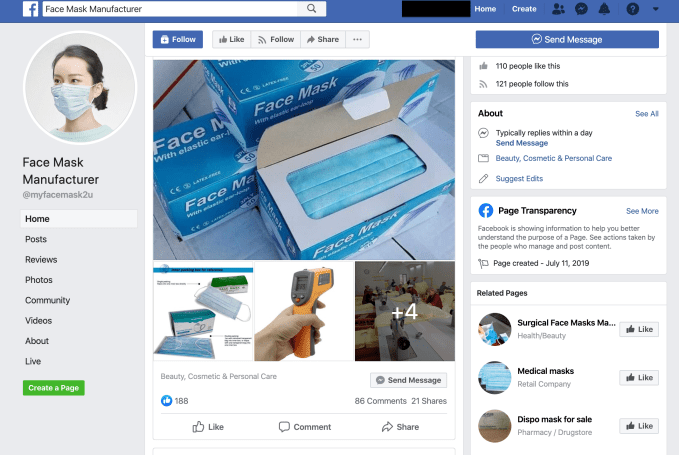
TechCrunch conducted our own searches on Facebook today and while some obvious search terms returned no results a little tweaking of keywords choice and we were quickly able to find additional pages hawking face masks — such as the below example grabbed from a Facebook page calling itself ‘Face Mask Manufacturer’.

From this page Facebook’s algorithm then recommended more pages — with names like ‘Medical Masks’ and ‘Dispo mask for sale’ — which also appeared to be selling masks.

The TTP’s review also found mask ads circulating on Facebook-owned Instagram.

“One Instagram account for @coronavsmask reads, ‘Act now before it’s too late! GET your N95 Respiratory Face Mask NOW!’ It only has a single post but already counts over 6,300 followers,” it wrote. “An account created on March 14 called @handsanitizers_and_coronamask includes over a dozen posts offering such products.”

It also found “several” Instagram accounts that sell drugs had begun to incorporate medical face masks into their offerings.

At the time of writing Facebook had not responded to our request for comment on the findings.

In further searches the group was reproduced examples of Google’s third party advertising display network serving ads for face masks alongside news stories related to the coronavirus — an issue highlighted by Sen. Mark Warner in a tweet last week when he blasted the company for “still running ads for facemasks and other coronavirus scams”.

“The Facebook mask pages were searched and collected on March 17-18 using the terms “corona mask,” “N95,” and “surgical mask” in Facebook’s search function,” a TTP spokesman told us when asked for more info about its review. “Of the more than 130 pages identified, 43 were created in the month of March, more than a dozen of those just days before TTP ran the searches.”

“We don’t have the same level of data from Instagram/Google. Instagram’s search function does not lend itself to the same search ability; it doesn’t bring up a list of accounts based on a single term like Facebook’s search function does. With Google, our goal was to show examples of Google-served ads; those were identified in news stories on March 18,” he added.

We reached out to Google for comment on the findings and a spokesman told us the company has a dedicated task force that has removed “millions” of ads in the past week alone — which he said jad already led to a sharp decrease in face mask ads. But Google said “opportunistic advertisers” had been trying to run “an unprecedented number” of these ads on its platforms.

Here’s Google’s statement:

Since January, we’ve blocked ads for products that aim to capitalise on coronavirus, including a temporary ban on face mask ads. In the past few weeks, we’ve seen opportunistic advertisers try to run an unprecedented number of these ads on our platforms. We have a dedicated task force working to combat this issue and have removed millions of ads in the past week alone. We’re monitoring the situation closely and continue to make real-time adjustments to protect our users.

Google declined to specify how many people it has working to identify and remove mask ads, saying only that the taskforce is made up of members from its product, engineering, enforcement and policy teams — and that it’s been set up with coverage across time zones.

It also said the examples highlighted by TTP are already over a week old and do not reflect the impact of its newest enforcement measures.

The company told us it’s analysing both ad content and how they’re served to enhance its takedown capacity.


source https://techcrunch.com/2020/03/26/its-still-easy-to-find-coronavirus-mask-ads-on-facebook/