Friday, 26 July 2019

Twitter Q2 beats on sales of $841M and EPS of $0.20, new metric of mDAUs up to 139M

Two days after Facebook reported growing numbers (even amid its regulatory turmoil), its social media counterpart Twitter today announced its Q2 results. The company made $841 million in overall revenues, up 18% on a year ago; with EPS and net income respectively at $1.43 and $1.1 billion, a huge bump due to a “significant income tax benefit” related to the establishment of a deferred tax asset for corporate structuring for certain geographies, Twitter said.

Without that, non-GAAP diluted EPS was $0.20 on non-GAAP adjusted net income of $156 million.

Monetizable Daily Active Users — Twitter’s new, preferred audience metric — is now at 139 million, which Twitter says is up 14% on a year ago.

The figures beat on revenues and edged out estimates for EPS: Analysts were expecting earnings per share of around $0.19 on revenues of just over $829 million for the quarter. A year ago, Twitter posted an EPS of $0.17 on sales of $710.5 million, and last quarter, the company handily beat analyst expectations on sales of $787 million and diluted EPS of $0.25.

GAAP operating income for the quarter was $76 million, down from $80 million a year ago.

The U.S. continues to be Twitter’s revenue engine, the company said. It accounted for $455 million of its sales, up 24%, while international revenue was $386 million, up just 12%. Japan continues to be Twitter’s No. 2 market, up 9% and accounting for $133 million of its overall sales.

Meanwhile, advertising continues to be the most important revenue stream for the company (one reason why mDAUs is now its preferred metric, too). It made $727 million in advertising revenues in Q2, up 21% on a year ago. Twitter noted that video ad formats “continued to show strength,” singling out its Video Website Card, In-Stream Video Ads and First View ads. Data licensing, the other component of Twitter’s business model, was $114 million, up just 4%.

One of the more notable figures in this latest report is a new metric called “monetizable daily active users,” which Twitter has introduced to replace monthly and daily active users; mDAUs is based on Twitter users who logged in or were “otherwise authenticated and accessed Twitter on any given day through twitter.com or Twitter applications that are able to show ads,” according to the company.

The advertising aspect is the key part: Twitter’s previous metrics, the more established MAU and DAU figures that other companies typically provide, did not distinguish which users were served ads, and which were not.

Twitter’s argument has been that MAUs and DAUs are not a great picture of the company’s business prospects because of that fact, and so it announced some time ago that it would stop reporting these figures, moving instead to mDAUs.

Be that as it may, it’s notable that the MAU figure had been a problematic one for Twitter: in the last quarter, the company’s MAUs were 330 million, a drop of 6 million users compared to a year ago, and people had been using the generally sluggish growth (and sometimes decline) of those numbers to underscore the contention that Twitter had a growth problem.

Moving to mDAUs is a way for Twitter to de-emphasize that view and to put a spotlight on more encouraging numbers: those that show Twitter is increasing its advertising base. Nevertheless, Twitter acknowledges that it’s not standard, and so harder to use as comparable against anything other than Twitter itself. “Our calculation of mDAU is not based on any standardized industry methodology and is not necessarily calculated in the same manner or comparable to similarly titled measures presented by other companies,” it noted in a recent letter to shareholders.

The company is still relatively young, and continues to tinker and make changes — some big, some small — to both its back end and user interface. Some have been made to address some of the larger issues that people have been (often critically) vocal about, such as coping with harassment or making the site more user-friendly for power-Tweeters, new adopters and everyone in between. Others are to continue building Twitter as a business, which means making it more advertising and media-partner friendly.

Not all the changes are always positive. There’s been a fair amount of backlash over the company’s new desktop design, which it introduced this month and features a much wider section of the page dedicated to the main news feed. I’m guessing this is in part to lay the groundwork for featuring larger media files, which should help it continue growing revenues in those areas. Indeed, this week Twitter announced a deal to stream Olympics coverage, likely helped by showing NBC that it is making efforts to make the experience a more pleasing one for Twitter users, but it’s not all about entertainment: the larger news feed will also help Twitter sell more advertising, too. It will be interesting to see how and if it proves to be a headwind in future quarters.

Updated with EPS figures based on non-GAAP diluted net income provided by Twitter in a separate note to TechCrunch (figures that it, frustratingly, didn’t publish in the actual shareholders’ letter).


source https://techcrunch.com/2019/07/26/twitter-q2-earnings/

Muzmatch adds $7M to swipe right on Muslim majority markets

Muzmatch, a matchmaking app for Muslims, has just swiped a $7 million Series A on the back of continued momentum for its community sensitive approach to soulmate searching for people of the Islamic faith.

It now has more than 1.5M users of its apps, across 210 countries, swiping, matching and chatting online as they try to find ‘the one’.

The funding, which Muzmatch says will help fuel growth in key international markets, is jointly led by US hedge fund Luxor Capital, and Silicon Valley accelerator Y Combinator — the latter having previously selected Muzmatch for its summer 2017 batch of startups. 

Last year the team also took in a $1.75M seed, led by Fabrice Grinda’s FJ Labs, YC and others.

We first covered the startup two years ago when its founders were just graduating from YC. At that time there were two of them building the business: Shahzad Younas and Ryan Brodie — a perhaps unlikely pairing in this context, given Brodie’s lack of a Muslim background. He joined after meeting Younas, who had earlier quit his job as an investment banker to launch Muzmatch. Brodie got excited by the idea and early traction for the MVP. The pair went on to ship a relaunch of the app in mid 2016 which helped snag them a place at YC.

So why did Younas and Brodie unmatch? All the remaining founder can say publicly is that its investors are buying Brodie’s stake. (While, in a note on LinkedIn — celebrating what he dubs the “bittersweet” news of Muzmatch’s Series A — Brodie writes: “Separate to this raise I decided to sell my stake in the company. This is not from a lack of faith — on the contrary — it’s simply the right time for me to move on to startup number 4 now with the capital to take big risks.”)

Asked what’s harder, finding a steady co-founder or finding a life partner, Younas responds with a laugh. “With myself and Ryan, full credit, when we first joined together we did commit to each other, I guess, a period of time of really going for it,” he ventures, reaching for the phrase “conscious uncoupling” to sum up how things went down. “We both literally put blood sweat and tears into the app, into growing what it is. And for sure without him we wouldn’t be as far as we are now, that’s definitely true.”

“For me it’s a fantastic outcome for him. I’m genuinely super happy for him. For someone of his age and at that time of his life — now he’s got the ability to start another startup and back himself, which is amazing. Not many people have that opportunity,” he adds.

Younas says he isn’t looking for another co-founder at this stage of the business. Though he notes they have just hired a CTO — “purely because there’s so much to do that I want to make sure I’ve got a few people in certain areas”.

The team has grown from just four people seven months ago to 17 now. With the Series A the plan is to further expand headcount to almost 30.

“In terms of a co-founder, I don’t think, necessarily, at this point it’s needed,” Younas tells TechCrunch. “I obviously understand this community a lot. I’ve equally grown in terms of my role in the company and understanding various parts of the company. You get this experience by doing — so now I think definitely it helps having the simplicity of a single founder and really guiding it along.”

Despite the co-founders parting ways that’s no doubting Muzmatch’s momentum. Aside from solid growth of its user base (it was reporting ~200k two years ago), its press release touts 30,000+ “successes” worldwide — which Younas says translates to people who have left the app and told it they did so because they met someone on Muzmatch.

He reckons at least half of those left in order to get married — and for a matchmaking app that is the ultimate measure of success.

“Everywhere I go I’m meeting people who have met on Muzmatch. It has been really transformative for the Muslim community where we’ve taken off — and it is amazing to see, genuinely,” he says, suggesting the real success metric is “much higher because so many people don’t tell us”.

Nor is he worried about being too successful, despite 100 people a day leaving because they met someone on the app. “For us that’s literally the best thing that can happen because we’ve grown mostly by word of mouth — people telling their friends I met someone on your app. Muslim weddings are quite big, a lot of people attend and word does spread,” he says.

Muzmatch was already profitable two years ago (and still is, for “some” months, though that’s not been a focus), which has given it leverage to focus on growing at a pace it’s comfortable with as a young startup. But the plan with the Series A cash is to accelerate growth by focusing attention internationally on Muslim majority markets vs an early focus on markets, including the UK and the US, with Muslim minority populations.

This suggests potential pitfalls lie ahead for the team to manage growth in a sustainable way — ensuring scaling usage doesn’t outstrip their ability to maintain the ‘safe space’ feel the target users need, while at the same time catering to the needs of an increasingly diverse community of Muslim singles.

“We’re going to be focusing on Muslim majority countries where we feel that they would be more receptive to technology. There’s slightly less of a taboo around finding someone online. There’s culture changes already happening, etc.,” he says, declining to name the specific markets they’ll be fixing on. “That’s definitely what we’re looking for initially. That will obviously allow us to scale in a big way going forward.

“We’ve always done [marketing] in a very data-driven way,” he adds, discussing his approach to growth. “Up til now I’ve led on that. Pretty much everything in this company I’ve self taught. So I learnt, essentially, how to build a growth engine, how to scale an optimize campaigns, digital spend, and these big guys have seen our data and they’re impressed with the progress we’ve made, and the customer acquisition costs that we’ve achieved — considering we really are targeting quite a niche market… Up til now we closed our Series A with more than half our seed round in our accounts.”

Muzmatch has also laid the groundwork for the planned international push, having already fully localized the app — which is live in 14 languages, including right to left languages like Arabic.

“We’re localized and we get a lot of organic users everywhere but obviously once you focus on a particular area — in terms of content, in terms of your brand etc — then it really does start to take off,” adds Younas.

The team’s careful catering to the needs of its target community — via things like manual moderation of every profile and offering an optional chaperoning feature for in-app chats — i.e. rather than just ripping out a ‘Tinder for Muslims’ clone, can surely take some credit for helping to grow the market for Muslim matchmaking apps overall.

“Shahzad has clearly made something that people want. He is a resourceful founder who has been listening to his users and in the process has developed an invaluable service for the Muslim community, in a way that mainstream companies have failed to do,” says YC partner Tim Brady in a supporting statement. 

But the flip side of attracting attention and spotlighting a commercial opportunity means Muzmatch now faces increased competition — such as from the likes of Dubai-based Veil: A rival matchmaking app which has recently turned heads with a ‘digital veil’ feature that applies an opaque filter to all profile photos, male and female, until a mutual match is made.

Muzmatch also lets users hide their photos, if they choose. But it has resisted imposing a one-size-fits-all template on the user experience — exactly in order that it can appeal more broadly, regardless of the user’s level of religious adherence (it has even attracted non-Muslim users with a genuine interest in meeting a life partner).

Younas says he’s not worried about fresh faces entering the same matchmaking app space — couching it as a validation of the market.

He’s also dismissive of gimmicky startups that can often pass through the dating space, usually on a fast burn to nowhere. Though he is expecting more competition from major players, such as Tinder-owner Match, which he notes has been eyeing up some of the same geographical markets.

“We know there’s going to be attention in this area,” he says. “Our goal is to basically continue to be the dominant player but for us to race ahead in terms of the quality of our product offering and obviously our size. That’s the goal. Having this investment definitely gives us that ammo to really go for it. But by the same token I’d never want us to be that silly startup that just burns a tonne of money and ends up nowhere.”

“It’s a very complex population, it’s very diverse in terms of culture, in terms of tradition,” he adds of the target market. “We so far have successfully been able to navigate that — of creating a product that does, to the user, marries technology with respecting the faith.”

Feature development is now front of mind for Muzmatch as it moves into the next phase of growth, and as — Younas hopes — it has more time to focus on finessing what its product offers, having bagged investment by proving product market fit and showing traction.

“The first thing that we’re going to be doing is an actual refreshing of our brand,” he says. “A bit of a rebrand, keeping the same name, a bit of a refresh of our brand, tidying that up. Actually refreshing the app, top to bottom. Part of that is looking at changes that have happened in the — call it — ‘dating space’. Because what we’ve always tried to do is look at the good that’s happening, get rid of the bad stuff, and try and package it and make it applicable to a Muslim audience.

“I think that’s what we’ve done really well. And I always wanted to innovate on that — so we’ve got a bunch of ideas around a complete refresh of the app.”

Video is one area they’re experimenting with for future features. TechCrunch’s interview with Younas takes place via a video chat using what looks to be its own videoconferencing platform, though there’s not currently a feature in Muzmatch that lets users chat remotely via video.

Its challenge on this front will be implementing richer comms features in a way that a diverse community of religious users can accept.

“I want to — and we have this firmly on our roadmap, and I hope that it’s within six months — be introducing or bringing ways to connect people on our platform that they’ve never been able to do before. That’s going to be key. Elements of video is going to be really interesting,” says Younas teasing their thinking around video.

“The key for us is how do we do [videochat] in a way that is sensible and equally gives both sides control. That’s the key.”

Nor will it just be “simple video”. He says they’re also looking at how they can use profile data more creatively, especially for helping more private users connect around shared personality traits.

“There’s a lot of things we want to do within the app of really showing the richness of our profiles. One thing that we have that other apps don’t have are profiles that are really rich. So we have about 22 different data points on the profile. There’s a lot that people do and want to share. So the goal for us is how do we really try and show that off?

“We have a segment of profiles where the photos are private, right, people want that anonymity… so the goal for us is then saying how can we really show your personality, what you’re about in a really good way. And right now I would argue we don’t quite do it well enough. We’ve got a tonne of ideas and part of the rebrand and the refresh will be really emphasizing and helping that segment of society who do want to be private but equally want people to understand what they’re about.”

Where does he want the business to be in 12 months’ time? With a more polished product and “a lot of key features in the way of connecting the community around marriage — or just community in general”.

In terms of growth the aim is at least 4x where they are now.

“These are ambitious targets. Especially given the amount that we want to re-engineer and rebuild but now is the time,” he adds. “Now we have the fortune of having a big team, of having the investment. And really focusing and finessing our product… Really give it a lot of love and really give it a lot of the things we’ve always wanted to do and never quite had the time to do. That’s the key.

“I’m personally super excited about some of the stuff coming up because it’s a big enabler — growing the team and having the ability to really execute on this a lot faster.”


source https://techcrunch.com/2019/07/26/muzmatch-adds-7m-to-swipe-right-on-muslim-majority-markets/

Thursday, 25 July 2019

Facebook ignored staff warnings about ‘sketchy’ Cambridge Analytica in September 2015

Facebook employees tried to alert the company about the activity of Cambridge Analytica as early as September 2015, per the SEC’s complaint against the company which was published yesterday.

This chimes with a court filing that emerged earlier this year — which also suggested Facebook knew of concerns about the controversial data company earlier than it had publicly said, including in repeat testimony to a UK parliamentary committee last year.

Facebook only finally kicked the controversial data firm off its ad platform in March 2018 when investigative journalists had blown the lid off the story.

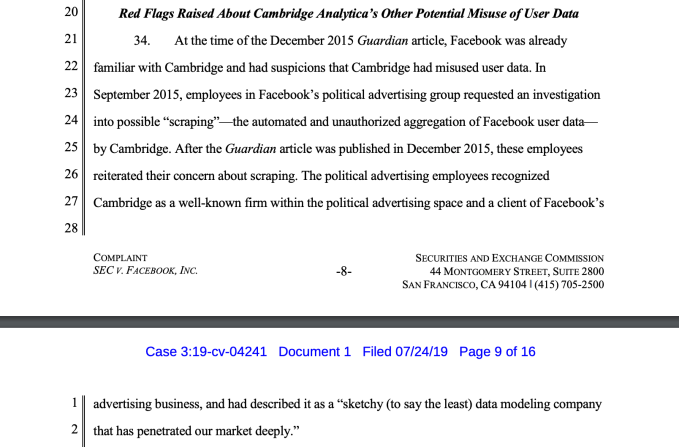
In a section of the SEC complaint on “red flags” raised about the scandal-hit company Cambridge Analytica’s potential misuse of Facebook user data, the SEC complaint reveals that it already knew of concerns raised by staffers in its political advertising unit — who described CA as a “sketchy (to say the least) data modeling company that has penetrated our market deeply”.

Screenshot 2019 07 25 at 11.43.17

Amid a flurry of major headlines for the company yesterday, including a $5BN FTC fine — all of which was selectively dumped on the same day media attention was focused on Mueller’s testimony before Congress — Facebook quietly disclosed it had also agreed to pay $100M to the SEC to settle a complaint over failures to properly disclose data abuse risks to its investors.

This tidbit was slipped out towards the end of a lengthy blog post by Facebook general counsel Colin Stretch which focused on responding to the FTC order with promises to turn over a new leaf on privacy.

CEO Mark Zuckerberg also made no mention of the SEC settlement in his own Facebook note about what he dubbed a “historic fine”.

As my TC colleague Devin Coldewey wrote yesterday, the FTC settlement amounts to a ‘get out of jail’ card for the company’s senior execs by granting them blanket immunity from known and unknown past data crimes.

‘Historic fine’ is therefore quite the spin to put on being rich enough and powerful enough to own the rule of law.

And by nesting its disclosure of the SEC settlement inside effusive privacy-washing discussion of the FTC’s “historic” action, Facebook looks to be hoping to detract attention from some really awkward details in its narrative about the Cambridge Analytica scandal which highlight ongoing inconsistencies and contradictions to put it politely.

The SEC complaint underlines that Facebook staff were aware of the dubious activity of Cambridge Analytica on its platform prior to the December 2015 Guardian story — which CEO Mark Zuckerberg has repeatedly claimed was when he personally became aware of the problem.

Asked about the details in the SEC document, a Facebook spokesman pointed us to comments it made earlier this year when court filings emerged that also suggested staff knew in September 2015. In this statement, from March, it says “employees heard speculation that Cambridge Analytica was scraping data, something that is unfortunately common for any internet service”, and further claims it was “not aware of the transfer of data from Kogan/GSR to Cambridge Analytica until December 2015”, adding: “When Facebook learned about Kogan’s breach of Facebook’s data use policies, we took action.”

Facebook staffers were also aware of concerns about Cambridge Analytica’s “sketchy” business when, around November 2015, Facebook employed psychology researcher Joseph Chancellor — aka the co-founder of app developer GSR — which, as Facebook has sought to pain it, is the ‘rogue’ developer that breached its platform policies by selling Facebook user data to Cambridge Analytica.

This means Facebook employed a man who had breached its own platform policies by selling user data to a data company which Facebook’s own staff had urged, months prior, be investigated for policy-violating scraping of Facebook data, per the SEC complaint.

Fast forward to March 2018 and press reports revealing the scale and intent of the Cambridge Analytica data heist blew up into a global data scandal for Facebook, wiping billions off its share price.

The really awkward question that Facebook has continued not to answer — and which every lawmaker, journalist and investor should therefore be putting to the company at every available opportunity — is why it employed GSR co-founder Chancellor in the first place?

Chancellor has never been made available by Facebook to the media for questions. He also quietly left Facebook last fall — we must assume with a generous exit package in exchange for his continued silence. (Assume because neither Facebook nor Chancellor have explained how he came to be hired.)

At the time of his departure, Facebook also made no comment on the reasons for Chancellor leaving — beyond confirming he had left.

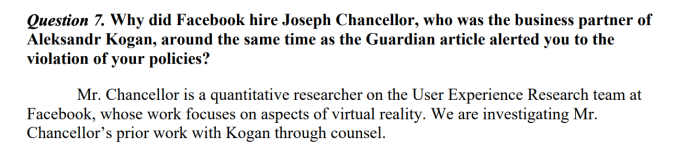
Facebook has never given a straight answer on why it hired Chancellor. See, for example, its written response to a Senate Commerce Committee’s question — which is pure, textbook misdirection, responding with irrelevant details that do not explain how Facebook came to identify him for a role at the company in the first place (“Mr. Chancellor is a quantitative researcher on the User Experience Research team at Facebook, whose work focuses on aspects of virtual reality. We are investigating Mr. Chancellor’s prior work with Kogan through counsel”).

Screenshot 2019 07 25 at 12.02.10

What was the outcome of Facebook’s internal investigation of Chancellor’s prior work? We don’t know because again Facebook isn’t saying anything.

More importantly, the company has continued to stonewall on why it hired someone intimately linked to a massive political data scandal that’s now just landed it an “historic fine”.

We asked Facebook to explain why it hired Chancellor — given what the SEC complaint shows it knew of Cambridge Analytica’s “sketchy” dealings — and got the same non-answer in response: “Mr Chancellor was a quantitative researcher on the User Experience Research team at Facebook, whose work focused on aspects of virtual reality. He is no longer employed by Facebook.”

We’ve asked Facebook to clarify why Chancellor was hired despite internal staff concerns linked to the company his company was set up to sell Facebook data to; and how of all possible professionals it could hire Facebook identified Chancellor in the first place — and will update this post with any response. (A search for ‘quantitative researcher’ on LinkedIn’s platform returns more than 177,000 results of professional who are using the descriptor in their profiles.)

Earlier this month a UK parliamentary committee accused the company of contradicting itself in separate testimonies on both sides of the Atlantic over knowledge of improper data access by third-party apps.

The committee grilled multiple Facebook and Cambridge Analytica employees (and/or former employees) last year as part of a wide-ranging enquiry into online disinformation and the use of social media data for political campaigning — calling in its final report for Facebook to face privacy and antitrust probes.

A spokeswoman for the DCMS committee told us it will be writing to Facebook next week to ask for further clarification of testimonies given last year in light of the timeline contained in the SEC complaint.

Under questioning in Congress last year, Facebook founder Zuckerberg also personally told congressman Mike Doyle that Facebook had first learned about Cambridge Analytica using Facebook data as a result of the December 2015 Guardian article.

Yet, as the SEC complaint underlines, Facebook staff had raised concerns months earlier. So, er, awkward.

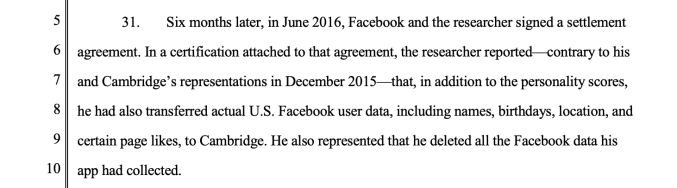
There are more awkward details in the SEC complaint that Facebook seems keen to bury too — including that as part of a signed settlement agreement, GSR’s other co-founder Aleksandr Kogan told it in June 2016 that he had, in addition to transferring modelled personality profile data on 30M Facebook users to Cambridge Analytica, sold the latter “a substantial quantity of the underlying Facebook data” on the same set of individuals he’d profiled.

This US Facebook user data included personal information such as names, location, birthdays, gender and a sub-set of page likes.

Raw Facebook data being grabbed and sold does add some rather colorful shading around the standard Facebook line — i.e. that its business is nothing to do with selling user data. Colorful because while Facebook itself might not sell user data — it just rents access to your data and thereby sells your attention — the company has built a platform that others have repurposed as a marketplace for exactly that, and done so right under its nose…

Screenshot 2019 07 25 at 12.40.29

The SEC complaint also reveals that more than 30 Facebook employees across different corporate groups learned of Kogan’s platform policy violations — including senior managers in its comms, legal, ops, policy and privacy divisions.

The UK’s data watchdog previously identified three senior managers at Facebook who it said were involved in email exchanges prior to December 2015 regarding the GSR/Cambridge Analytica breach of Facebook users data, though it has not made public the names of the staff in question.

The SEC complaint suggests a far larger number of Facebook staffers knew of concerns about Cambridge Analytica earlier than the company narrative has implied up to now. Although the exact timeline of when all the staffers knew is not clear from the document — with the discussed period being September 2015 to April 2017.

Despite 30+ Facebook employees being aware of GSR’s policy violation and misuse of Facebook data — by April 2017 at the latest — the company leaders had put no reporting structures in place for them to be able to pass the information to regulators.

“Facebook had no specific policies or procedures in place to assess or analyze this information for the purposes of making accurate disclosures in Facebook’s periodic filings,” the SEC notes.

The complaint goes on to document various additional “red flags” it says were raised to Facebook throughout 2016 suggesting Cambridge Analytica was misusing user data — including various press reports on the company’s use of personality profiles to target ads; and staff in Facebook’s own political ads unit being aware that the company was naming Facebook and Instagram ad audiences by personality trait to certain clients, including advocacy groups, a commercial enterprise and a political action committee.

“Despite Facebook’s suspicions about Cambridge and the red flags raised after the Guardian article, Facebook did not consider how this information should have informed the risk disclosures in its periodic filings about the possible misuse of user data,” the SEC adds.


source https://techcrunch.com/2019/07/25/facebook-ignored-staff-warnings-about-sketchy-cambridge-analytica-in-september-2015/

The Definitive Guide to Mobile Deep Linking

mobile

The average consumer is spending five hours per day on their smartphones and this number is only going up.

We do everything on our phones these days, from shopping to browsing social media and managing our businesses.

This is why it’s more important than ever to optimize the user experience to keep people on your app for longer periods, enjoying it more, and sharing it with friends.

If you’re trying to optimize your mobile app, I’m sure you’ve already tinkered with the layout, fonts, copy, and more, but there’s one thing you probably haven’t…

Mobile deep linking.

It’s a small detail that can drastically enhance how users engage with your app but few are taking advantage of it.

That’s why I’m going to be teaching you what mobile deep linking is, why you need it, and how you can implement it yourself.

Let’s dive in.

What is mobile deep linking, anyways?

Mobile deep linking is the practice of funneling users deeper into your app through the use of a uniform resource identifier or URI for short.

This allows mobile app developers to push to a specific page within an application versus simply opening it.

Think of it as a website URL.

If you were trying to sell a product, would you want users landing on the homepage or being forwarded to a sales page found deeper in the website?

The latter, of course.

By helping users go to a certain page within an app, you’re making the customer journey easier by getting them closer to the end goal sooner.

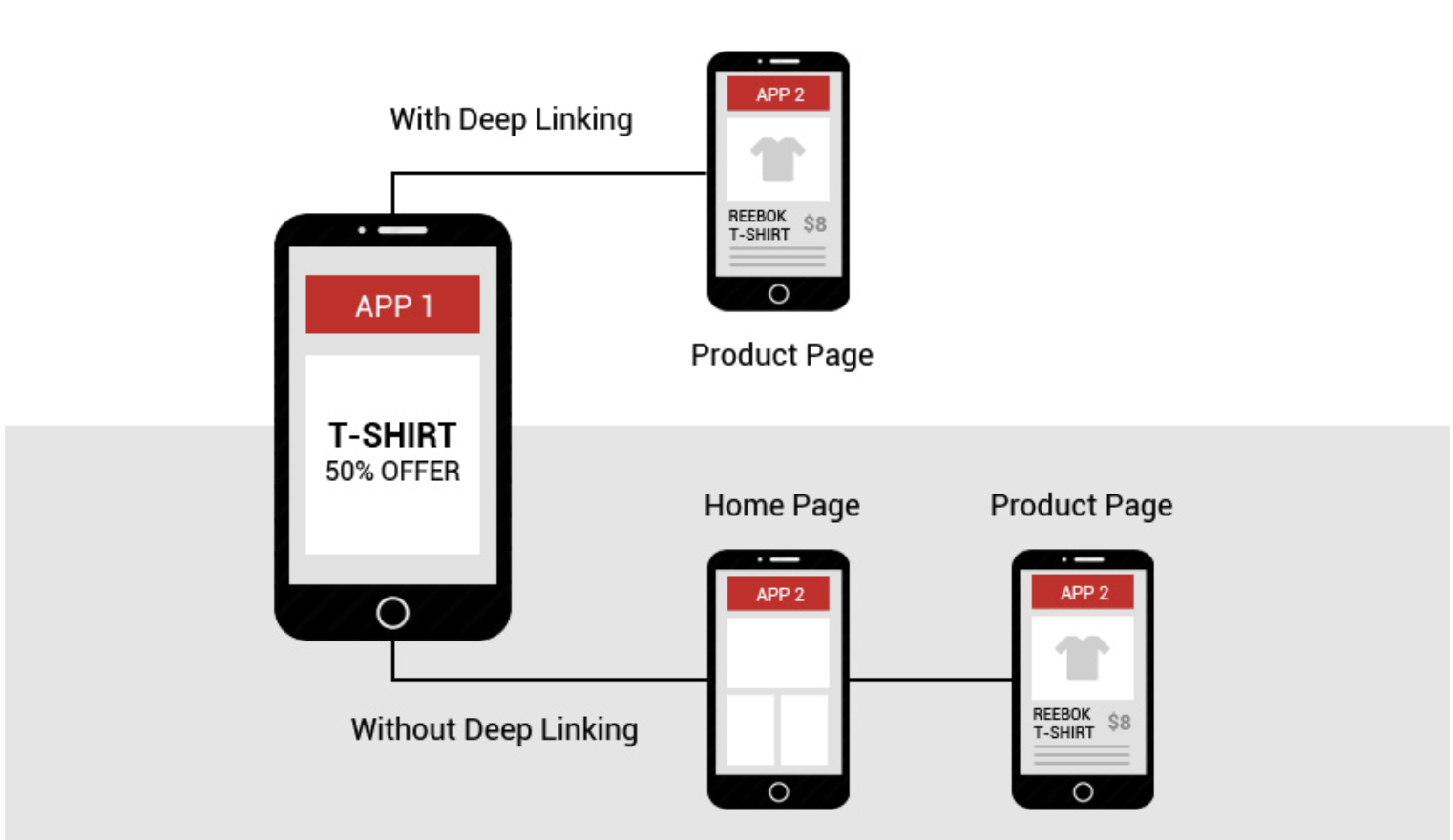
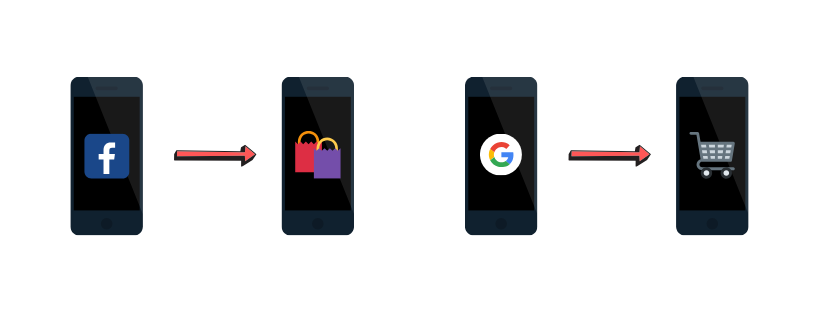
Here’s a visual of what the process looks like:

While it might seem simple, mobile linking comes in three different forms that you need to be aware of. They include the following:

Standard deep linking

This is the straightforward deep linking that forwards a user to a specific part of the app. It’s also known as universal linking.

It only works if the customer already has the app installed.

The problem is within traditional linking is that when a user clicks a link, it won’t open the mobile app, but rather directs them to the browser version.

If someone is on a mobile device, the app version will always be more optimized and streamlined.

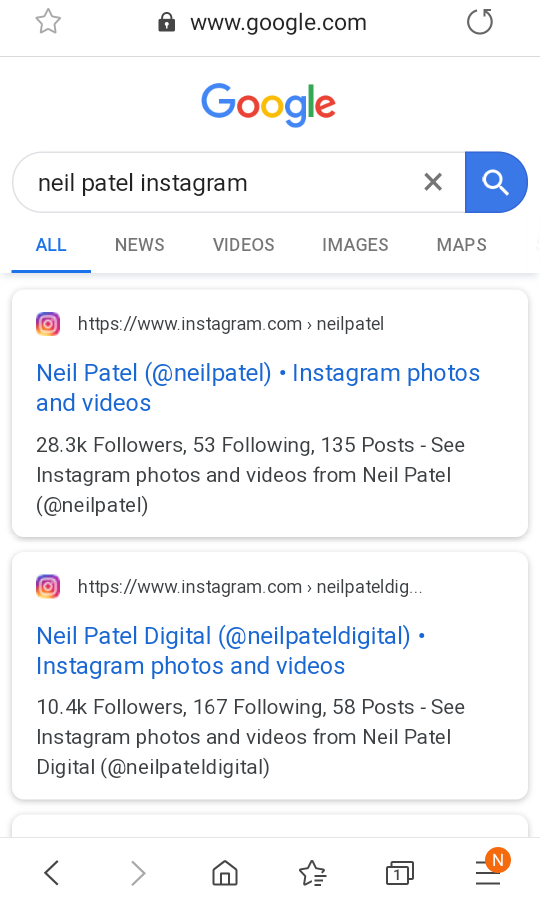
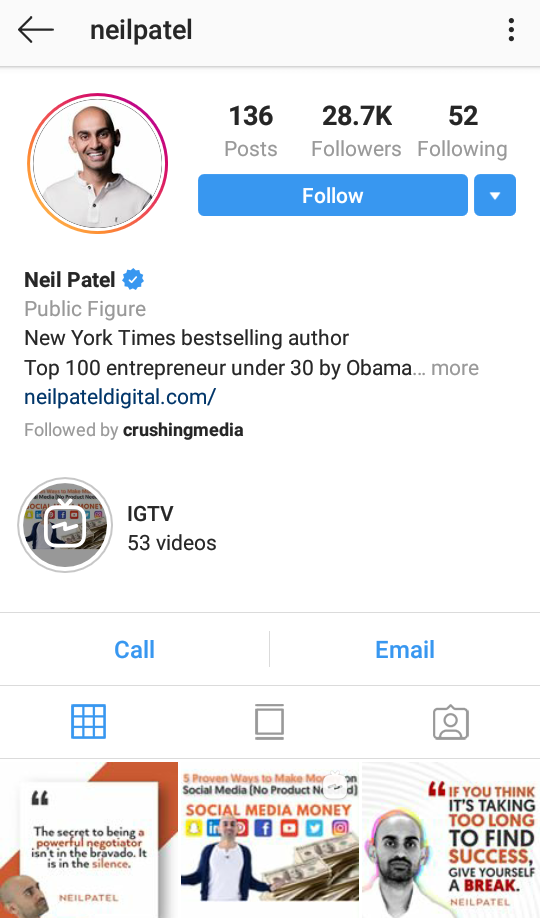
Here’s what happens if you search for my Instagram on Google for example with the app installed.

The results appear to be the exact same whether you have the Instagram app or not, but clicking it opens up the app seamlessly.

This is a good example of basic deep linking. 

Someone that doesn’t have the Instagram mobile application installed will be given an error or redirected to a fallback page.

Deferred deep linking

This form of deep linking works the same way as standard linking does with the exception that it will direct users without the app to the download location.

This is beneficial because it can help app developers and companies acquire more customers.

Once the app is installed, the user will be referred to where they were originally navigating.

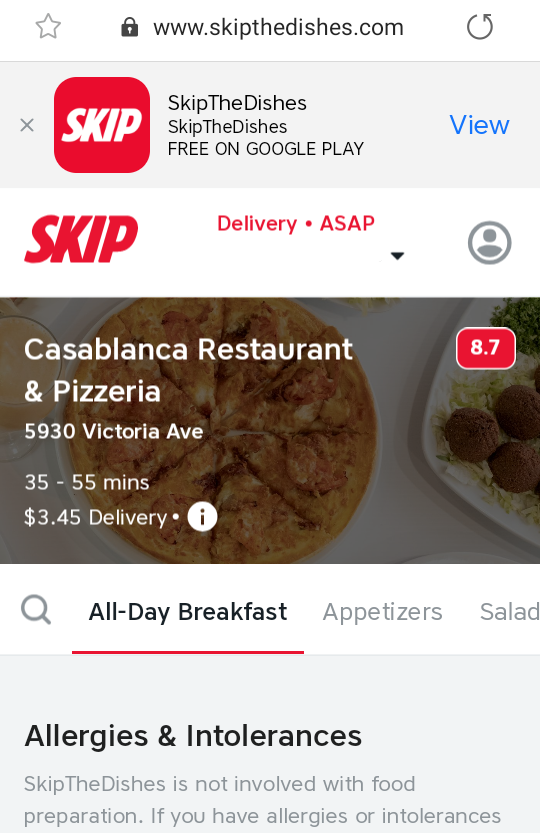
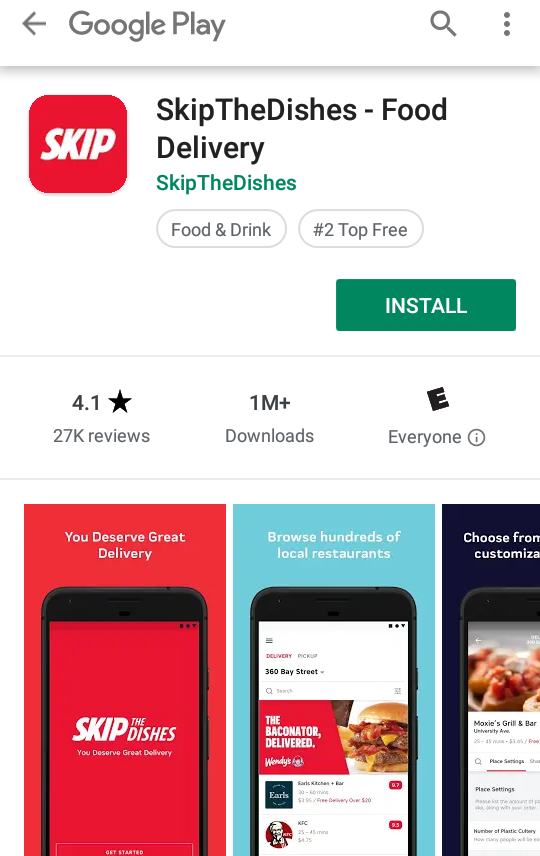
Check out the Skip The Dishes app to see what I mean.

While a user is creating their order, they are able to download the mobile app for Android or iOS.

They are forwarded back to the exact step they were taking, except in the mobile app after downloading it.

This means that they don’t have to manually go through the entire process again to get back to where they were.

Contextual deep linking

Contextual deep linking, also known as onboarding, is commonly used for gathering information on customers to personalize the user experience of an app.

Data such demographics, how users navigate to the app, and more is recorded.

The app onboarding process can be different depending on if the user installed via the Google Play Store, the Apple Store, a Facebook campaign, or another source.

A mobile app downloaded through a Facebook Ad might look different than when it’s downloaded through a Google Display Ad, for example.

The landing page is able to be customized through what is known as a deep view in mobile app development.

Just as the deep link forwards users to a specific deeper page in the application, the deep view is the visual result they see that’s different than others.

URI schemes

Deep linking is only doable thanks to what is known as URI schemes. These schemes are similar to how a website URL can direct you to a specific page on a website.

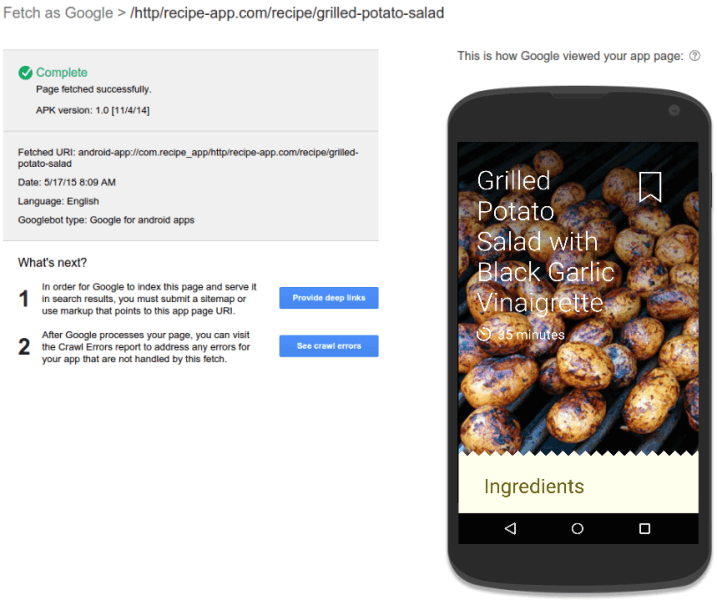
They look something like this:

See the fetched URI? Its format is appname://path/to/location.

Custom URIs are simple to set up for developers (Often created by default) and present the opportunity to redirect users wherever you please.

The mobile customer journey and how it applies to deep linking

The mobile buyer’s journey is the individual’s steps a user takes to find, use, and share your application.

It’s similar to the regular funnel a customer goes through when purchasing a product with some small differences you need to be aware of.

Here’s how the various steps in the mobile buyer’s journey can be applied to mobile deep linking.

Discovery

The first step in the mobile customer journey is discovering your app in the first place.

While this can be achieved through strategies like content marketing and SEO, deep linking gives you a nice boost to these tactics.

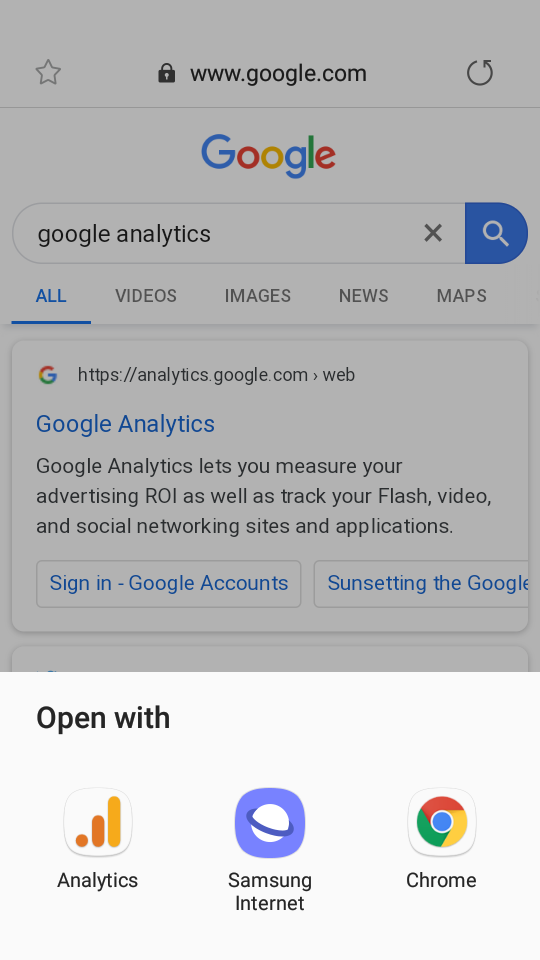
Google indexes deep links from mobile apps, giving you more opportunities to rank and drive organic traffic.

Users can click the search engine listing and open the link directly through the app instead of an internet browser.

Look at this search for Google Analytics to see what I mean:

This helps businesses acquire more users and increase brand awareness versus having a single search engine listing.

Check out my video on skyrocketing mobile app organic traffic, and pair it with deep linking for mind-blowing results.

Compare

Once a user has narrowed down a few options, they’re naturally going to want to find the best app by comparing them.

They’ll look at factors such as pricing, ease of use, and features. 

Deep linking enables you to push users to the best features of your app, reviews, or customize the experience to make your application better than competitors.

By reducing the number of steps it takes to get to important functions of the app, you’re also decreasing the chance of users bouncing.

Decision

The third step in the mobile buyer’s journey is making a decision and commitment to a single app.

Having a clear value proposition and refined user experience is crucial here. 

Better yet, contextual deep linking helps you collect data to make the application as tailored as possible to your buyer’s persona. 

Marketing campaigns can also be optimized with this information to improve targeting and performance.

Retain

Once you begin acquiring more users, you need to keep them.

Standard and deferred deep linking will help navigate users back to your app when they are on search engines, social media, and other platforms. 

This keeps them using your app more often.

Data that can be collected as a result of deep links will assist you in understanding why and how they use your mobile application.

Doubling down on these is what we call Pareto’s Principle or the 80/20 rule.

This rule can be seen everywhere and defines that 80% of results come from 20% of actions.

In the case of mobile app development, you might discover that users are only engaging with a few features and others are taking up space.

You could hypothetically update the features and pages that are used the most, boosting engagement and retention.

Businesses will miss out on discovers like this if they don’t use deep links to collect information.

Why mobile deep linking matters

I know what you’re thinking.

“Why should I bother with mobile deep linking?”

Let me explain.

It improves the user experience

If you can save the user from going through multiple steps instead of one, why wouldn’t you?

That’s exactly what deep linking does, and improves UX because of it.

You’re making the life of users easier by using deep linking to get them where they want to go faster.

This gives them a better experience and impression with your app as a result.

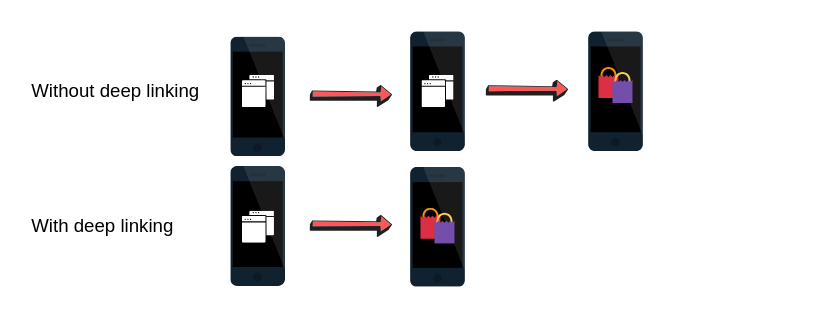
Here’s what the difference between not using mobile deep linking and taking advantage of it looks like:

Much simpler, right?

This brings me to my next point.

It increases customer retention and engagement

Wouldn’t it be nice if every user that downloaded your app stay active all year round?

Unfortunately, that’s not how it works.

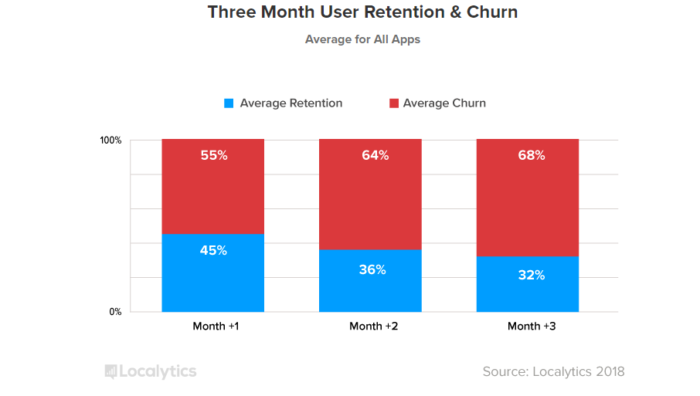
It’s been found that 55% of users will churn after the first month of use. That means nearly half of the new downloads will be lost.

Look at mobile app user retention the same way you approach a website.

It’s common for nearly half of all visitors to leave a website and not take any action.

Do you just sit there and do nothing about it? Of course not!

You implement strategies like email options through popups and exclusive content to capture those users before they leave.

This is precisely what deep linking can be used for but in the sense for a mobile app.

Once a user has visited your app, you can retarget them and use a different style of deep linking to improve their experience.

It improves the onboarding of new users

When a mobile app uses a form of deep linking like the deferred approach, you are capable of acquiring more users.

This is because as a user goes through the mobile browser version of your application, they will be given the option or automatically forwarded to the appropriate download location.

The contextual linking technique can be used to onboard new users in different ways depending on where they originally download the app from.

If you understand that users coming from a Facebook ad campaign regularly navigate to a certain product category, you can push them there automatically.

Furthermore, perhaps users from Google like to learn more about your business first before purchasing.

https://neilpatel.com/blog/mobile-deep-linking/

Facebook ignored staff warnings about “sketchy” Cambridge Analytica in September 2015

Facebook employees tried to alert the company about the activity of Cambridge Analytica as early as September 2015, per the SEC’s complaint against the company which was published yesterday.

This chimes with a court filing that emerged earlier this year — which also suggested Facebook knew of concerns about the controversial data company earlier than it had publicly said, including in repeat testimony to a UK parliamentary committee last year.

Facebook only finally kicked the controversial data firm off its ad platform in March 2018 when investigative journalists had blown the lid off the story.

In a section of the SEC complaint on “red flags” raised about the scandal-hit company Cambridge Analytica’s potential misuse of Facebook user data, the SEC complaint reveals that it already knew of concerns raised by staffers in its political advertising unit — who described CA as a “sketchy (to say the least) data modeling company that has penetrated our market deeply”.

Screenshot 2019 07 25 at 11.43.17

Amid a flurry of major headlines for the company yesterday, including a $5BN FTC fine — all of which was selectively dumped on the same day media attention was focused on Mueller’s testimony before Congress — Facebook quietly disclosed it had also agreed to pay $100M to the SEC to settle a complaint over failures to properly disclose data abuse risks to its investors.

This tidbit was slipped out towards the end of a lengthy blog post by Facebook general counsel Colin Stretch which focused on responding to the FTC order with promises to turn over a new leaf on privacy.

CEO Mark Zuckerberg also made no mention of the SEC settlement in his own Facebook note about what he dubbed a “historic fine”.

As my TC colleague Devin Coldewey wrote yesterday, the FTC settlement amounts to a ‘get out of jail’ card for the company’s senior execs by granting them blanket immunity from known and unknown past data crimes.

‘Historic fine’ is therefore quite the spin to put on being rich enough and powerful enough to own the rule of law.

And by nesting its disclosure of the SEC settlement inside effusive privacy-washing discussion of the FTC’s “historic” action, Facebook looks to be hoping to detract attention from some really awkward details in its narrative about the Cambridge Analytica scandal which highlight ongoing inconsistencies and contradictions to put it politely.

The SEC complaint underlines that Facebook staff were aware of the dubious activity of Cambridge Analytica on its platform prior to the December 2015 Guardian story — which CEO Mark Zuckerberg has repeatedly claimed was when he personally became aware of the problem.

Asked about the details in the SEC document, a Facebook spokesman pointed us to comments it made earlier this year when court filings emerged that also suggested staff knew in September 2015. In this statement, from March, it says “employees heard speculation that Cambridge Analytica was scraping data, something that is unfortunately common for any internet service”, and further claims it was “not aware of the transfer of data from Kogan/GSR to Cambridge Analytica until December 2015”, adding: “When Facebook learned about Kogan’s breach of Facebook’s data use policies, we took action.”

Facebook staffers were also aware of concerns about Cambridge Analytica’s “sketchy” business when, around November 2015, Facebook employed psychology researcher Joseph Chancellor — aka the co-founder of app developer GSR — which, as Facebook has sought to pain it, is the ‘rogue’ developer that breached its platform policies by selling Facebook user data to Cambridge Analytica.

This means Facebook employed a man who had breached its own platform policies by selling user data to a data company which Facebook’s own staff had urged, months prior, be investigated for policy-violating scraping of Facebook data, per the SEC complaint.

Fast forward to March 2018 and press reports revealing the scale and intent of the Cambridge Analytica data heist blew up into a global data scandal for Facebook, wiping billions off its share price.

The really awkward question that Facebook has continued not to answer — and which every lawmaker, journalist and investor should therefore be putting to the company at every available opportunity — is why it employed GSR co-founder Chancellor in the first place?

Chancellor has never been made available by Facebook to the media for questions. He also quietly left Facebook last fall — we must assume with a generous exit package in exchange for his continued silence. (Assume because neither Facebook nor Chancellor have explained how he came to be hired.)

At the time of his departure, Facebook also made no comment on the reasons for Chancellor leaving — beyond confirming he had left.

Facebook has never given a straight answer on why it hired Chancellor. See, for example, its written response to a Senate Commerce Committee’s question — which is pure, textbook misdirection, responding with irrelevant details that do not explain how Facebook came to identify him for a role at the company in the first place (“Mr. Chancellor is a quantitative researcher on the User Experience Research team at Facebook, whose work focuses on aspects of virtual reality. We are investigating Mr. Chancellor’s prior work with Kogan through counsel”).

Screenshot 2019 07 25 at 12.02.10

What was the outcome of Facebook’s internal investigation of Chancellor’s prior work? We don’t know because again Facebook isn’t saying anything.

More importantly, the company has continued to stonewall on why it hired someone intimately linked to a massive political data scandal that’s now just landed it an “historic fine”.

We asked Facebook to explain why it hired Chancellor — given what the SEC complaint shows it knew of Cambridge Analytica’s “sketchy” dealings — and got the same non-answer in response: “Mr Chancellor was a quantitative researcher on the User Experience Research team at Facebook, whose work focused on aspects of virtual reality. He is no longer employed by Facebook.”

We’ve asked Facebook to clarify why Chancellor was hired despite internal staff concerns linked to the company his company was set up to sell Facebook data to; and how of all possible professionals it could hire Facebook identified Chancellor in the first place — and will update this post with any response. (A search for ‘quantitative researcher’ on LinkedIn’s platform returns more than 177,000 results of professional who are using the descriptor in their profiles.)

Earlier this month a UK parliamentary committee accused the company of contradicting itself in separate testimonies on both sides of the Atlantic over knowledge of improper data access by third-party apps.

The committee grilled multiple Facebook and Cambridge Analytica employees (and/or former employees) last year as part of a wide-ranging enquiry into online disinformation and the use of social media data for political campaigning — calling in its final report for Facebook to face privacy and antitrust probes.

A spokeswoman for the DCMS committee told us it will be writing to Facebook next week to ask for further clarification of testimonies given last year in light of the timeline contained in the SEC complaint.

Under questioning in Congress last year, Facebook founder Zuckerberg also personally told congressman Mike Doyle that Facebook had first learned about Cambridge Analytica using Facebook data as a result of the December 2015 Guardian article.

Yet, as the SEC complaint underlines, Facebook staff had raised concerns months earlier. So, er, awkward.

There are more awkward details in the SEC complaint that Facebook seems keen to bury too — including that as part of a signed settlement agreement, GSR’s other co-founder Aleksandr Kogan told it in June 2016 that he had, in addition to transferring modelled personality profile data on 30M Facebook users to Cambridge Analytica, sold the latter “a substantial quantity of the underlying Facebook data” on the same set of individuals he’d profiled.

This US Facebook user data included personal information such as names, location, birthdays, gender and a sub-set of page likes.

Raw Facebook data being grabbed and sold does add some rather colorful shading around the standard Facebook line — i.e. that its business is nothing to do with selling user data. Colorful because while Facebook itself might not sell user data — it just rents access to your data and thereby sells your attention — the company has built a platform that others have repurposed as a marketplace for exactly that, and done so right under its nose…

Screenshot 2019 07 25 at 12.40.29

The SEC complaint also reveals that more than 30 Facebook employees across different corporate groups learned of Kogan’s platform policy violations — including senior managers in its comms, legal, ops, policy and privacy divisions.

The UK’s data watchdog previously identified three senior managers at Facebook who it said were involved in email exchanges prior to December 2015 regarding the GSR/Cambridge Analytica breach of Facebook users data, though it has not made public the names of the staff in question.

The SEC complaint suggests a far larger number of Facebook staffers knew of concerns about Cambridge Analytica earlier than the company narrative has implied up to now. Although the exact timeline of when all the staffers knew is not clear from the document — with the discussed period being September 2015 to April 2017.

Despite 30+ Facebook employees being aware of GSR’s policy violation and misuse of Facebook data — by April 2017 at the latest — the company leaders had put no reporting structures in place for them to be able to pass the information to regulators.

“Facebook had no specific policies or procedures in place to assess or analyze this information for the purposes of making accurate disclosures in Facebook’s periodic filings,” the SEC notes.

The complaint goes on to document various additional “red flags” it says were raised to Facebook throughout 2016 suggesting Cambridge Analytica was misusing user data — including various press reports on the company’s use of personality profiles to target ads; and staff in Facebook’s own political ads unit being aware that the company was naming Facebook and Instagram ad audiences by personality trait to certain clients, including advocacy groups, a commercial enterprise and a political action committee.

“Despite Facebook’s suspicions about Cambridge and the red flags raised after the Guardian article, Facebook did not consider how this information should have informed the risk disclosures in its periodic filings about the possible misuse of user data,” the SEC adds.


source https://techcrunch.com/2019/07/25/facebook-ignored-staff-warnings-about-sketchy-cambridge-analytica-in-september-2015/

Wednesday, 24 July 2019

Facebook says it’s under antitrust investigation by the FTC

Facebook’s investors were not fazed by the announcement of a $5 billion FTC fine after baking it into share price expectations, but Facebook’s admission that it was now under investigation by the FTC over antitrust issues was a surprise.

Facebook detailed in its Q2 earnings release that it has paid the record fine and agreed to certain privacy stipulations, but a short sentence in the release also detailed that the company’s FTC troubles may continue.

“The online technology industry and our company have received increased regulatory scrutiny in the past quarter,” the release read. “In June 2019, we were informed by the FTC that it had opened an antitrust investigation of our company. In addition, in July 2019, the Department of Justice announced that it will begin an antitrust review of market-leading online platforms.”

Just yesterday, the U.S. Department of Justice announced that its antitrust division had opened an investigation into the country’s big tech companies.

We’ll have more details from the company’s earnings call starting shortly.


source https://techcrunch.com/2019/07/24/facebook-says-its-under-antitrust-investigation-by-the-ftc/

Following record FTC fine, Facebook stock pops on Q2 earnings beat

Hours after receiving a record $5 billion FTC fine on privacy violations, Facebook delivered a Q2 earnings beat with revenue of $16.9 billion with $1.99 adjusted EPS compared to the Zacks Consensus Estimate of $1.90 EPS on revenue of $16.45 billion.

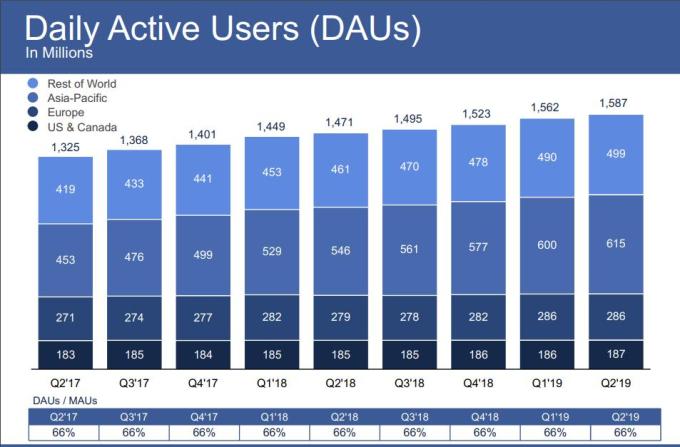
Facebook reported it has 1.59 billion DAUs and 2.1 billion daily active users of its family of apps. The U.S. & Canada and Asia-Pacific contingents continued to see nearly flat growth while the company saw quicker growth in its European and “Rest of World” sectors.

EARTU4AAffxT

The company’s stock was up around 3% in after-hours trading.

Facebook detailed that it will be paying a $5 billion FTC fine and submitting to certain stipulations, as was confirmed this morning, but for those hoping this agreement signaled the end of Facebook’s FTC troubles, the earnings report detailed that may not be the case. The release disclosed that last month the FTC opened an antitrust investigation of Facebook; this news follows reports of a DOJ investigation into the company — among others — as well.

“The online technology industry and our company have received increased regulatory scrutiny in the past quarter,” the earnings release reads. “In June 2019, we were informed by the FTC that it had opened an antitrust investigation of our company. In addition, in July 2019, the Department of Justice announced that it will begin an antitrust review of market-leading online platforms.”


source https://techcrunch.com/2019/07/24/following-record-ftc-fine-facebook-stock-pops-on-q2-earnings-beat/