Thursday, 27 September 2018

Yes Facebook is using your 2FA phone number to target you with ads

Facebook has confirmed it does in fact use phone numbers that users provided it for security purposes to also target them with ads.

Specifically a phone number handed over for two factor authentication (2FA) — a security technique that adds a second layer of authentication to help keep accounts secure.

Facebook’s confession follows a story Gizmodo ran a story yesterday, related to research work carried out by academics at two U.S. universities who ran a study in which they say they were able to demonstrate the company uses pieces of personal information that individuals did not explicitly provide it to, nonetheless, target them with ads.

While it’s been — if not clear, then at least evident — for a number of years that Facebook uses contact details of individuals who never personally provided their information for ad targeting purposes (harvesting people’s personal data by other means, such as other users’ mobile phone contact books which the Facebook app uploads), the revelation that numbers provided to Facebook by users in good faith, for the purpose of 2FA, are also, in its view, fair game for ads has not been so explicitly ‘fessed up to before.

Some months ago Facebook did say that users who were getting spammed with Facebook notifications to the number they provided for 2FA was a bug. “The last thing we want is for people to avoid helpful security features because they fear they will receive unrelated notifications,” Facebook then-CSO Alex Stamos wrote in a blog post at the time.

Apparently not thinking to mention the rather pertinent additional side-detail that it’s nonetheless happy to repurpose the same security feature for ad targeting.

Because $$$s, presumably.

We asked Facebook to confirm this is indeed what it’s doing — to make doubly doubly sure. Because, srsly wtaf. And it sent us a statement confirming that it repurposes digits handed to it by people wanting to secure their accounts to target them with marketing.

Here’s the statement, attributed to a Facebook spokesperson: “We use the information people provide to offer a better, more personalized experience on Facebook, including ads. We are clear about how we use the information we collect, including the contact information that people upload or add to their own accounts. You can manage and delete the contact information you’ve uploaded at any time.”

A spokesman also told us that users can opt out of this ad-based repurposing of their security digits by not using phone number based 2FA. (Albeit, the company only added the ability to do non-mobile phone based 2FA back in May, so anyone before then was all outta luck.)

On the ‘shadow profiles’ front — aka Facebook maintaining profiles of non-users based on the data it has been able to scrape about them from users and other data sources — the company has also been less than transparent.

Founder Mark Zuckerberg feigned confusion when questioned about the practice by US lawmakers earlier this year — claiming it only gathers data on non-users for “security purposes”.

Well it seems Facebook is also using the (valid) security concerns of actual users to extend its ability to target individuals with ads — by using numbers provided for 2FA to also carry out ad targeting.

Safe to say criticism of the company has been swift and sharp.

Soon Facebook will also be using behind-the-scenes tech means to target ads at WhatsApp users — despite also providing a robust encrypted security wrapper around their actual messages.

Stamos — now Facebook’s ex-CSO — has also defended its actions on that front.


source https://techcrunch.com/2018/09/27/yes-facebook-is-using-your-2fa-phone-number-to-target-you-with-ads/

India’s new technology infrastructure has created a platform to build domestic tech giants

In the two years since Indian social media app ShareChat raised $4 million in funding from Lightspeed Ventures the converging trends of increasing smartphone use, wireless internet connectivity, and cashless banking have combined to create a new social media juggernaut.

Now Lightspeed has confirmed that the company has raised an additional $100 million in financing at roughly a half billion dollar valuation alongside investment partners including India Quotient, Jesmond Holdings, Morningside, SAIF Partners, Shunwei Ventures, Venture Highway and Xiaomi. 

In the years since that first Lightspeed investment, ShareChat has gone from a company with 1 million monthly active users to 25 million monthly active users — and while the company lags behind the messaging giant WhatsApp (whose app is used by more than 200 million people in India) its growth in India is remarkable.

“ShareChat is really looking to tap into the next billion users in India,” says Ravi Mhatre, a partner at Lightspeed, whose investment dollars helped architect the ShareChat rise.

What’s giving this startup the ability to connect to those next billion users is one strategy of a 9-year-old plan to develop what’s been called the “India Stack” — an entirely new digital infrastructure for a country with a population of 1.32 billion spread across an area of nearly 1.3 million square miles.

The push began in 2009 with the launch of Aadhaar, India’s (recently amended) national biometric recording scheme. Seven years later it took a huge leap forward with the implementation of the nation’s massive demonetization plan and the near-simultaneous rollout of a 4G high speed mobile network across the country.

While the demonetization strategy ate into growth rates across the country, and likely didn’t reduce the amount of money in circulation, according to Indian financial publication LiveMint, the 4G rollout was a huge success.

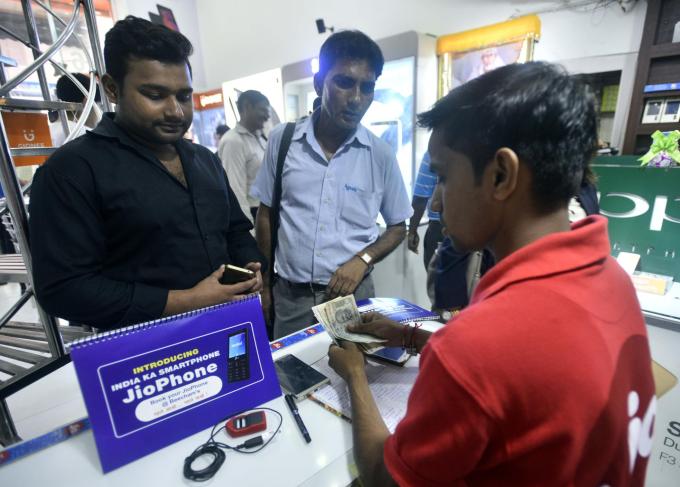
Since Jio, the telecommunications arm of the giant industrial conglomerate Reliance Group, launched its 4G service in September 2016, adoption rates across the country have skyrocketed.

According to a report from the telecommunications analysis firm, OpenSignal, Jio’s contribution to networking India has been massive.

During the quarter ending June 2017, total data usage stood at over 4.2 million terabytes, out of which 4G data accounted for 3.9 million TBs, according to TRAI. The growth is most visible when checking the numbers from a year ago, when 4G data usage stood at a mere 8,050 TBs; that’s a 500-fold increase… [And] LTE availability in India is remarkable: users were able to connect to an LTE signal over 84% of the time, a rise of over 10 percentage points from a year earlier. This places India ahead of more established countries in the 4G landscape such as Sweden, Taiwan, Switzerland or the U.K.

Disrupt telco Reliance Jio laid the foundation for India’s phone owners to switch to using mobile data packages (Photo by Arun Sharma/Hindustan Times via Getty Images)

For a startup like ShareChat that means tens of millions of daily active users, according to Mhatre.

Those users are drawn to ShareChat’s broadcast chat feature, which allows users on mobile phones to broadcast conversations and commentary about any topic they wish. “It’s a platform where content that is relevant to you is surfaced to you and you engage with it,” Mhatre says.

The company was founded by three Bangalore-based developers. Farid Ahsan, 26, Ankush Sachdeva, 25, and Bhanu Pratap Singh, also 26 — all graduates from India’s famous IIT Kanpur University — had worked up 17 different prototypes for a product before they finally settled on the version that would become ShareChat.

The company’s founders are also taking a page from the popular Chinese app WeChat and hope to turn their broadcast chat service into a platform for micropayments, education, and other types of entertainment.

What started as a niche site for people to communicate in their local dialects could now become the first true domestic social media giant in India.

There are other Chinese corollaries to ShareChat’s business that may be informative. Toutiao, the news aggregation service owned by Bytedance, is perhaps the closest in kind to ShareChat at the moment, but even that is only accurate to a point.

China’s infrastructure is still somewhat based on personal computers and landlines, whereas India’s is wholly mobile-first. For Mhatre, it’s the first country to make the leap to a digital economy based entirely on mobile computing.

At Lightspeed the opportunity that presents is similar to the mid-90s birth of the Internet in the U.S. and the late 2000 technology boom that created billions of dollars in value for companies like Alibaba, Baidu, and Tencent.

ShareChat is built to support India’s plethora of local languages, as opposed to English-first services like WhatsApp

What makes this feat even more impressive was that until two or three years ago, it looked like India wouldn’t be living up to the expectations that had been set for it and emerging market countries like Russia and Brazil that comprise three-fourths of the BRICs that were supposed to be the foundational building blocks of the 21st century global economy.

“If you look at China — the GDP in China is $12 to $13 trillion… India is about $2.5 trillion [but] infrastructure got developed there earlier than in India,” Mhatre said. India is at the same inflection point now, where the infrastructure boom is contributing to the development of new business models. 

The constraints of that infrastructure have also informed the business ShareChat has built as well. Because while digital penetration rates in the country are high, the download speeds are exceptionally low (due in part to overwhelming demand).

Again, the OpenSignal report is informative.

While LTE availability saw a meteoric rise, the same cannot be said of 4G speeds. In our latest State of LTE report, India occupied the lowest spot among the 77 countries we examined, with average download speeds of 6.1 Mbps, over 10 Mbps lower than the global average.

ShareChat’s focus on messaging and sharing data light images is a platform that’s suited to the current strengths and limitations of India’s infrastructure. “You have half a billion people with a high speed internet terminal in their hand and they want to do things with it,” Mhatre said. And ShareChat isn’t just localized in its tech stack. The company also is localized by language. 

As the investors at Lightspeed noted in their thoughts on the deal.

The “next billion” users in India speak 22 different languages and are spread out over an area the size of Europe. ShareChat’s founders Ankush, Bhanu and Farid blew us away with their insight into this new user base. Their first brush with this user base came in 2015 when they noticed that sharing of photos, videos, poetry, jokes and even good morning messages was at epidemic levels on WhatsApp. Yet there was no easy one-stop shop for finding this content.  ShareChat was born to solve this problem. As they developed the idea, they also saw that this audience hungered for connection and content about their cities and villages of origin. They noticed emergent behavior around users wanting to “look cool” to their friends by finding the best content, solving for loneliness by finding friends in their own language, and even wanting to drive fame and celebrity in their own geographies.  


source https://techcrunch.com/2018/09/27/indias-new-technology-infrastructure-has-created-a-platform-to-build-domestic-tech-giants/

Berkanan is a Bluetooth-powered group messaging app

A new messaging app is looking to give folks a way to communicate in situations with poor or no cellular connectivity.

Berkanan, founded by Zsombor Szabó, is a group messaging app that uses Bluetooth to send and receive messages. This means that Berkanan works in a plane, at a festival, camping, or anywhere else where cellular coverage is disappointing.

Imagine people on a plane asking each other for top movie recommendations from the in-flight entertainment system, or folks at a festival figuring out a rally point to meet up between sets. Public messages auto-delete after 24 hours.

Alongside group messaging, Berkanan also allows private one-to-one messaging, as well as audio calls placed over Bluetooth. The range for these calls and messages is about 50 meters, but if there are people between you and your intended recipient with the app installed, Berkanan can send messages further by going through other users devices.

Berkanan will also show users if they are getting closer or further away from the user they’re messaging with, without ever showing either person’s exact location.

Group chatting with strangers in your location might seem a bit icky at first glance, but group chatting with strangers is essentially the basis of Twitter. With Berkanan, however, a common location replaces the #topic.

Berkanan is entirely bootstrapped, but Szabo has implemented a somewhat unconventional method of generating revenue.

Inspired by games like Fortnite, which make money off of custom skins, dances, and other virtual items, Berkanan will charge users to edit their profile. When a user logs on, their profile will consist of the name they assigned to their iPhone and their profile picture will be their initials, similar to the iOS Contacts interface.

Users can pay to add their own profile picture and add a short bio to their profile.

To be clear, it’s already possible to send SMS via Bluetooth. But Berkanan offers a way to broadcast that message to everyone (with the app) in your location. Of course, user acquisition is critical for the app, which is why Szabó is considering ways for the enterprise to take advantage of the app.


source https://techcrunch.com/2018/09/27/berkanan-is-a-bluetooth-powered-group-messaging-app/

Bumble responds to Match Group’s patent infringement lawsuit

Bumble is continuing to go on the offensive against Match Group. Earlier this week, the dating app maker said it was serving Match Group with papers (which Match Group said at the time it hadn’t yet received – but it has now). Bumble is taking Match Group to court for fraudulently obtaining trade secrets during acquisition talks. Today, Bumble is also officially responding to Match Group’s suit against it, which claims patent infringement and misuse of intellectual property.

Bumble this morning put out a statement, indicating that it plans to now take the battle to court:

“Bumble has today formally responded to Match’s lawsuit from March 2018 alleging patent infringement and misappropriation of trade secrets. We believe all of the claims are baseless, and are seeking to have several claims dismissed immediately, given their lack of merit.

As stated previously, this was a thinly veiled attempt by Match to interfere with Bumble’s growth, as Bumble continues to take share from Tinder, and to scare potential suitors so Match could acquire Bumble at below market value. It also demonstrates an attempt by Match to monopolize the very practice of making real, meaningful connections. Match did not invent the world of dating; men and especially women everywhere deserve the opportunity to connect with who they want, on their terms, and Bumble will continue to stand up for our users and our values as we take this battle to court.”

The two companies have a history of bad blood between them.

Bumble was founded by CEO Whitney Wolfe, who was also a co-founder at Tinder and had previously sued Tinder for sexual harassment. She then branded Bumble as a more empowering dating app for women, by allowing women to start the chats first.

Like many dating apps on the market today, Bumble uses the double opt-in mechanism of creating matches, as determined by a right swipe on a profile card.

The app has grown to over 40 million users, Wolfe said recently at TechCrunch Disrupt SF 2018, and the company says its revenue run rate has now climbed to $200 million per year.

Match Group has unsuccessfully tried to acquire Bumble twice – once in a deal that would have valued it at over $1 billion.

Bumble says Match Group filed its original lawsuit against it to make it less attractive to other potential acquirers.

The two tried to work out their differences since the lawsuits’ filings in March, but were unsuccessful. Now, they’re headed to court – and to the press.

The claims Match Group makes around patent infringement involve Bumble’s use of a stack of profile cards, mutual opt-in, and its swiped-based gestures – things Tinder popularized for dating apps, but have since become something of an industry standard, similar to how Facebook’s News Feed became a model for other social apps. But whether or not Bumble is illegally infringing on those patents will be left to the courts to decide.

Match Group is very aggressive when it comes to maintaining a dominant position in the dating app market.

The company already owns top brands like Tinder, Match.com, Plenty of Fish, OKCupid, and others. It also more recently took a majority stake in Hinge. And it often copies the features of rivals it doesn’t own, as it did with Hinge’s media-sharing feedCoffee Meets Bagel’s top picks, Happn’s location-based features, and, as of this week, Bumble’s “ladies first” feature.

We’ve reached out to Match Group for comment, and will update if the company responds.


source https://techcrunch.com/2018/09/27/bumble-responds-to-match-groups-patent-infringement-lawsuit/

Facebook’s ex-CSO, Alex Stamos, defends its decision to inject ads in WhatsApp

Alex Stamos, Facebook’s former chief security officer, who left the company this summer to take up a role in academia, has made a contribution to what’s sometimes couched as a debate about how to monetize (and thus sustain) commercial end-to-end encrypted messaging platforms in order that the privacy benefits they otherwise offer can be as widely spread as possible.

Stamos made the comments via Twitter, where he said he was indirectly responding to the fallout from a Forbes interview with WhatsApp co-founder Brian Acton — in which Acton hit at out at his former employer for being greedy in its approach to generating revenue off of the famously anti-ads messaging platform.

Both WhatsApp founders’ exits from Facebook has been blamed on disagreements over monetization. (Jan Koum left some months after Acton.)

In the interview, Acton said he suggested Facebook management apply a simple business model atop WhatsApp, such as metered messaging for all users after a set number of free messages. But that management pushed back — with Facebook COO Sheryl Sandberg telling him they needed a monetization method that generates greater revenue “scale”.

And while Stamos has avoided making critical remarks about Acton (unlike some current Facebook staffers), he clearly wants to lend his weight to the notion that some kind of trade-off is necessary in order for end-to-end encryption to be commercially viable (and thus for the greater good (of messaging privacy) to prevail); and therefore his tacit support to Facebook and its approach to making money off of a robustly encrypted platform.

Stamos’ own departure from the fb mothership was hardly under such acrimonious terms as Acton, though he has had his own disagreements with the leadership team — as set out in a memo he sent earlier this year that was obtained by BuzzFeed. So his support for Facebook combining e2e and ads perhaps counts for something, though isn’t really surprising given the seat he occupied at the company for several years, and his always fierce defence of WhatsApp encryption.

(Another characteristic concern that also surfaces in Stamos’ Twitter thread is the need to keep the technology legal, in the face of government attempts to backdoor encryption, which he says will require “accepting the inevitable downsides of giving people unfettered communications”.)

This summer Facebook confirmed that, from next year, ads will be injected into WhatsApp statuses (aka the app’s Stories clone). So it is indeed bringing ads to the famously anti-ads messaging platform.

For several years the company has also been moving towards positioning WhatsApp as a business messaging platform to connect companies with potential customers — and it says it plans to meter those messages, also from next year.

So there are two strands to its revenue generating playbook atop WhatsApp’s e2e encrypted messaging platform. Both with knock-on impacts on privacy, given Facebook targets ads and marketing content by profiling users by harvesting their personal data.

This means that while WhatsApp’s e2e encryption means Facebook literally cannot read WhatsApp users’ messages, it is ‘circumventing’ the technology (for ad-targeting purposes) by linking accounts across different services it owns — using people’s digital identities across its product portfolio (and beyond) as a sort of ‘trojan horse’ to negate the messaging privacy it affords them on WhatsApp.

Facebook is using different technical methods (including the very low-tech method of phone number matching) to link WhatsApp user and Facebook accounts. Once it’s been able to match a Facebook user to a WhatsApp account it can then connect what’s very likely to be a well fleshed out Facebook profile with a WhatsApp account that nonetheless contains messages it can’t read. So it’s both respecting and eroding user privacy.

This approach means Facebook can carry out its ad targeting activities across both messaging platforms (as it will from next year). And do so without having to literally read messages being sent by WhatsApp users.

As trade offs go, it’s a clearly a big one — and one that’s got Facebook into regulatory trouble in Europe.

It is also, at least in Stamos’ view, a trade off that’s worth it for the ‘greater good’ of message content remaining strongly encrypted and therefore unreadable. Even if Facebook now knows pretty much everything about the sender, and can access any unencrypted messages they sent using its other social products.

In his Twitter thread Stamos argues that “if we want that right to be extended to people around the world, that means that E2E encryption needs to be deployed inside of multi-billion user platforms”, which he says means: “We need to find a sustainable business model for professionally-run E2E encrypted communication platforms.”

On the sustainable business model front he argues that two models “currently fit the bill” — either Apple’s iMessage or Facebook-owned WhatsApp. Though he doesn’t go into any detail on why he believes only those two are sustainable.

He does say he’s discounting the Acton-backed alternative, Signal, which now operates via a not-for-profit (the Signal Foundation) — suggesting that rival messaging app is “unlikely to hit 1B users”.

In passing he also throws it out there that Signal is “subsidized, indirectly, by FB ads” — i.e. because Facebook pays a licensing fee for use of the underlying Signal Protocol used to power WhatsApp’s e2e encryption. (So his slightly shade-throwing subtext is that privacy purists are still benefiting from a Facebook sugardaddy.)

Then he gets to the meat of his argument in defence of Facebook-owned (and monetized) WhatsApp — pointing out that Apple’s sustainable business model does not reach every mobile user, given its hardware is priced at a premium. Whereas WhatsApp running on a cheap Android handset ($50 or, perhaps even $30 in future) can.

Other encrypted messaging apps can also of course run on Android but presumably Stamos would argue they’re not professionally run.

“I think it is easy to underestimate how radical WhatsApp’s decision to deploy E2E was,” he writes. “Acton and Koum, with Zuck’s blessing, jumped off a bridge with the goal of building a monetization parachute on the way down. FB has a lot of money, so it was a very tall bridge, but it is foolish to expect that FB shareholders are going to subsidize a free text/voice/video global communications network forever. Eventually, WhatsApp is going to need to generate revenue.

“This could come from directly charging for the service, it could come from advertising, it could come from a WeChat-like services play. The first is very hard across countries, the latter two are complicated by E2E.”

“I can’t speak to the various options that have been floated around, or the arguments between WA and FB, but those of us who care about privacy shouldn’t see WhatsApp monetization as something evil,” he adds. “In fact, we should want WA to demonstrate that E2E and revenue are compatible. That’s the only way E2E will become a sustainable feature of massive, non-niche technology platforms.”

Stamos is certainly right that Apple’s iMessage cannot reach every mobile user, given the premium cost of Apple hardware.

Though he elides the important role that second hand Apple devices play in helping to reduce the barrier to entry to Apple’s pro-privacy technology — a role Apple is actively encouraging via support for older devices (and by its own services business expansion which extends its model so that support for older versions of iOS (and thus secondhand iPhones) is also commercially sustainable).

Robust encryption only being possible via multi-billion user platforms essentially boils down to a usability argument by Stamos — which is to suggest that mainstream app users will simply not seek encryption out unless it’s plated up for them in a way they don’t even notice it’s there.

The follow on conclusion is then that only a well-resourced giant like Facebook has the resources to maintain and serve this different tech up to the masses.

There’s certainly substance in that point. But the wider question is whether or not the privacy trade offs that Facebook’s monetization methods of WhatsApp entail, by linking Facebook and WhatsApp accounts and also, therefore, looping in various less than transparent data-harvest methods it uses to gather intelligence on web users generally, substantially erodes the value of the e2e encryption that is now being bundled with Facebook’s ad targeting people surveillance. And so used as a selling aid for otherwise privacy eroding practices.

Yes WhatsApp users’ messages will remain private, thanks to Facebook funding the necessary e2e encryption. But the price users are having to pay is very likely still their personal privacy.

And at that point the argument really becomes about how much profit a commercial entity should be able to extract off of a product that’s being marketed as securely encrypted and thus ‘pro-privacy’? How much revenue “scale” is reasonable or unreasonable in that scenario?

Other business models are possible, which was Acton’s point. But likely less profitable. And therein lies the rub where Facebook is concerned.

How much money should any company be required to leave on the table, as Acton did when he left Facebook without the rest of his unvested shares, in order to be able to monetize a technology that’s bound up so tightly with notions of privacy?

Acton wanted Facebook to agree to make as much money as it could without users having to pay it with their privacy. But Facebook’s management team said no. That’s why he’s calling them greedy.

Stamos doesn’t engage with that more nuanced point. He just writes: “It is foolish to expect that FB shareholders are going to subsidize a free text/voice/video global communications network forever. Eventually, WhatsApp is going to need to generate revenue” — thereby collapsing the revenue argument into an all or nothing binary without explaining why it has to be that way.


source https://techcrunch.com/2018/09/27/facebooks-ex-cso-alex-stamos-defends-its-decision-to-inject-ads-in-whatsapp/

Wednesday, 26 September 2018

The E-Commerce Benchmark KPI Study: The Most Valuable Online Consumer Trend of 2018 Revealed

Posted by Alan_Coleman

The latest Wolfgang E-Commerce Report is now live. This study gives a comprehensive view of the state of digital marketing in retail and travel, allowing digital marketers to benchmark their 2018 performance and plan their 2019 strategy.

The study analyzes over 250 million website sessions and more than €500 million in online revenue. Google Analytics, new Facebook Analytics reports, and online surveys are used to glean insights.

Revenue volume correlations

One of the unique features of the study is its conversion correlation. All website metrics featured in the study are correlated with conversion success to reveal what the most successful websites do differently.

This year we've uncovered our strongest success correlation ever at 0.67! Just to give that figure context: normally, 0.2 is worth talking about and 0.3 is noteworthy. Not only is this correlation with success very strong, the insight itself is highly actionable and can become a pillar of your digital marketing strategy.

These are the top factors that correlated with revenue volume. You can see the other correlations in the full study.

Click to see a bigger version

  • Average pages per session (.37)
  • Average session length (.49)
  • Conversion rate by users (.41)
  • Number of sessions per user (.67)
  • Percentage of sessions from paid search (.25)

Average website engagement metrics

Number of sessions per user Average pages per session Average session duration Bounce rate Average page load time Average server response time
Retail 1.58 6 3min 18sec 38.04% 6.84 1.02
Multi-channel 1.51 6 3min 17sec 35.27% 6.83 1.08
Online-only 1.52 5 3min 14sec 43.80% 6.84 0.89
Travel 1.57 3 2min 34sec 44.14% 6.76 0.94
Overall 1.58 5 3min 1sec 41.26% 6.80 0.97

Above are the average website engagement metrics. You can see the average number of sessions per user is very low at 1.5 over 12 months. Anything a digital marketer can do to get this to 2, to 3, and to 4 makes for about the best digital marketing they can do.

At Wolfgang Digital, we’ve been witnessing this phenomenon at a micro-level for some time now. Many of our most successful campaigns of late have been focused on presenting the user with an evolving message which matures with each interaction across multiple media touchpoints.

Click through to the Wolfgang E-Commerce KPI Report in full to uncover dozens more insights, including:

  • Is a social media engagement more valuable than a website visit?
  • What's the true value of a share?
  • What’s the average conversion rate for online-only vs multi-channel retailers?
  • What’s the average order value for a hotel vs. tour operator?

Video Transcript

Today I want to talk to you about the most important online consumer trend in 2018. The story starts in a client meeting about four years ago, and we were meeting with a travel client. We got into a discussion about bounce rate and its implication on conversion rate. The client was asking us, "could we optimize our search and social campaigns to reduce bounce rate?", which is a perfectly valid question.

But we were wondering: Will we lower the rate of conversions? Are all bounces bad? As a result of this meeting, we said, "You know, we need a really scientific answer to that question about any of the website engagement metrics or any of the website channels and their influence on conversion." Out of that conversation, our E-Commerce KPI Report was born. We're now four years into it. (See previous years on the Moz Blog: 2015, 2016, 2017.)

The metric with the strongest correlation to conversions: Number of sessions per user

We've just released the 2019 E-Commerce KPI Report, and we have a standout finding, probably the strongest correlation we've ever seen between a website engagement metric and a website conversion metric. This is beautiful because we're all always optimizing for conversion metrics. But if you can isolate the engagement metrics which deliver, which are the money-making metrics, then you can be much more intelligent about how you create digital marketing campaigns.

The strongest correlation we've ever seen in this study is number of sessions per user, and the metric simply tells us on average how many times did your users visit your website. What we're learning here is any digital marketing you can do which makes that number increase is going to dramatically increase your conversions, your revenue success.

Change the focus of your campaigns

It's a beautiful metric to plan campaigns with because it changes the focus. We're not looking for a campaign that's a one-click wonder campaign. We're not looking for a campaign that it's one message delivered multiple times to the same user. Much more so, we're trying to create a journey, multiple touchpoints which deliver a user from their initial interaction through the purchase funnel, right through to conversion.

Create an itinerary of touchpoints along the searcher's journey

1. Research via Google

Let me give you an example. We started this with a story about a travel company. I'm just back from a swimming holiday in the west of Ireland. So let's say I have a fictional travel company. We'll call them Wolfgang Wild Swimming. I'm going to be a person who's researching a swimming holiday. So I'm going to go to Google first, and I'm going to search for swimming holidays in Ireland.

2. E-book download via remarketing

I'm going to go to the Wolfgang Wild Swimming web page, where I'm going to read a little bit about their offering. In doing that, I'm going to enter their Facebook audience. The next time I go to Facebook, they're now remarketing to me, and they'll be encouraging me to download their e-book, which is a guide to the best swimming spots in the wild west of Ireland. I'm going to volunteer my email to them to get access to the book. Then I'm going to spend a bit more time consuming their content and reading their book.

3. Email about a local offline event

A week later, I get an email from them, and they're having an event in my area. They're going for a swim in Dublin, one of my local spots in The Forty Foot, for example. I'm saying, "Well, I was going to go for a swim this weekend anyway. I might as well go with this group." I go to the swim where I can meet the tour guides. I can meet people who have been on it before. I'm now really close to making a purchase.

4. YouTube video content consumed via remarketing

Again, a week later, they have my email address, so they're targeting me on YouTube with videos of previous holidays. Now I'm watching video content. All of a sudden, Wolfgang Wild Swimming comes up. I'm now watching a video of a previous holiday, and I'm recognizing the instructors and the participants in the previous holidays. I'm really, really close to pressing Purchase on a holiday here. I'm on the phone to my friend saying, "I found the one. Let's book this."

Each interaction moves the consumer closer to purchase

I hope what you're seeing there is with each interaction, the Google search, the Facebook ad which led to an e-book download, the offline event, back online to the YouTube video, with each interaction I'm getting closer to the purchase.

You can imagine the conversion rate and the return on ad spend on each interaction increasing as we go. This is a really powerful message for us as digital marketers. When we're planning a campaign, we think about ourselves as though we're in the travel business too, and we're actually creating an itinerary. We're simply trying to create an itinerary of touchpoints that guide a searcher through awareness, interest, right through to action and making that purchase.

I think it's not just our study that tells us this is the truth. A lot of the best-performing campaigns we've been running we've seen this anecdotally, that every extra touchpoint increases the conversion rate. Really powerful insight, really useful for digital marketers when planning campaigns. This is just one of the many insights from our E-Commerce KPI Report. If you found that interesting, I'd urge you to go read the full report today.


Sign up for The Moz Top 10, a semimonthly mailer updating you on the top ten hottest pieces of SEO news, tips, and rad links uncovered by the Moz team. Think of it as your exclusive digest of stuff you don't have time to hunt down but want to read!


source https://moz.com/blog/ecommerce-benchmark-kpi-study-2018

Oculus Hybrid Apps let you use 2D & 3D software simultaneously in VR

Oculus showed off the future of working in VR today. Rather than just splaying out 2D software on an infinite desktop, the new Oculus Hybrid Apps system lets you see both 2D screens and 3D models in VR at the same time. That means you could use a traditional image editing suite to change the look of a piece of a 3D object while also being able to rotate, move, and look around that object.

Hybrid Apps were announced at the Oculus Connect 5 conference today in San Jose where Facebook also revealed the new Oculus Quest headset, forward compatability for Oculus content, a mobile app for discovering and remotely installing software on the Rift, and the debut of the YouTube VR app on Oculus Go.

Hybrid Apps are built atop the Oculus Dash virtual desktop system announced last year. In this demo, you can see an artist using the 2D Substance Painter software to polish the colors and textures of a 3D robot model while being able to see changes live.

Oculus showed off a wide array of other new software today. Your Sims-style customizable Oculus Home can now sport Custom Developer Items so you can earn (or maybe one day buy) 3D goods within games. Earn an airship in a flying game, and that airship can float inside your Oculus Home when you’re done playing. The feature could let you build your own trophy wall, making those in-game achievements a lot more tangible.

Each year Oculus shows off the newest versions of its Avatars system that lets you create in-VR visual identity. They’re getting more lifelike thanks to additional hairstyles, skin tones, and accessories. And later this year, Oculus will launch Expressive Avatars that use its research on simulated eye and mouth movement as well as microexpressions to make them feel real.

Overall, Oculus Connect 5 felt a bit anti-climactic. Facebook has a lot of scandals distracting from its VR efforts while also triggering more scrutiny of any choices it makes related to privacy. What once might have been seen as mildly creepy now triggers damaging press cycles. Facebook ended up adding a privacy shield to cover the lens of its upcoming Portal video chat screen, Cheddar’s Alex Heath reports.

Combined with slow adoption of VR, it seems like there is less and less progress between Oculus’ annual conference. Instead of big advances in avatars, we get cosmetic upgrades and reveals of changes that won’t arrive for months. The newest Oculus Quest headset looks pretty similar to its previous prototypes.

At this point, the necessary technology for satisfactory VR has largely arrived. It’s now on Oculus and its legion of developers to build products and experiences that are simple, affordable, and impressive enough to be worth the hassle of face computing.

more Oculus Connect 5 coverage


source https://techcrunch.com/2018/09/26/oculus-hybrid-apps/