Facebook takes (small) steps to improve its content policies as advertisers join a broad boycott, founder Alexis Ohanian is leaving Initialized Capital and Waze gets a new look.
In a live-streamed segment of the company’s weekly all-hands meeting, CEO Mark Zuckerberg announced new measures to fight voter suppression and misinformation. At the heart of the policy changes is an admission that the company will continue to allow politicians and public figures to disseminate hate speech that does, in fact, violate Facebook’s own guidelines — but it will add a label to denote they’re remaining on the platform because of their “newsworthy” nature.
This announcement comes as advertiser momentum against the social network’s content and monetization policies continues to grow, with Unilever and Verizon (which owns TechCrunch) both committing to pull advertising from Facebook.
Ohanian is leaving Initialized Capital to work on “a new project that will support a generation of founders in tech and beyond,” the firm said in a statement to TechCrunch. According to Axios, Ohanian is leaving Initialized to work more closely on pre-seed efforts.
The new look is much more colorful, and also foregrounds the ability for individual drivers to share their current emotions with Moods, a set of user-selectable icons (with an initial group of 30) that can reflect how you’re feeling as you’re driving.
Amazon warehouse workers in Germany are striking for 48 hours this week, to protest conditions that have led to COVID-19 infections among fellow employees. Strikes began today at six warehouses and are set to continue through the end of day Tuesday.
Normally, the government would process tens of thousands of visa applications and renewals in October at the start of its fiscal year, but President Trump’s executive order all but guarantees new visas won’t be granted until 2021. Four TechCrunch staffers analyzed the president’s move in an attempt to see what it portends for the tech industry, the U.S. economy and our national image. (Extra Crunch membership required.)
Unlike other rush initiatives undertaken by the company once the virus hit, however, the forthcoming Apple Watch handwashing app wasn’t built overnight. The feature was the result of “years of work,” VP of Technology Kevin Lynch told TechCrunch.
The Daily Crunch is TechCrunch’s roundup of our biggest and most important stories. If you’d like to get this delivered to your inbox every day at around 9am Pacific, you can subscribe here.
Developer and programmer Brie Code has worked at the peak of the video game industry – she was responsible for many of the AI systems that powered non-player character (NPC) behavior in the extremely popular Assassin’s Creed series created by Ubisoft. It’s obvious that gaming isn’t for everyone, but Code became more and more interested in why that maxim seemed to play out along predictable gender lines, leading her ultimately to develop and launch #SelfCare through her own independent development studio TRU LUV.
#SelfCare went on to win accolades including a spot of Apple’s App Store Best of 2018 list, and Code and TRU LUV was also the first Canadian startup to attend Apple’s Entrepreneur Camp program. Now, with over 2 million downloads of #SelfCare (without any advertising at all), Code and TRU LUV have brought on a number of investors for their first outside funding including Real Ventures, Evolve Ventures, Bridge Builders Collaborative and Artesian Venture Partners.
I spoke to Code about how she came up with and created #SelfCare, what’s next for TRU LUV, and how the current COVID-19 crisis actually emphasizes the need for an alternative to gaming that serves many similar functions, but for a previously underserved groups of people for whom the challenges and rewards structures of traditional gaming just don’t prove very satisfying.
“I became very, very interested in why video games don’t interest about half of people, including all of my friends,” Code told me. “And at that point, tablets were becoming popular, and everyone had a phone. So if there was something universal about this medium, it should be being more widely adopted, yet I was seeing really clear patterns that it wasn’t. The last time I checked, which was maybe a couple years ago, there were 5 billion mobile users and around 2.2 billion mobile gamers.”
Her curiosity piqued by the discrepancy, especially as an industry insider herself, Code began to do her own research to figure out potential causes of the divide – the reason why games only seemed to consistently appeal to about half of the general computer user population, at best.
“I started doing a lot of focus groups and research and I saw really clear patterns, and I knew that if there is a clear pattern, there must be an explanation,” Code said. “What I discovered after I read Sheri Grainer Ray’s book Gender Inclusive Game Design, which she wrote in 2004, in a chapter on stimulation was how, and these are admittedly gross generalizations, but men tend to be stimulated by the sense of danger and things flashing on screen. And women, in her research, tended to be stimulated by something mentioned called a mutually-beneficial outcome to a socially significant situation. That’s when you help an NPC and they help you, for instance. In some way, that’s more significant, in the rules of the world than just the score going up.”
TRU LUV founder and CEO Brie Code
Code then dug in further, using consumer research and further study, and found a potential cause behind this divide that then provided a way forward for developing a new alternative to a traditional gaming paradigm that might prove more appealing to the large group of people who weren’t served by what the industry has traditionally produced.
“I started to read about the psychology of stimulation, and from there I was reading about the psychology of defense, and I found a very simple and clear explanation for this divide, which is that there are two human stress responses,” she said. “One of them, which is much more commonly known, is called the ‘fight-or-flight’ response. When we experience the fight-or-flight response, in the face of challenge or pressure or danger, you have adrenaline released in your body, and that makes you instinctively want to win. So what a game designer does is create these situations of challeng,e and then give you opportunities to win and that leverages the fight-or-flight response to stress: That’s the gamification curve. But there is another human stress response discovered at the UCLA Social Cognitive Neuroscience lab in 2000, By Dr. Shelly Taylor and her colleagues. It’s very prevalent, probably about half of stress responses that humans experience, and it’s called tend-and-befriend.”
Instead of generating an adrenaline surge, it releases oxytocin in the brain, and instead of seeking a victory over a rival, people who experience this want to take care of those who are more vulnerable, connect with friends and allies, and find mutually beneficial solutions to problems jointly faced. Seeking to generate that kind fo response led to what Code and TRU LUV call AI companions, a gaming alternative that is non-zero sum and based on the tend-and-befriend principal. Code’s background as an AI programmer working on some of the most sophisticated virtual character interactions available in modern games obviously came in handy here.
Code thought she might be on to something, but didn’t anticipate the level of #SelfCare’s success, which included 500,00 downloads in just six weeks, and more than 2 million today. And most of the feedback she received from users backed up her hypotheses about what the experience provided, and what users were looking for an an alternative to a mobile gaming experience.
Fast forward to now, and TRU LUV is growing its team, and focused on iterating and developing new products to capitalize on the clear vein of interest they’ve tapped among that underserved half of mobile users. Code and her team have brought on investors whose views and portfolios align with their product vision and company ethos, including Evolve Ventures which has backed a number of socially progressive ventures, and whose managing director Julius Mokrauer actually teaches a course on the subject at Columbia Business School.
#SelfCare was already showing a promising new path forward for mobile experience development before COVID-19 struck, but the product and TRU LUV are focused on “resilience and psychological development,” so it proved well-suited to a market in which mobile users were looking for ways to make sustained isolation more pleasant. Obviously we’re just at the beginning of feeling whatever impacts come out of the COVID-19 crisis, but it seems reasonable to expect that different kinds of mobile apps that trigger responses more aligned with personal well-being will be sought after.
Code says that COVID-19 hasn’t really changed TRU LUV’s vision or approach, but that it has led to the team moving more quickly on in-progress feature production, and on some parts of their roadmap, including building social features that allow players to connect with one another as well as with virtual companions.
“We want to move our production forward a bit faster than planned in order to respond to the need,” Code said.”Also we’re looking at being able to create social experiences a little bit earlier than planned, and also to attend to the need of people to be able to connect, above and beyond people who connect through video games.”
Facebook is expanding the availability of the tools it offers to help game streamers and other online creators make money.
The social network first launched fan subscriptions in early 2018, giving a small group of creators in the United States and the United Kingdom the ability to charge their fans a $4.99 monthly fee for exclusive content and a fan badge for their profiles.
Participation in the subscription program was limited until today. In a blog post, Facebook now says that any creator in Australia, Brazil, Canada, Mexico, Thailand, United Kingdom and United States that meets the subscription eligibility criteria (having 10,000 followers or more than 250 return viewers, and either 50,000 post engagements or 180,000 watch minutes in the last 60 days, as well as abiding by Facebook’s general monetization policies) should be able to sign up to participate.
The company monetizes these subscriptions by taking up to 30% of subscription revenue. (It only collects revenue on subscribers acquired after January 1, 2020.)
Image Credits: Facebook
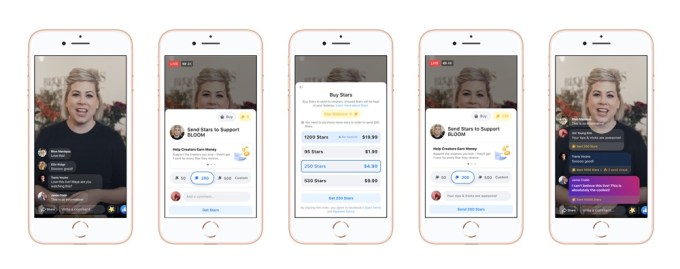
Facebook is also expanding the availability of Stars, a virtual currency that fans can use to tip their favorite creators. Creators in Australia, Canada, Columbia, India, Indonesia, Italy, Spain, Germany, France, Malaysia, Mexico, New Zealand, Peru, Philippines, Taiwan, Thailand, United Kingdom and the United States can now participate.
“We’re seeing the traditional notion of a creator evolve as comedians, artists, fitness instructors, athletes, small businesses and sports organizations use video and online events to connect with their audience,” wrote Product Marketing Director Yoav Arnstein, Product Marketing Director and Head of Creator & Publisher Experience Jeff Birkeland. “To better support our partners, we’re improving the tools that help creators earn money and manage their presence on Facebook.”
Beyond subscriptions and virtual currencies, the company says it’s giving creators new ways to make money through advertising, including image and post-roll ads in short-form videos (60 to 180 seconds), as well as ads in live videos.
Lastly, Facebook says it’s improving the Creator Studio tool with features like Comment Insights (which show how comments on posts can affect engagement and audience size) and the ability to log in using Instagram credentials.
This is a big picture overview of a site’s overall SEO and PPC marketing efforts.
And if you want to dig deeper, you can get details on a site’s organic traffic, backlinks, PPC campaigns, engagement metrics (like bounce rate), the site’s main competitors in Google search, and more.
This report is helpful if you want to quickly see how much traffic a site gets from SEO or Google Ads.
But the real value here comes from each of the detailed subreports. So let’s break down a few of these right now.
Organic Research
This feature is simple. Yet super powerful if you know how to use it.
Organic Research tells you how much traffic a site gets from Google. And how it’s changed over the years.
Yeah, it’s interesting to see how a competitor’s rankings have changed over time. But it’s not super useful.
The real value in this report is the regularly-updated list of the keywords that a site ranks for in organic Google search.
In my experience, reverse engineering your competitor’s keywords is one of the best keyword research strategies on the planet.
And SEMrush is one of the best SEO tools on the market for this approach.
That’s because SEMrush has a HUGE database of 17 billion keywords. And they update this list pretty much every day.
That’s the good news.
The bad news is that SEMrush’s organic traffic estimates can be pretty inaccurate at times.
For example, right now SEMrush says that my website’s traffic is up 72.75%.
Fractl has produced thousands of content marketing campaigns across every topic, and for the past seven years, we’ve been keeping track of each and every campaign in order to refine and improve the content we produce on behalf of our clients.
In my last post for Moz, I explained how to set realistic digital PR expectations for your content based on your niche. In this topic, I want to dive a little bit deeper into the data and share insights about how the source of your content can be just as important in determining how your content will perform.
In this analysis, I looked at 1,474 client content campaigns across six different data source categories:
Client data
Social media
Participatory methods
Publicly available data
Survey
Germ swab
It’s important to note that there are countless other data sources that we use for content campaigns every day at Fractl that are not mentioned in this article. In this analysis, each category has at least 20 campaigns, while some categories have several hundred campaigns.
It’s also important to note that averages were collected by excluding upper outliers. For campaigns that went “viral” and performed well above the norm, we excluded them in the calculation so as not to skew the averages higher.
In addition to sharing link and press averages, I will also be walking through how to produce pressworthy, sharable content from each data source and providing examples.
Managing expectations across content types
Across the entire sample of 1,474 campaigns, a project on average received 24 dofollow links and 89 press mentions in total.
A press mention is defined as any time the content campaign was mentioned on a publisher’s website.
There were some individual data source category averages that were on par with the sample average, while other categories deviated greatly from the sample average.
Publicly available data
For almost any niche out there, you can bet there is a publicly available data set available for use. Some examples include data from the CDC, the U.S. Census, colleges and universities, the WHO, and the TSA. The opportunities really are endless when it comes to using publicly available data as a methodology for your content.
While free data sets can be a treasure trove of information for your content, keep in mind that they’re not always the simplest to work with. They do require a lot of analysis to make sense of the massive amount of information in them, and to make the insights digestible for your audience.
Take for example a campaign we produced for a client called Neighborhood Names. The data was free from the US Census, but in order to make any sense of it, our researchers had to use QGIS, Python, text-mining, and phrasemachine (a text analysis API) just to narrow it down to what we were looking for.
And what were we looking for? Looking at neighborhood names across America seems boring at first, until you realize that certain words correspond to wealth.
I was the outreach specialist for this project, and by using the wealth angle, I was able to secure two notable placements on CNBC as well as a press mention on MSN. The project quickly made its way around the internet after that, earning 76 dofollow links and 202 total press mentions by the end of our reporting period.
Survey
Unlike scouring the internet for free data, using a survey as a methodology can be more costly. That being said, there is one major advantage to using a survey to shape your content: you can find out anything you want.
While publicly available data will tell a story, it’s not always the story you want to tell, and that’s where surveys come in.
Of course, when it comes to surveys, anyone can create one without paying attention to research method best practices. That's one of the problems we need to address. With “fake news” in the forefront of everyone’s minds in 2020, building trust with journalists and editors is of the utmost importance.
As content creators, we have a responsibility to ensure that content is not only attention-grabbing and entertaining, but also accurate and informative.
Survey campaigns, in particular, require you to analyze responses through a rigorous methodological lens. When collecting data for surveys, be sure to pay close attention to ethical upholdance, data validity, and fair visual representations.
Germ swab
From my own personal experience, germ swab content campaigns are the most fun, and often, the most disturbing. Fractl did some research a while back about the emotions that make content go viral, and oftentimes, germ swab campaigns hit all of the right emotions in the viral equation.
Negative emotions like disgust are often evoked when reviewing the results of germ swab campaigns. Our study found that when negative emotions are paired with emotions like anticipation or surprise, they can still achieve viral success (internet viral, not germ viral). What is more surprising than finding out the airplane tray table is dirtier than a toilet seat?
Publishers around the world seemed to think the content was surprising, too. This campaign performed above the norm for a typical content campaign earning 38 dofollows and 195 total press mentions — and this was before the COVID-19 pandemic.
Participatory methods
Participatory methods are campaigns that require active participation for the methodology. These are unique ideas — no two are alike. Some examples of campaigns that fall under the participatory methods category are when we had team members do a 30-day squat challenge, asked respondents to draw brand logos from memory, or when we literally drove from D.C. to NYC with a dash cam to record traffic violations.
These campaigns have a certain level of risk associated with them. They require a lot of upfront effort and planning without the promise of any return — and that’s scary for clients and for our team who put in tremendous effort to pull them off.
As you can see from the chart above, however, these ideas collectively performed right on par with other campaign types, and even better than survey methodologies for both the number of dofollow links and press mentions. In order to reap big benefits, it seems you need to be willing to take a big risk.
Social media
Social medIa as a data source is almost a no-brainer, right up there with survey methodologies and publicly available data sets. Unlike participatory methods campaigns, you don’t have to leave your computer in order to produce a campaign based on social media data.
Through our seven years of content creation, Fractl has produced campaigns based on data scrapes from Twitter, Instagram, Facebook, LinkedIn, Reddit, and more. From this experience, we know firsthand what kinds of social campaigns work and which ones fall flat.
The best thing about using social media as a source for content is that it can be applied to all verticals.
The biggest lesson we’ve learned from producing content based on social media data is that the methodology is typically subjective, so you need to keep the project lighthearted in nature in order to earn major coverage.
For example, we produced a campaign for a client in which we looked at Instagram posts with the hashtag #sexy and a geolocation. From this, we were able to glean the “sexiest” countries in the world as well as U.S. states.
While it would be impossible to learn what the actual sexiest places in the world were, (what does that even mean?) we were able to produce a fun campaign that used geo-bait to appeal to lighthearted publishers, like Glamour, E! Online, Women's Health, and Elite Daily.
Make sure that no matter the topic, whatever you produce contributes to an ongoing conversation. Statistics that don’t point to anything meaningful won’t be relevant for writers actually trying to add to the conversation.
Client data
Client data is often the most underappreciated data source for content marketers. You may be sitting on a wealth of actionable industry insights and not even know it.
You might think of internal data as only being useful for improving your internal processes at work, but it can also be valuable outside of your organization.
Unlike publicly available data, internal data is never-before-seen and 100% unique. Journalists eat this up because it means that you’re providing completely exclusive resources.
Think of this article, for example. This article is filled with data and insights that Fractl has gleaned after producing thousands of content marketing campaigns.
An added bonus of using internal data to craft your content is that, according to our analysis, it performs on par with surveys. Unlike surveys, though, it’s completely free.
Conclusion
No matter what methodology you’re using or vertical you’re creating content for, it’s important to realize that as content creators, we have an ethical and moral responsibility to create with an audience in mind.
With “fake news” on the forefront of everyone’s minds, building and maintaining trust with writers and editors is of the utmost importance.
All of the content you produce and promote must be assessed through a rigorous methodological lens to ensure that content is accurate and informative as well as eye-grabbing and entertaining.
Regardless of your methodology, if you don’t take the proper steps to make sure your data sources are accurate, you are contributing to the fake news epidemic.
Sign up for The Moz Top 10, a semimonthly mailer updating you on the top ten hottest pieces of SEO news, tips, and rad links uncovered by the Moz team. Think of it as your exclusive digest of stuff you don't have time to hunt down but want to read!
Games and esports analytics firm Newzoo released its highly cited annual report on the size and state of the video gaming industry yesterday. The firm is predicting 2020 global game industry revenue from consumers of $159.3 billion, a 9.3% increase year-over-year. Newzoo predicts the market will surpass $200 billion by the end of 2023.
Importantly, the data excludes in-game advertising revenue (which surged +59% during COVID-19 lockdowns, according to Unity) and the market of gaming digital assets traded between consumers. Advertising within games is a meaningful source of revenue for many mobile gaming companies. In-game ads in just the U.S. drove roughly $3 billion in industry revenue last year, according to eMarketer.
To compare with gaming, the global markets for other media and entertainment formats are:
Music: $62 billion in 2017 ($30 billion recorded music, $6 billion music publishing, $26 billion live music)
Board games and playing cards: $12 billion in 2018
Podcasting: $863 million 2020 advertising revenue (there is no good data on subscription and live events revenue in podcasting, but it is fair to estimate it at a fraction of the total ad revenue figure)
Counting gamers
Of 7.8 billion people on the planet, 4.2 billion (53.6%) of whom have internet connectivity, 2.69 billion will play video games this year, and Newzoo predicts that number to reach three billion in 2023. It broke down the current geographic distribution of gamers as:
As advertisers pull away from Facebook to protest the social networking giant’s hands-off approach to misinformation and hate speech, the company is instituting a number of stronger policies to woo them back.
In a livestreamed segment of the company’s weekly all-hands meeting, CEO Mark Zuckerberg recapped some of the steps Facebook is already taking, and announced new measures to fight voter suppression and misinformation — although they amount to things that other social media platforms like Twitter have already enacted and enforced in more aggressive ways.
At the heart of the policy changes is an admission that the company will continue to allow politicians and public figures to disseminate hate speech that does, in fact, violate the Facebook’s own guidelines — butit will add a label to denote they’re remaining on the platform because of their “newsworthy” nature.
It’s a watered down version of the more muscular stance that Twitter has taken to limit the ability of its network to amplify hate speech or statements that incite violence.
A handful of times a year, we leave up content that would otherwise violate our policies if the public interest value outweighs the risk of harm. Often, seeing speech from politicians is in the public interest, and in the same way that news outlets will report what a politician says, we think people should generally be able to see it for themselves on our platforms.
We will soon start labeling some of the content we leave up because it is deemed newsworthy, so people can know when this is the case. We’ll allow people to share this content to condemn it, just like we do with other problematic content, because this is an important part of how we discuss what’s acceptable in our society — but we’ll add a prompt to tell people that the content they’re sharing may violate our policies.
The problems with this approach are legion. Ultimately, it’s another example of Facebook’s insistence that with hate speech and other types of rhetoric and propaganda, the onus of responsibility is on the user.
Zuckerberg did emphasize that threats of violence or voter suppression are not allowed to be distributed on the platform whether or not they’re deemed newsworthy, adding that “there are no exceptions for politicians in any of the policies I’m announcing here today.”
But it remains to be seen how Facebook will define the nature of those threats — and balance that against the “newsworthiness” of the statement.
The steps around election year violence supplement other efforts that the company has taken to combat the spread of misinformation around voting rights on the platform.
The new measures that Zuckerberg announced also include partnerships with local election authorities to determine the accuracy of information and what is potentially dangerous. Zuckerberg also said that Facebook would ban posts that make false claims (like saying ICE agents will be checking immigration papers at polling places) or threats of voter interference (like “My friends and I will be doing our own monitoring of the polls”).
Facebook is also going to take additional steps to restrict hate speech in advertising.
“Specifically, we’re expanding our ads policy to prohibit claims that people from a specific race, ethnicity, national origin, religious affiliation, caste, sexual orientation, gender identity or immigration status are a threat to the physical safety, health or survival of others,” Zuckerberg said. “We’re also expanding our policies to better protect immigrants, migrants, refugees and asylum seekers from ads suggesting these groups are inferior or expressing contempt, dismissal or disgust directed at them.”
Zuckerberg’s remarks came days of advertisers— most recently Unilever and Verizon — announced that they’re going to pull their money from Facebook as part the #StopHateforProfit campaign organized by civil rights groups.
These some small, good steps from the head of a social network that has been recalcitrant in the face of criticism from all corners (except, until now. from the advertisers that matter most to Facebook). But they don’t do anything at about the teeming mass of misinformation that exists in the private channels that simmer below the surface of Facebook’s public facing messages, memes and commentary.