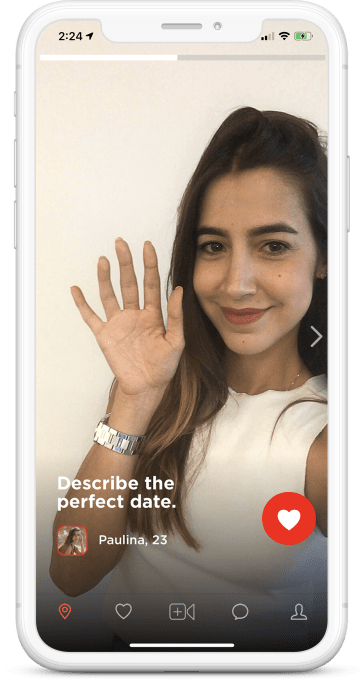
As the quarantine dramatically transforms social and romantic lives, a new dating app advised by Grindr founder Joel Simkhai and former YC chief Sam Altman is aiming to capitalize on the skyrocketing popularity of video chat.
CEO Brenden Strauss hopes his NYC-based startup Curtn can approach video calling in a mindful way during a time when so many people are sheltering in place and significantly cutting back on social interactions. Video chat can offer a temporary alternative for users that might otherwise meet up in the real world for a first date.
“What’s going on right now has entirely changed the dating game,” Strauss tells TechCrunch. “As people are struggling to connect, we’re giving people a better way to connect while they’re physically apart.”
The app is pushing video as its differentiating factor, encouraging users to create short videos for their dating profiles and aiming to move conversations to video chat after users match. Most of the major dating apps have had a complicated relationship with rich media over the past several years, moving away from sending pics or videos in favor of sidestepping the associated expenses and potential for abuse.
Bumble launched video calling in early 2019; Tinder does not support video communications.
While the company presents users with the ability to video chat with new matches, one user must get the okay from the other inside the app if they’re interested in making a call. Strauss says the team has built in reporting features from the beginning so that once bad actors pop up, they can be handled quickly.
“Safety is our top priority,” Strauss says. “The last thing we want is for this to turn into Chatroulette.”
Strauss and CTO Benjamin Honig have some noteworthy advisors to help them build a next-gen dating app. For one, Strauss’ boyfriend Joel Simkhai is the co-founder of Grindr and was one of his biggest inspirations for building out the app, he says. Former YC president and current OpenAI CEO Sam Altman is also serving as an advisor and is one of the startup’s first investors.
The team has raised a small ($425,000) pre-seed round of investment to get the app ready to share with the world.
The app’s launch is a crucial time for the company to make a splash, capitalizing on the renewed interest in video chatting apps across the board. During an earnings call this past week, Facebook CEO Mark Zuckerberg said time on group video chats had increased 1,000%. Last week, Houseparty shared they had received 50 million sign-ups in the past month.
Strauss says the team has been building out a marketing strategy with a spread of social media influencer partnerships.
Curtn’s biggest challenge is reaching critical mass and acquiring a network of users across different geographies that can encourage widespread usage of the app. The app is casting a wide net, aiming to court users of any and all sexual orientations. For the time being, users of the service only receive 10 matches per day, an effort to limit the geographic spread of suggestions and make the most of the early user base.
With video calling continuing to be a rare feature for dating apps, Curtn hopes it can own the feature and make the most of how the quarantine is shifting user habits.
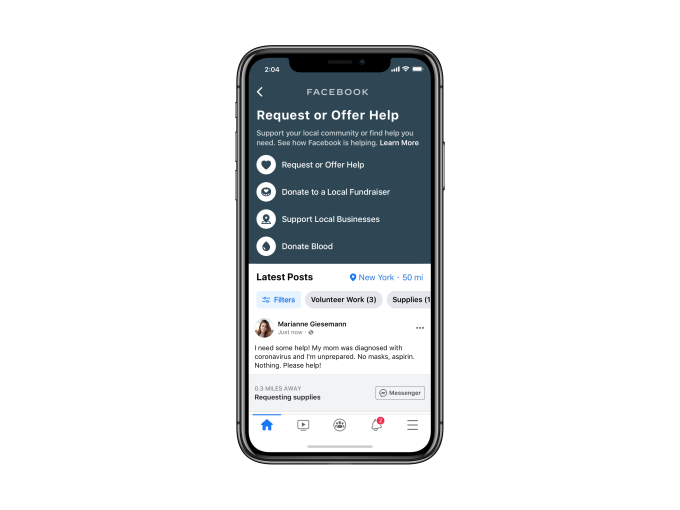
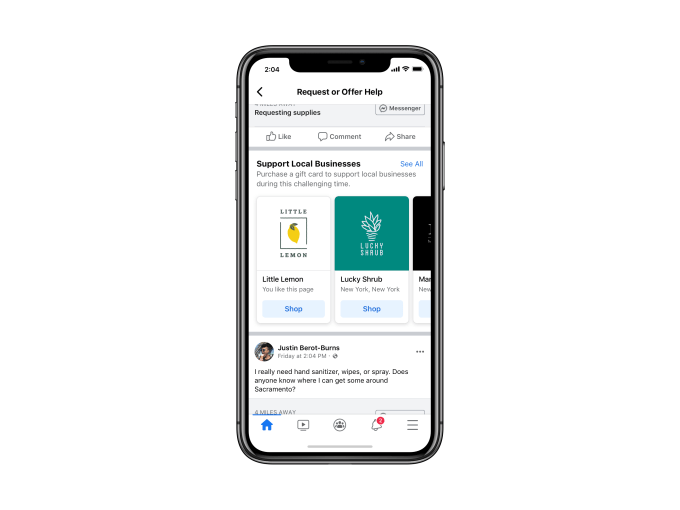
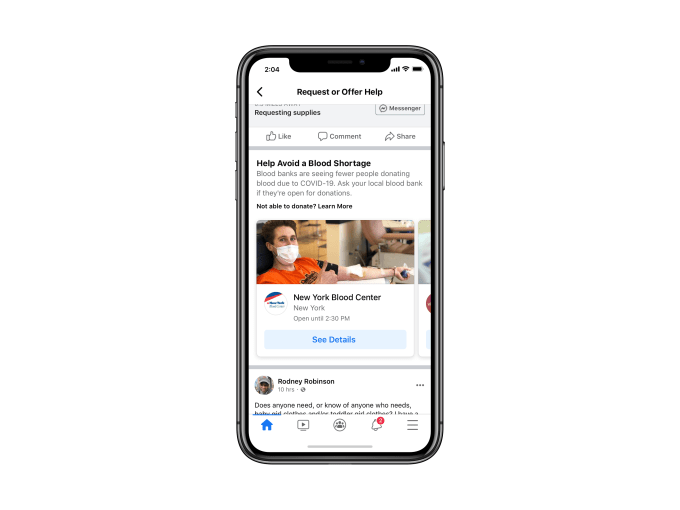
Facebook is expanding its Community Help hub to better serve local communities amid the COVID-19 pandemic. The hub has already seen significant usage by those requesting food, supplies and information about local resources, as well as use by volunteers and groups willing to lend a hand. Now, Facebook is adding more features to the hub to allow people to support local businesses, blood banks, nonprofits, and more.
As part of Facebook’s efforts with GivingTuesday, it will roll out these new additions on May 5th, it says.
Typically, the GivingTuesday charitable giving event is held on the Tuesday after Thanksgiving in the U.S. — after Black Friday and Cyber Monday sales wrap. But in response to the unprecedented need caused by the pandemic, GivingTuesday announced an emergency day of giving, called Giving Tuesday Now.
This new event happens tomorrow, May 5th, and already has a number of partners and supporters, including Facebook, as well as PayPal, America’s Food Fund, Ford, Bill & Melinda Gates Foundation, CDC Foundation, LinkedIn, United Way, GoFundMe, and many others.
Starting tomorrow, Facebook users will be able to go to Community Help at Facebook.com/covidsupport in order to buy gift cards to local businesses, sign up to donate to local nonprofits and fundraisers, sign up to be a donor at local blood banks, and find local job opportunities.
In some cases, Facebook already had built the technology and formed partnerships needed to launch these features. For example, Facebook began its work to connect Facebook users with blood banks back in 2017, then expanded the blood donations feature to the U.S. last June.
On Tuesday, these efforts are being centralized in the Community Help hub, which will give them increased visibility.
Facebook is not the only platform helping local businesses and nonprofits by rolling out new features.
Neighborhood social network Nextdoor also recently launched tools to allow businesses to promote their fundraisers and gift cards; Yelp just added a way for businesses to promote their virtual services; Instagram has introduced a range of tools for businesses, including those for connecting customers to Facebook’s gift cards or stickers for food ordering and more.
The revamped Community Help section will be live tomorrow, May 5, 2020.
You can now debunk thousands of coronavirus-related hoaxes with a few texts on WhatsApp.
Poynter Institute, a non-profit organization that supports journalism, today launched a bot on the Facebook-owned service that will allow people across the globe to debunk over 4,000 hoaxes surrounding the pandemic such as whether the infectious disease originated in a lab in Wuhan, China. (A belief popular in many circles, though no conclusive evidence to support this claim has been disclosed to the public yet — so a no for now. That’s what the bot — citing fact-checking organizations — also says, for the record.)
The chatbot relies on information supplied by over 100 independent fact-checkers in more than 70 countries. It’s the largest database of debunked falsehoods related to COVID-19, said Poynter Institute. The service is currently available in English, but support for other languages including Hindi, Spanish and Portuguese are in the works, said WhatsApp.
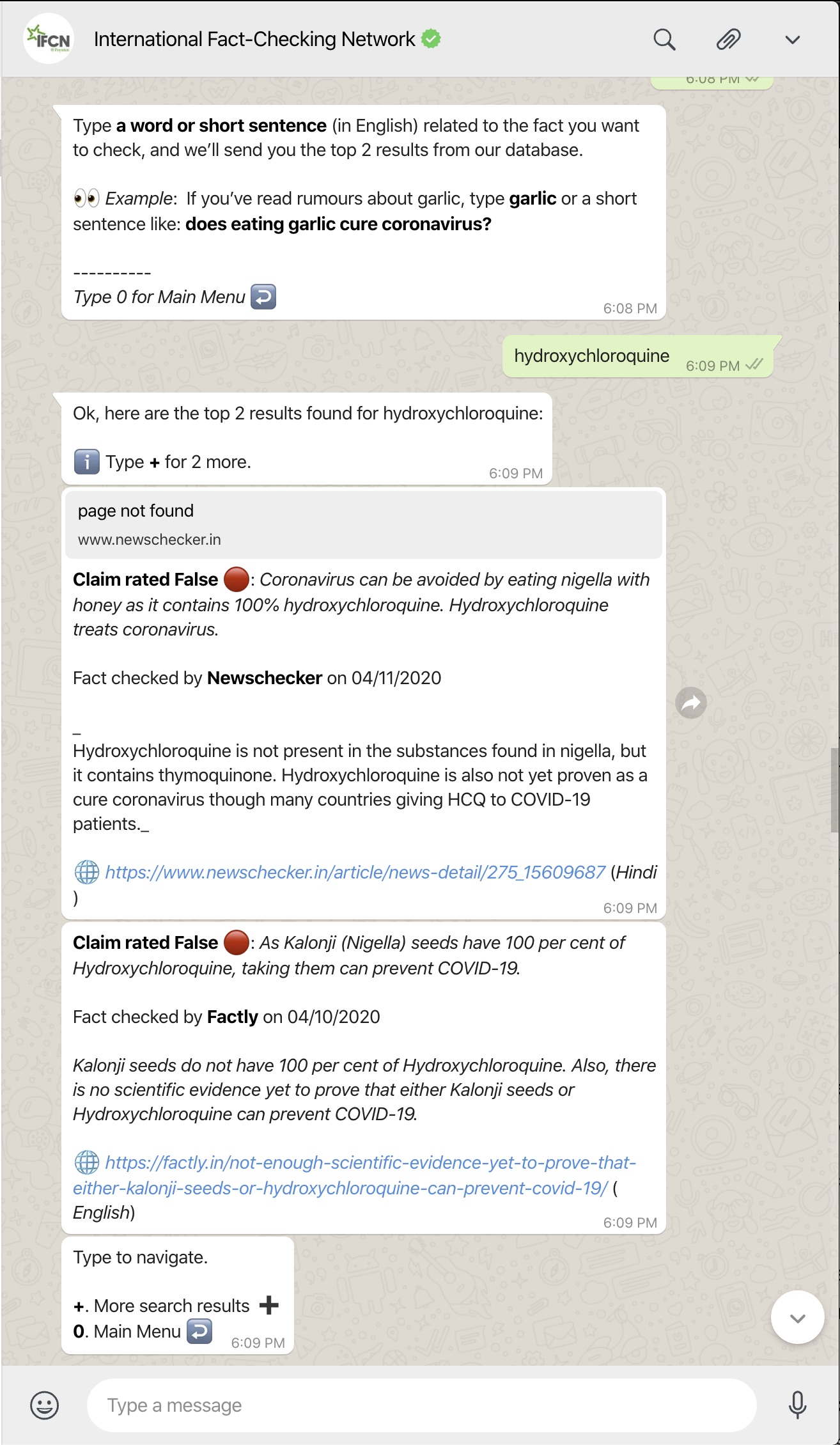
Users can test the chatbot by either saving +1 (727) 2912606 as a contact number and texting the word “hi.” Alternatively, they can click on http://poy.nu/ifcnbot that does not require one to save the chatbot’s number to their phonebook.
Once they have texted “hi” to the bot, sending “1” prompts a new message from the chatbot that asks them to enter the keyword or a short sentence of their query. Then you can type “origin,” “garlic” (to know if there is any evidence that this herb helps in fighting with coronavirus — there isn’t) or any other keyword that is on your mind. (You may have to wait for 2-3 seconds every time you engage with this chatbot and let it respond to your query before you ask a new question.)
The chatbot identifies a user’s country (by checking their mobile country code), and provides them with information that has been fact-checked by an organization that is closest to them. It also shares general tips to fight the coronavirus outbreak.
The service, which is free and works round the clock, says in its terms of condition that it may aggregate and share anonymous results of user queries and other interactions with the research community and program partners. But “your personal information, however, will never be shared.”
In a statement, Baybars Orsek, IFCN’s Director, said, “Billions of users rely on WhatsApp to stay in touch with their friends and families every month. Since bad actors use every single platform to disseminate falsehoods, to mislead others during such troubling times, fact-checkers’ work is more important than ever.”
You can now debunk thousands of coronavirus-related hoaxes with a few texts on WhatsApp.
Poynter Institute, a nonprofit organization that supports journalism, today launched a bot on WhatsApp to help people across the globe debunk over 4,000 hoaxes, including whether the infection originated in a lab in Wuhan, China. (No conclusive evidence yet.)
The chatbot relies on information supplied by over 100 independent fact-checkers in more than 70 countries. It’s the largest database of debunked falsehoods related to COVID-19, said Poynter Institute. The service is currently available in English, but support for other languages including Hindi, Spanish, and Portuguese will be rolled out soon.
Users can test the chatbot by either saving +1 (727) 2912606 as a contact number and texting the word ‘hi’. Alternatively, they can click on http://poy.nu/ifcnbot that does not require them to save the chatbot’s number to their phonebook.
Once they have texted ‘hi’ to the bot, sending ‘1’ (and then waiting for the chatbot to respond, which can take 2-3 seconds) prompts a new message from the bot, which asks them to enter the keyword of their query. Here you can type “origin,” “garlic” (to know if there is any evidence that this herb helps in fighting with coronavirus; there isn’t), or any other keyword.
The chatbot identifies a user’s country (by checking their mobile country code), and provides them with information that has been fact-checked by their closest organization. The chatbot also shares general tips to fight the coronavirus outbreak, and offers transparency on the nearest fact-checkers a person has.
The chatbot says on WhatsApp that it may aggregate and share anonymous results of user queries and other interactions with the research community and program partners. But that, “your personal information, however, will never be shared.”
In a statement, Baybars Orsek, IFCN’s Director, commented: “Billions of users rely on WhatsApp to stay in touch with their friends and families every month. Since bad actors use every single platform to disseminate falsehoods, to mislead others during such troubling times, fact-checkers’ work is more important than ever.”
The new chatbot is the latest effort from WhatsApp, used by more than 2 billion people, to curb the spread of misinformation on its platform. In recent months WhatsApp has also collaborated with the WHO to launch an information service that reached more than 10 million users within days. The Facebook-owned service is also working with federal and state governments in many markets to help them deliver authoritative information about the infectious disease in many countries.
For the last decade, I’ve touted the enormous long-term value of a dualistic approach to content marketing for SEO.
By leveraging data-centered campaigns, paired with personalized outreach to top publishers, we regularly garner earned media placements for our clients.
In rare cases, we create content that generates results so far beyond what was anticipated that a single project can greatly move the needle.
I’m going to walk through one such instance to reveal how it all works together, what can be learned from this experience, and the type of result it can achieve.
While typically you need to invest in ongoing content generation and promotion, extraordinary examples like these demonstrate the impact this kind of work has over the long-term.
Content marketing + digital PR case study: ADT
ADT is a household name with good domain authority, providing a great base to start from.
We knew that the content we’d create would likely have a leg up in terms of ranking potential, especially if that content addressed many potential high-intent keywords.
Content production
After speaking with ADT, we determined our joint goal was to create a piece of content that could earn dozens to hundreds of links from top publishers, with another focus on earning links from local news publications.
The client had the idea to create a crime map tool for ADT.com, and it fit the bill for everything we typically look for in a piece of content. But for the purpose of this article, I’ll examine what makes it ideal.
Say you were starting from scratch. You can start with a simple Google search of “crime,” which would serve as a reminder of how localized the topic is.
Just from this search alone, you can identify the desire for crime maps specifically, and you can consider why someone would search for a crime map:
To identify crime in their area
To investigate the crime in places they’re looking to visit
To investigate the crime in places they’re looking to move
Because people might not want to know just about the areas right around where they live, it was a strong idea to create a comprehensive, interactive crime mapping tool that gives users the ability to search local areas and see detailed, local-level crime statistics.
This concept had a high chance of success for other reasons as well, including:
1. It has a practical use. Not all content necessarily needs to be practical — it depends on the industry you’re in and whether you can get by with entertainment value. If it’s not practical, it should reveal insights that speak to the human experience and inform a reader about their context in the world. We actually added this element in the crime map project by building in functionality where you can compare the crime rate in your area to national averages.
However, having a practical element (or actionable advice) means your content has built-in value. It communicates that you care about the person reading it, and they engage with the content more because they feel like they can do something with the information.
2. It's data-based, making it authoritative and accurate. It’s very difficult these days to pitch publishers anything that isn’t data-based. Not only does it add credibility to what you’re working on, but showing that you did your research also indicates that you’re an authority (or becoming an authority) on the subject. I’ll dive into more on this toward the end of the article.
3. The data can be tailored to countless local angles. If your goal is to build as many valuable links and as much general brand awareness as possible, you should always consider how to localize your content.
This has to happen at the beginning when you’re collecting your data. Ask yourself: Is the data set comprehensive enough that insights about different segments, like geographic locations, can be gathered? The more people who can connect with and “see” themselves in your content by having it be as personalized as possible, the better.
4. It invokes emotions like safety and concern for loved ones. Tapping into emotional concepts is always a good strategy when creating content. Crime and security inherently come with some obvious emotions: fear, concern, pride in protecting your family, etc. If you’re in a niche that doesn’t seem to have straightforward ties to emotion, ask yourself these questions to reveal the emotions at work in the background:
Why do people care about this?
What is our audience’s biggest struggle?
What might our audience worry most about?
For example, while it doesn't seem so on the surface, personal finance can be extremely emotional. It involves the way people lead their lives and is tied to the guilt of not saving enough, the pride of being on top of their finances, the fear they won’t have enough money to retire, etc. No matter what vertical you’re in, there are emotions involved, and tapping into them with empathy can make your content exponentially more compelling and helpful.
5. As a security company, it makes perfect sense for ADT to be the brand that’s offering a resource where people can check the crime rates all over the country. When you have this sort of brand alignment with an idea, it's clear to publishers and readers alike why the brand created it, and it helps build trust.
Always consider these types of criteria when you move forward on a content concept.
Digital PR
Because of the local/regional aspect of the interactive, our outreach approach was to pitch regional news publishers with the exclusive coverage.
We customized pitches for publishers by state for our initial outreach. Here is a sample pitch similar to the one that successfully landed coverage:
Hi [Website Name] team,
In the wake of natural disasters like Hurricane Florence, fears of looting and other forms of crime are often heightened. The newly released ADT crime map wants residents to be aware of crime hot spots in their neighborhoods and use precautionary measures to prevent being victims of crime, especially during hurricane season.
The interactive map allows users to look up specific crime data and compare it to national averages to determine how much crime is happening in their area. For example, Florida’s overall crime rate is 1.21x higher than the national average. That said, the murder rate is relatively low when compared to the rest of the nation (0.03x less).
Interested in covering this so that your readers can stay as safe as possible under any circumstance? If so, feel free to use this press release or graphics from the map. We just ask that you attribute ADT by linking to the Crime Map somewhere in your coverage.
Best,
[Your Name]
Each pitch was personalized by adjusting the first and second paragraph to include locally relevant details for that area.
This regional outreach strategy had a high chance of success because:
The content was highly relevant to local news publishers
Local news publications are often the best syndicators
We put together a new, exclusive resource that many consumers would find helpful
Offering content as an exclusive makes it especially newsworthy and appealing to writers
In this case, the exclusive was given to ABCActionNews.com, a Tampa Bay, Florida ABC affiliate.
Luckily, the publisher liked the story so much, they decided to include it in that day’s nightly news coverage. As one of the largest local news affiliates in that area, this coverage was likely seen on over 25,000 local televisions.
We continued pitching the story, attempting to exhaust our pitch list and support syndication of the exclusive picked up by ABCActionNews.com.
After roughly a month, we compiled a report on all coverage and syndications. We were happy to report to our client that the story was picked up by dozens of local news publishers, eventually generating links from 127 unique linking domains per Ahrefs.
The impact on search
A graph of acquired links shows a very organic progression — something we see often when a story syndicates well across many domains.
Almost immediately the page began ranking — likely a result of the ADT site’s awesome existing domain authority, topical relevance of the project related to the domain, and the massive injection of new unique links to the crime maps page.
Don’t have high domain authority?
While having an authoritative brand can make this whole strategy a bit easier, that doesn’t mean it can’t work for you if you are newer or are trying to keep up with huge, household-name competitors.
It just means it’s even more important that you use data-focused content. We’ve always thought that using data as a foundation for content was the best way to build authority, but a recent study we did with BuzzStream about authoritative content confirmed that.
Having an authoritative methodology can increase the chances people trust your content — and thus your brand — by extension. And when you’re trying to get attention in competitive spaces, every authority signal matters.
Regarding promotions, all of the tips I’ve provided in this article should work for you. Perhaps when pitching, you can provide a sentence or two describing your brand. It’s also best practice to have someone at your company, either the person who knows the most about the topic or the person who did the research, ready to answer questions that writers may have about the content.
But in general, promotional success will be heavily based on the quality of the content you’re pitching, especially if the writer isn’t familiar with who you are.
Conclusion
Is this type of strategy easy? No. It’s much simpler to pay for links or churn out quick blog posts.
But if you’re looking for long-lasting, sustainable, never-to-be-penalized, link-and-authority-building content, this is your best route.
As we can see here, a combination of existing domain authority, an injection of a large number of new high-authority links, and a topically relevant/related piece of content for the brand can generate huge numbers of new ranking keywords extremely quickly.
If you don’t have that level of domain authority, don’t worry! This strategy can still work for you — just don’t expect it to happen overnight (as that’s so rarely the case for anyone).
It’s an investment, but as we’ve seen time and time again, it pays off exponentially.
To learn more about keyword research, visit the Keyword Research Master Guide!
Sign up for The Moz Top 10, a semimonthly mailer updating you on the top ten hottest pieces of SEO news, tips, and rad links uncovered by the Moz team. Think of it as your exclusive digest of stuff you don't have time to hunt down but want to read!
Are you mindful of your customer's experience after they become a lead? It's easy to fall in the same old rut of newsletters, invoices, and sales emails, but for a truly exceptional customer experience that improves their retention and love for your brand, you need to go above and beyond. In this popular episode of Whiteboard Friday, the ever-insightful Dana DiTomaso shares three big things you can start doing today that will immensely better your customer experience and make earning those leads worthwhile.
Click on the whiteboard image above to open a high-resolution version in a new tab!
Video Transcription
Hi, Moz fans. My name is Dana DiTomaso. I'm the President and partner of Kick Point, and today I'm going to talk to you about building better customer experiences. I know that in marketing a lot of our jobs revolve around getting leads and more leads and why can't we have all of the leads.
The typical customer experience:
But in reality, the other half of our job should be making sure that those leads are taken care of when they become customers. This is especially important if you don't have, say, a customer care department. If you do have a customer care department, really you should be interlocking with what they do, because typically what happens, when you're working with a customer, is that after the sale, they usually get surveys.
- Surveys
"How did we do? Please rate us on a scale of 1 to 10," which is an enormous scale and kind of useless. You're a 4, or you're an 8, or you're a 6. Like what actually differentiates that, and how are people choosing that?
- Invoices
Then invoices, like obviously important because you have to bill people, particularly if you have a big, expensive product or you're a SaaS business. But those invoices are sometimes kind of impersonal, weird, and maybe not great.
- Newsletters
Maybe you have a newsletter. That's awesome. But is the newsletter focused on sales? One of the things that we see a lot is, for example, if somebody clicks a link in the newsletter to get to your website, maybe you've written a blog post, and then they see a great big popup to sign up for our product. Well, you're already a customer, so you shouldn't be seeing that popup anymore.
What we've seen on other sites, like Help Scout actually does a great job of this, is that they have a parameter of newsletter at the end of any URLs they put in their newsletter, and then the popups are suppressed because you're already in the newsletter so you shouldn't see a popup encouraging you to sign up or join the newsletter, which is kind of a crappy experience.
- Sales emails
Then the last thing are sales emails. This is my personal favorite, and this can really be avoided if you go into account-based marketing automation instead of personal-based marketing automation.
We had a situation where I was a customer of the hosting company. It was in my name that we've signed up for all of our clients, and then one of our developers created a new account because she needed to access something. Then immediately the sales emails started, not realizing we're at the same domain. We're already a customer. They probably shouldn't have been doing the hard sale on her. We've had this happen again and again.
So just really make sure that you're not sending your customers or people who work at the same company as your customers sales emails. That's a really cruddy customer experience. It makes it look like you don't know what's going on. It really can destroy trust.
Tips for an improved customer experience
So instead, here are some extra things that you can do. I mean fix some of these things if maybe they're not working well. But here are some other things you can do to really make sure your customers know that you love them and you would like them to keep paying you money forever.
1. Follow them on social media
So the first thing is following them on social. So what I really like to do is use a tool such as FullContact. You can take everyone's email addresses, run them through FullContact, and it will come back to you and say, "Here are the social accounts that this person has." Then you go on Twitter and you follow all of these people for example. Or if you don't want to follow them, you can make a list, a hidden list with all of their social accounts in there.
Then you can see what they share. A tool like Nuzzel, N-U-Z-Z for Americans, zed zed for Canadians, N-U-Z-Z-E-L is a great tool where you can say, "Tell me all the things that the people I follow on social or the things that this particular list of people on social what they share and what they're engaged in." Then you can see what your customers are really interested in, which can give you a good sense of what kinds things should we be talking about.
A company that does this really well is InVision, which is the app that allows you to share prototypes with clients, particularly design prototypes. So they have a blog, and a lot of that blog content is incredibly useful. They're clearly paying attention to their customers and the kinds of things they're sharing based on how they build their blog content. So then find out if you can help and really think about how I can help these customers through the things that they share, through the questions that they're asking.
Then make sure to watch unbranded mentions too. It's not particularly hard to monitor a specific list of people and see if they tweet things like, "I really hate my (insert what you are)right now," for example. Then you can head that off at the pass maybe because you know that this was this customer. "Oh, they just had a bad experience. Let's see what we can do to fix it,"without being like, "Hey, we were watching your every move on Twitter.Here's something we can do to fix it."
Maybe not quite that creepy, but the idea is trying to follow these people and watch for those unbranded mentions so you can head off a potential angry customer or a customer who is about to leave off at the pass. Way cheaper to keep an existing customer than get a new one.
2. Post-sale monitoring
So the next thing is post-sale monitoring. So what I would like you to do is create a fake customer. If you have lots of sales personas, create a fake customer that is each of those personas, and then that customer should get all the emails, invoices, everything else that a regular customer that fits that persona group should get.
Then take a look at those accounts. Are you awesome, or are you super annoying? Do you hear nothing for a year, except for invoices, and then, "Hey, do you want to renew?" How is that conversation going between you and that customer? So really try to pay attention to that. It depends on your organization if you want to tell people that this is what's happening, but you really want to make sure that that customer isn't receiving preferential treatment.
So you want to make sure that it's kind of not obvious to people that this is the fake customer so they're like, "Oh, well, we're going to be extra nice to the fake customer." They should be getting exactly the same stuff that any of your other customers get. This is extremely useful for you.
3. Better content
Then the third thing is better content. I think, in general, any organization should reward content differently than we do currently.
Right now, we have a huge focus on new content, new content, new content all the time, when in reality, some of your best-performing posts might be old content and maybe you should go back and update them. So what we like to tell people about is the Microsoft model of rewarding. They've used this to reward their employees, and part of it isn't just new stuff. It's old stuff too. So the way that it works is 33% is what they personally have produced.
So this would be new content, for example. Then 33% is what they've shared. So think about for example on Slack if somebody shares something really useful, that's great. They would be rewarded for that. But think about, for example, what you can share with your customers and how that can be rewarding, even if you didn't write it, or you can create a roundup, or you can put it in your newsletter.
Like what can you do to bring value to those customers? Then the last 33% is what they shared that others produced. So is there a way that you can amplify other voices in your organization and make sure that that content is getting out there? Certainly in marketing, and especially if you're in a large organization, maybe you're really siloed, maybe you're an SEO and you don't even talk to the paid people, there's cool stuff happening across the entire organization.
A lot of what you can bring is taking that stuff that others have produced, maybe you need to turn it into something that is easy to share on social media, or you need to turn it into a blog post or a video, like Whiteboard Friday, whatever is going to work for you, and think about how you can amplify that and get it out to your customers, because it isn't just marketing messages that customers should be seeing.
They should be seeing all kinds of messages across your organization, because when a customer gives you money, it isn't just because your marketing message was great. It's because they believe in the thing that you are giving them. So by reinforcing that belief through the types of content that you create, that you share, that you find that other people share, that you shared out to your customers, a lot of sharing, you can certainly improve that relationship with your customers and really turn just your average, run-of-the-mill customer into an actual raving fan, because not only will they stay longer, it's so much cheaper to keep an existing customer than get a new one, but they'll refer people to you, which is also a lot easier than buying a lot of ads or spending a ton of money and effort on SEO.
Sign up for The Moz Top 10, a semimonthly mailer updating you on the top ten hottest pieces of SEO news, tips, and rad links uncovered by the Moz team. Think of it as your exclusive digest of stuff you don't have time to hunt down but want to read!
By the summer of 2016, Marie Outtier had spent eight years as a consultant advising media agencies and martech companies on marketing growth strategy.
Pierre-Jean “PJ” Camillieri started as a music software engineer before joining one of Apple’s consumer electronics divisions. Inspired by Siri, he left to start Timista, a smart lifestyle assistant.
When the two joined forces to co-found Aiden.ai, the combination was potent — one was a consummate marketer, the other, a specialist in machine learning. Their goal: create an AI-driven marketing analyst that offered actionable advice in real time.
Humans who manage ad campaigns must analyze vast amounts of numbers, but Outtier and Camillieri envisioned a tool that could make optimization recommendations in real time. Analytics are vast and unwieldy, so theirs was a no-brainer proposition with a market crying out for solutions.
The company’s first office was at Bloom Space in Gower Street, London. It was just a handful of hot desks and a nearby sofa shared with four other startups. That summer, they began in earnest to build the company. A few months later, they had a huge opportunity when the still 100% bootstrapped company was selected for Techcrunch Disrupt’s Startup Battlefield competition.
Interviewed by TechCrunch, they explained their proposition: Marketers wanted to know where a digital marketing campaign was getting the most traction: Twitter or Facebook. You might need to check several dashboards across multiple accounts, plus Google analytics to compile the data — and even if you conclude that one platform is outperforming the other, that might change next week as users shift attention to Instagram, potentially wasting 60% of ad spend.
Aiden was intended to feel like just another co-worker, relying on natural language processing to make the exchange feel chatty and comfortable. It queried data from multiple dashboards and quickly compiled it into flash charts, making it easy to find and digest.
Eventually, instead of managing 10 clients, marketing analysts would be able to manage 50 using dynamic predictions as well as visualizations. Aiden incorporated Outtier’s expertise into its algorithms so it could suggest how to tweak a Facebook campaign and anticipate what was going to happen.
Was appearing at Disrupt a significant moment? “It was a big deal for us,” says Outtier. “The exposure gave us ammunition to raise our first round. And being part of the Disrupt Battlefield alumni gave us many meaningful networking and PR opportunities.”
A few weeks later the company had raised a seed round of $750,000. But not without difficulty. By this time Outtier was in the latter stages of pregnancy. Raising money under these circumstances was difficult, but, she says, “it can be done. It’s tougher than ‘normal circumstances.’ It’s a bit like running a marathon, but with a fridge on your back.”