Twitter is making it possible for developers and researchers to study the public conversation around COVID-19 in real time with an update to its API platform. The company is introducinga new COVID-19 stream endpoint to those participating in Twitter Developer Labs — a program that offers access to new API endpoints and other features ahead of their public release. The new COVID-19 endpoint will allow approved developers to access COVID-19 and coronavirus-related tweets across languages, resulting in a data set that will include tens of millions of tweets daily, Twitter says.
The data can be used to research a range of topics related to the coronavirus pandemic, including things like the spread of the disease, the spread of misinformation, crisis management within communities and more.
Developers may also use the new data set to build machine learning and data tools to help the scientific community answer key questions about COVID-19, Twitter notes.
The company itself will determine which tweets qualify for inclusion in this data set based on which words are used in the tweets — like “COVID-19” or “coronavirus,” for example. It also will pull tweets that use common coronavirus hashtags, which tend to be language-agnostic. These, by the way, are the same keywords that Twitter uses for its existing COVID-19 topic, which is powered by a Tweet annotation.
Twitter will also filter this data stream to exclude spammy and low-quality content.
While access to the endpoint will be free, Twitter will be hand-selecting which developers and researchers will be granted permission to use it. Developers will also have to inform Twitter of their project plan, detail their experience in working with big data and detail the available resources they have to process such a data set.
“Given the expertise and computational resources necessary to handle this data, and recognizing the sensitivity of it, we’ve created a dedicated application to access this endpoint and plan to carefully review access requests to ensure they support the public good,” notes Twitter in an announcement. “We also encourage applicants to describe in detail the safeguards they intend to implement to protect the privacy and safety of people represented in these data, including applicable institutional reviews and ethics screenings,” it says.
Twitter says it will prioritize processing applications from researchers and developers with established expertise and resources.
The application and endpoint are launching today. No developers or researchers had early access.
In addition to the application requirement to access the new endpoint, developers will also need to already have an approved developer account and adhere to the terms of Twitter’s Developer Agreement and Policy, which provides guidance about restricted use cases relevant to projects analyzing health-related topics. To ensure the data is kept in compliance, approved developers will also gain access to a new compliance stream endpoint, as well.
The new endpoint is one of several efforts Twitter has made since the coronavirus outbreak began, focused on connecting people with information about the pandemic. Across its platform, it introduced changes to make COVID-19 facts and reliable health information more accessible. It also updated its ads policy, partnered with relief organizations and matched fundraising donations, among other things.
“Public conversation can help the world learn faster, solve problems better and realize we’re all in this together,” said Twitter CEO Jack Dorsey, in a statement released today. “Facing a devastating global pandemic really brings that, and Twitter’s role, to light,” he added.
Twitter has said that tweets posted early Tuesday morning by Tesla and SpaceX CEO Elon Musk that irresponsibly call for restrictions put in place to defend against the spread of COVID-19 don’t violate its guidelines around inaccurate or disputed information about the coronavirus that could cause harm. Musk tweeted a series of things on Tuesday, including an endorsement of a controversial Wall Street Journal op-ed with the caption “Give people their freedom back!”
A Twitter spokesperson told TechCrunch that these tweets, which also include an urging to “FREE AMERICA NOW,” are “not currently in violation of the Twitter rules. According to the company, it has said previously that it’s not enforcing punitive or corrective action on each instance of tweets about COVID-19 that don’t provide a full picture or that appear to contain info that’s disputed by other sources.
Twitter says that it has removed over 2,400 Tweets since March 18 when it implemented its new policy, and that it’s automated filtering systems have addressed in some way or another as many as 3.4 million accounts which seemed to be spamming or providing manipulative info regarding COVID-19 discussions. Thus far, however, some of the most influential sources of have not been subject to punitive or corrective action under the policy.
President Trump’s tweets calling to “liberate” states, for instance, which bear a content and formatting similarity to the new tweets by Musk, have not been removed or disputed by the social network, and Twitter provided a similar statement about those missives not currently violating its rules.
Trump and Musk represent some of the most influential Twitter users, with 78.9 million and 33.3 minion users respectively, so their voices have outweighed impact on the community and public discourse relative to spam or automated misinformation accounts. In both cases, these messages indirectly seek to encourage the curtailing or disruption of social distancing, isolation and quarantine measures, even as the U.S. surged past 1 million diagnosed cases this week, with many more likely undiagnosed and therefore unaccounted for in the total.
The coronavirus pandemic has sent record numbers of new users to video chat apps. Now, video messaging app Marco Polo aims to capitalize on the increases it’s also seeing to launch its new subscription business, Marco Polo Plus. The service delivers a handful of new features — including support for HD video, voice-only messaging options, custom emoji, expanded speed controls and more — for $5 per month with an annual subscription of $59.99.
On a monthly basis, the service costs $10 per month.
Marco Polo had already carved out its own space on the market before the coronavirus outbreak. Instead of focusing on live video calls or group video chats, Marco Polo focuses on asynchronous communication. That is, users leave a video message for friends and family, which the other party can watch at their convenience, then reply to.
This works particularly well for people who have different work schedules or those who are spread out among various timezones. It also works for adults who have less free time to chat than the teens who virtually “hang out” in group video chat apps, like Houseparty.
With the new Marco Polo Plus subscription, the company is offering an expanded feature set that will appeal to its most frequent users. However, it will remain an optional upgrade — free users will still be able to use Marco Polo as before.
Subscribers, meanwhile, will be able to message their friends and family in HD or have the option to respond using only their voice, for those times you’re not camera-ready.
The subscription will also expand its set of built-in reaction emoji, which today includes a smiley face, sad face, heart, prayer hands, and thumbs up — to now include support for adding any emoji from your keyboard.
In addition, subscribers will have more granular control over playback speed. While free users can choose to 2x their video messages, paying users will be able to access speed control options of anywhere between 1.5x and 3x speed.
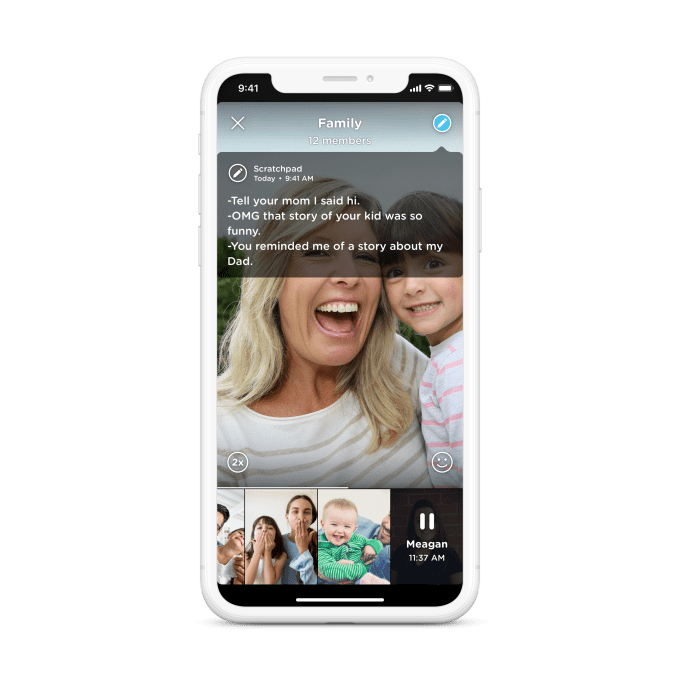
They’ll also gain a time scrubber for more easily moving to different parts of the video and a scratchpad for personal notes. The latter is especially helpful for jotting down the different parts of the message you want to respond to — something that can be hard to remember after listening to a long video.
Subscribers will be able to share their $5 per month subscription in the form of “Plus Passes” you can dole out to friends and family, as well.
Like many apps in the space, Marco Polo has seen a sizable jump in usage due to the COVID-19 pandemic, it says.
In March 2020, Marco Polo saw a 16x increase in new sign-ups for its service and a 3x increase in activity versus the prior month. In one 24-hour period in April, Marco Polo even saw a record 20 million video messages shared in its app. And its social media campaign designed at reaching out to others, #PoloTogether, resulted in over 1 million check-ins.
According to data from Sensor Tower, Marco Polo has seen nearly 56 million lifetime installs across iOS and Android since January 2014. Publicly, Marco Polo says it has “millions” of users and 3 billion messages sent to date. Across its 1.7 million user reviews on both app stores, the app averages a 4.8 rating.
The new subscription program is only one way Marco Polo is working to gain traction for its app in the coronavirus era.
The company also recently launched a program called Channels by Marco Polo into beta testing, which allows creators to reach fans through the Marco Polo platform, but via a dedicated app.
The program is aimed at those with a following — like leaders, speakers, facilitators, creators, fitness instructors, and health and career coaches — who want to offer their content to a paid membership base.
While these creators could publish to social media platforms and then try to monetize in other ways, like through ads or brand deals, Marco Polo offers a way to facilitate more private one-to-many interactions.
The advantages of this program is that the content won’t be at the mercy of changing algorithms or interrupted with ads. However, as a paid membership program, it limits exposure. That means it would likely only supplement the efforts creators made across social media to raise awareness of their offerings and their personal brand, in order to gain new subscribers.
The program is not broadly available, but is being used by a handful of testers today.
The Channels program is also aimed at helping Marco Polo generate revenue, as the company takes a 10% cut of the monthly membership fees charged by the creators.
The new Marco Polo Plus subscription service replaces an older, less feature-rich service that never gained traction. Along with the new Channels program, the company hopes stay ad-free and turn a profit.
“From the time Marco Polo was founded, we’ve never shown ads in the app. We will never use social comparisons or manipulate algorithms, as so many social networking companies must do for their business model,” explains CEO and co-founder Vlada Bortnik. “We believe that Marco Polo Plus is the best version of our app to date, and subscription is an important part of our strategy to achieve profitability. Based on our early pilot of Channels by Marco Polo, we’re optimistic that it also has the potential to contribute significantly to our monetization goals,” she continued.
“I know we can become a sustainable business in a way that feels true to our brand values of authenticity and trust,” Bortnik added.
Marco Polo’s parent company Joya Communications has raised at least $25 million in funding from investors including Benchmark, Stanford’s StartX Fund, Matrix Partners, Battery Ventures, Altos Ventures, Evolve Ventures, and others, according to Crunchbase. The company declined to comment its total raise or investor lineup, however.
Here’s some consolation for the Class of 2020: a virtual graduation ceremony, which kicks off at 11AM PT/2PM ET on May 15 via the Facebook Watch App. Oprah Winfrey will be giving the commencement address, while Awkwafina, Jennifer Garner, Lil Nas X and Simone Biles will all be giving speeches. And Miley Cyrus is set to perform.
Other sites are holding similar events — and many schools are also planning their own, less star-studded events to celebrate graduations remotely.
More details have emerged about a coronavirus contact tracing app being developed by U.K. authorities. NHSX CEO Matthew Gould said today that future versions of the app could ask users to share location data to help authorities learn more about how the virus propagates.
The app is actually an update and rebrand of Arrive, an app for tracking packages from Shopify merchants and other retailers — in addition to package tracking, Shop allows consumers to browse a feed of recommended products, learn more about each brand and make purchases using the one-click Shop Pay checkout process.
David Bradbury, a security veteran with more than two-decades of security experience and recently served as chief security officer at Symantec, takes over from Yassir Abousselham, who departed for Splunk in February.
This month, when we asked 17 VCs how this era would impact consumer startups, gaming was one of the top verticals they named. We wanted to learn more about how the venture community thinks about the future of this sector, so we asked five experienced gaming investors about where they do — and don’t — see new opportunities within this trend. (Extra Crunch membership required.)
The original Mavic Air’s 21 minutes of life was among Brian Heater’s key frustrations with the product. The company says the new drone should be able to get up to 34 minutes on a charge.
The firm is looking for companies at the very early stage, from pre-seed to pre-Series A. Partech can invest as little as a few hundred thousands dollars and as much as several million dollars, depending on the stage of the startup.
The Daily Crunch is TechCrunch’s roundup of our biggest and most important stories. If you’d like to get this delivered to your inbox every day at around 9am Pacific, you can subscribe here.
Now that the COVID-19 pandemic has forced millions into isolation, video games are seeing a surge in usage as people seek entertainment and social interaction.
When we surveyed gaming-focused VCs in October, Andreessen Horowitz partner Jonathan Lai predicted that “next-generation games will be bigger than anything we’ve seen yet,” eventually reaching “Facebook scale.” This month, when we asked 17 VCs how this era would impact consumer startups, gaming was one of the top verticals they named.
We wanted to learn more about how the venture community thinks about the future of this sector, so weasked five experienced gaming investors about where they do — and don’t — seenewopportunities within this trend:
Below are their responses, edited for space and clarity. We’ll follow up with surveys on other gaming categories in the next couple of weeks.
And if you’re interested in understanding the challenges for gaming companies aiming to become next-generation social platforms, be sure to read myeight-part series on virtual worlds.
I’m going to make a bet with you that if you follow the 3 steps below, and you really follow them, you can get 10,000 visitors from Google.
I promise it won’t be hard, but it will take time.
And if you follow my steps and don’t get the results, hit me up and I will personally help you with your marketing.
All I ask is you do it for 3 months straight. You may not get to 10,000 visitors from Google in 3 months as some niches are really tiny, but most of you should get there or be well on your way.
Again, if you prove to me that you followed everything below and you don’t achieve the results, you can get in touch and I will personally help you with your marketing for free.
Ready?
Step #1: Finding the right keywords
If you pick the wrong keywords, you’ll find yourself with little to no traffic and, even worse, you’ll find yourself with little to no sales.
So, before we get you on your way to more search traffic, let’s find you the right keywords.
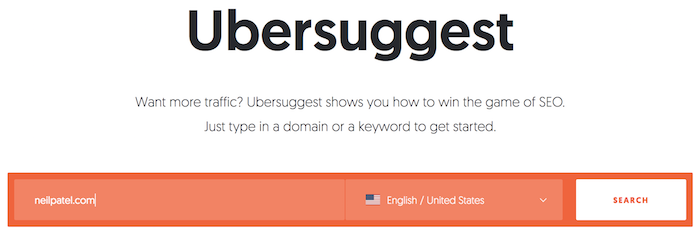
I want you to head to Ubersuggest and type in your competitor’s domain name.
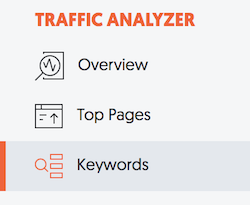
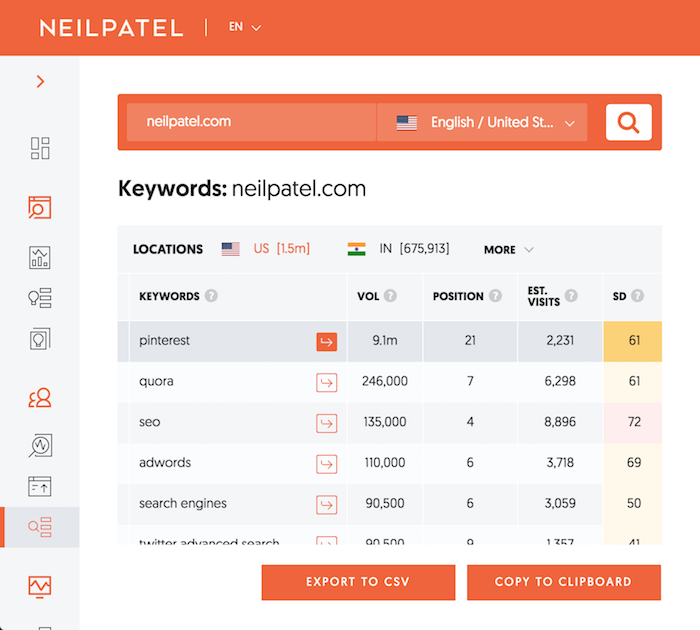
Now, I want you to click on the “Keywords” navigational option in the sidebar.
This report will show you all of the keywords that your competition is ranking for.
If you don’t see a list of thousands of keywords, that means you didn’t type in a big enough competitor. And if you don’t know who a big competitor is, just do a Google search for any major term related to your industry. The sites at the top are your major competitors.
I want you to go through the list of keywords and look for all of the keywords that are related to your business and have an SEO Difficulty (SD) score of 40 or less. The higher the number, the harder the keyword is to rank for. The lower the number, the easier it is to rank for.
In addition to an SD score of 40 or lower, I want you to look for keywords that have a volume of 500 or more.
Volume means the number of people that search for the keyword on a monthly basis. The higher the number, the more potential visitors that term will drive once you rank for it.
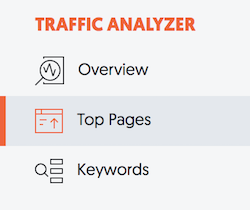
Next up, I want you to click on “Top Pages” in the navigation.
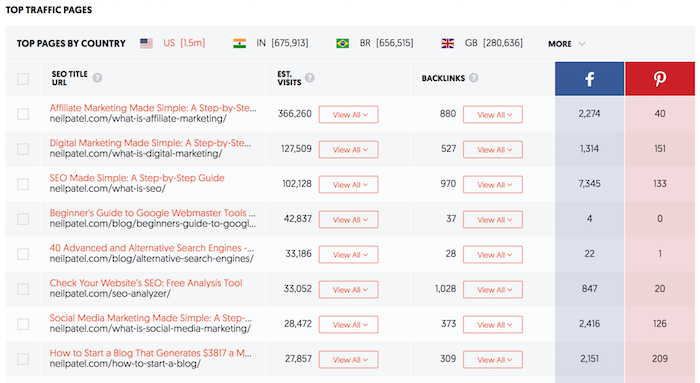
This will bring you to a report that looks like this:
This report shows you the most popular pages on your competitor’s site.
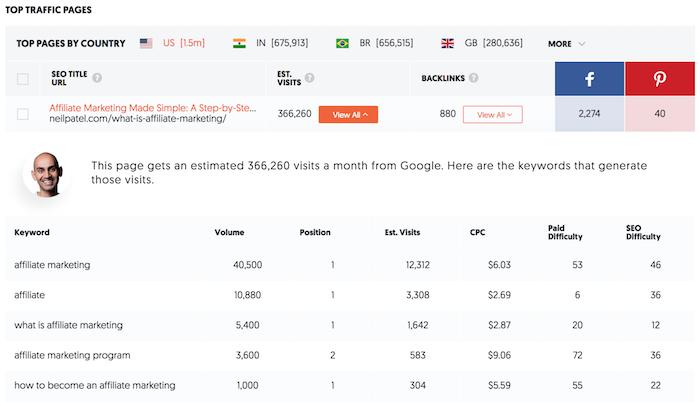
Now, under the Est. Visits (Estimated Visits) column, I want you to click on “view all” for the first few results.
Every time you do that it shows you all of the keywords that drive traffic to that page.
Just like you did with the keywords report, I want you to look at the keywords that have an SD of 40 or lower and a volume of 500 or more.
The one difference though, is that I want you to check out some of the URLs on the Top Pages report.
Click on over to the site so you can see the type of content they are writing. This is important because it will give you an idea of the types of content that Google likes to rank.
When you create similar pages (I will teach you how to do this shortly), it will allow you to get similar results to your competition over time.
Now that you have a handful of keywords, I want you to expand the list and find other related keywords.
In the navigation menu, click on “Keyword Ideas.”
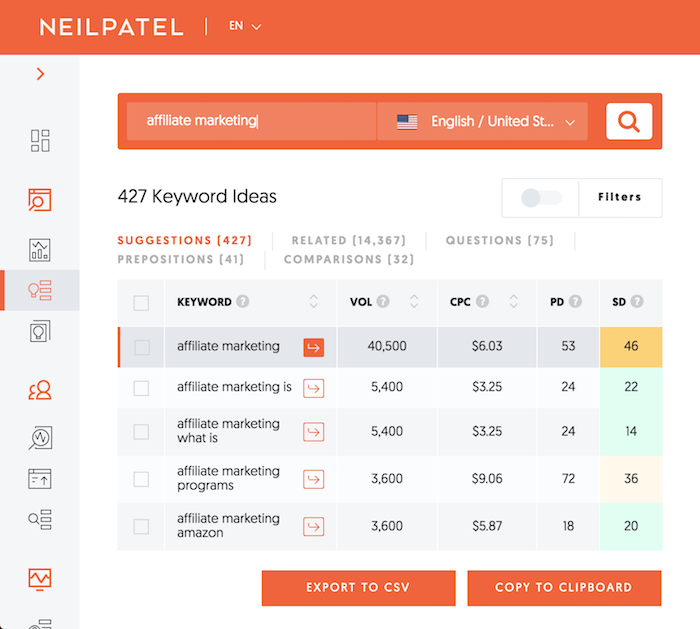
When you type in one of the keywords you are thinking of going after in this report, it will give you a big list of other similar keywords.
This is important because it will show you all of the closely related terms.
For example, let’s say you came up with a list of keywords of a handful of keywords, such as:
Dog food
Cat food
Dog bed
How to clean your cat
What do birds eat
You can’t just take all of those keywords and write one article and shove all the keywords in because they aren’t similar to each other. Someone looking for “dog beds” is probably not interested in reading about what birds eat.
So by typing in a keyword into the Keyword Ideas report, it will show you all of the other similar keywords that you can include in a single article.
When you are on the Keyword Ideas report you’ll notice some tabs: Suggestions, Related, Questions, Prepositions, and Comparisons.
I want you to go through each of those tabs. They will show you a different group of similar keywords that you may be able to include in your article (we will go over how to write the article in step 2).
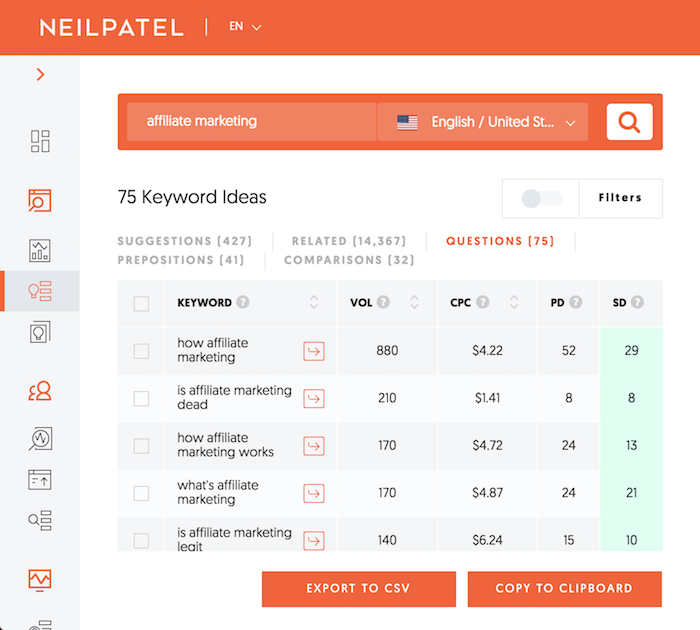
Just take a look at the Questions tab:
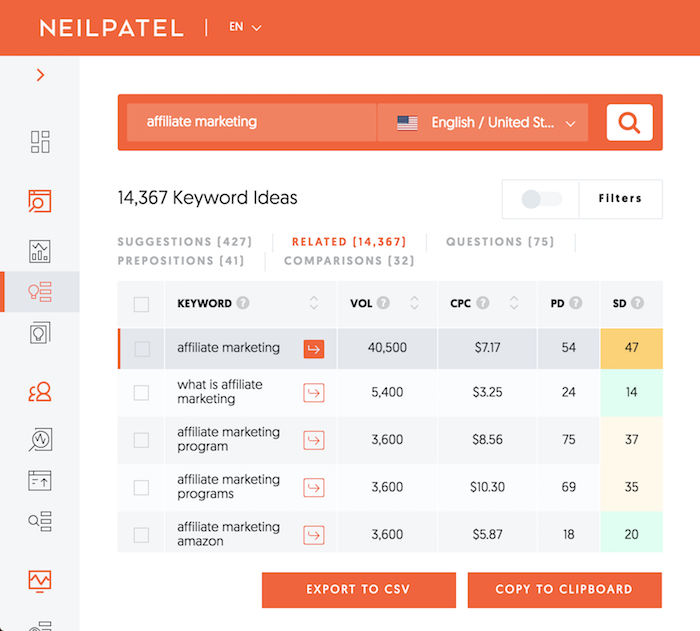
You can see the keywords are drastically different than the Related tab:
Again, you’ll want to look for all keywords that have an SD score of 40 or lower. But this report looks for keywords that have a volume above 200.
I know 200 may seem like a small number, but if you find 100 good keywords that all have a volume of 200 or more, that adds up to 20,000 potential visitors per month. Or better yet, 240,000 per year.
Now it’s rare that you are going to get all of those people to come to your site, but you can get a portion of them. Even 10% would add up… especially if you did this with a handful of articles.
Your goal should be to have a list of at least 100 keywords that are very similar. You’ll want to do this at least five times. For example, remember that list of five keywords I mentioned above wasn’t too similar to each other…
Dog food
Cat food
Dog bed
How to clean your cat
What do birds eat
You’ll want to make sure that for each main keyword you use the Keyword Ideas report to find another 100 that can accompany each keyword.
Step #2: Write content
At this point, you should have a list of keywords. If your list of keywords isn’t at least 100 keywords per group, go back to step 1 and keep at it.
It’s not that hard to get to 100 similar keywords that you can include in one article. It just takes some time to continually search and find them.
In general, as a rule of thumb, I can find 100 keywords in less than 8 minutes. It may take you a bit longer than me at first, but once you get the hang of it, it’ll be easy.
With your newly found keywords, I want you to write an article.
All you have to do is follow this tutorial step-by-step to write your first article.
Or, if you prefer a video tutorial, watch this:
As for your keywords, naturally place them into the article when it makes sense.
What you’ll quickly learn is that you probably won’t be able to “naturally” include all 100 keywords within your article. And that’s fine.
The last thing you want to do is stuff in keywords because you aren’t writing this article for just search engines, you are writing it for people… and the secondary benefit is that search engines will rank it because it contains the right keywords.
Before you make your article live on your site, I want you to keep a few things in mind:
Keep your URLs short – Google prefers shorter URLs.
Include your main keyword in your headline – by having your main keyword in your headline, you’ll be more likely to rank higher.
Include your three main keywords in your meta tags – whether it is your title tag or meta description, include at least three main keywords in them. You won’t fit as many in your title tag, and that’s fine, but you should be able to within your meta description tag.
There are a lot of other things you can do to optimize your articles for SEO, but my goal is to keep this simple. Again, if you just follow these three steps, you’ll hit the 10,000-visitor mark.
So, for now, let’s just keep things simple and once you hit your goal, then you can get into the advanced stuff.
Step #3: Promoting your content
Writing content is only half the battle. Even if you include the right keywords in your article, if you don’t promote, it’s unlikely that it would be read or rank on Google.
So how do you make sure your content is read and ranks well?
Well, first you need to get social shares, and second, you need to get backlinks.
Yes, search engines don’t necessarily rank pages higher when they get more Facebook shares or tweets, but the more eyeballs that see your page the more likely you are to get backlinks.
And the more backlinks you get, generally, the higher you will rank.
So here’s how you get social shares…
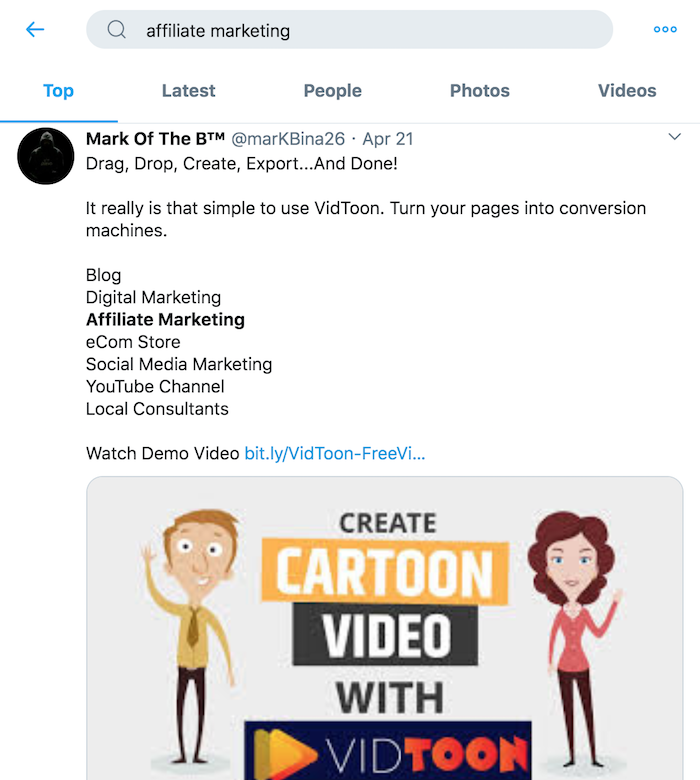
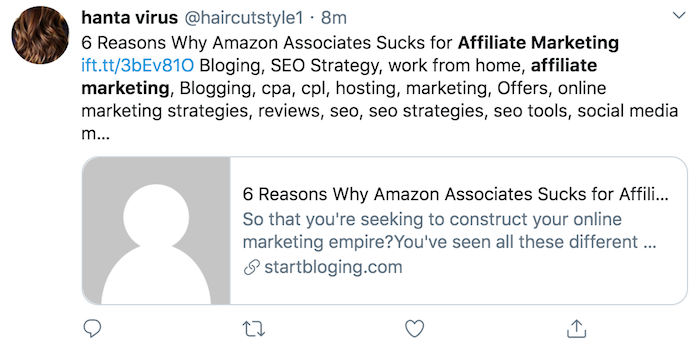
First, I want you to go to Twitter and search for keywords related to your article.
As you scroll down, you’ll see thousands of people tweeting about stuff related to your keywords. Some of them will just be general updates but look for the members sharing articles.
And…
Now what I want you to do is click on their profile and see if they mention their contact information or their website. If they mention their email you are good to go. If they mention their website, head to it, and try to find their contact information.
You won’t be able to find everyone’s contact information, but for the people you do, I want you to send them this email:
Subject: [insert the keyword you searched for on Twitter]
Hey [insert their first name],
I saw that you tweeted out [insert the title of the article they tweeted]. I actually have an article that I recently released on that subject.
But mine covers [talk about what your article covers and how it is unique].
[insert link to your article]
If you like it, feel free to share it.
Cheers,
[insert your name]
PS: Let me know if you want me to share anything for you on Twitter or any other social network.
What you’ll find is a large percentage of the people will be willing to share your content because they already are sharing related content and, of course, you offered to share their content, which helps out too.
If you send out 30 to 40 emails like this, you’ll start getting traction on the social web.
Now that you have social shares, it’s time to build backlinks. Instead of giving you tons of link building methods as there are many that work, I am just going to start you off with one that works very well.
I want you to head back to the Keyword Ideas report on Ubersuggest.
Once you get there, type in some of the keywords that you are trying to go after.
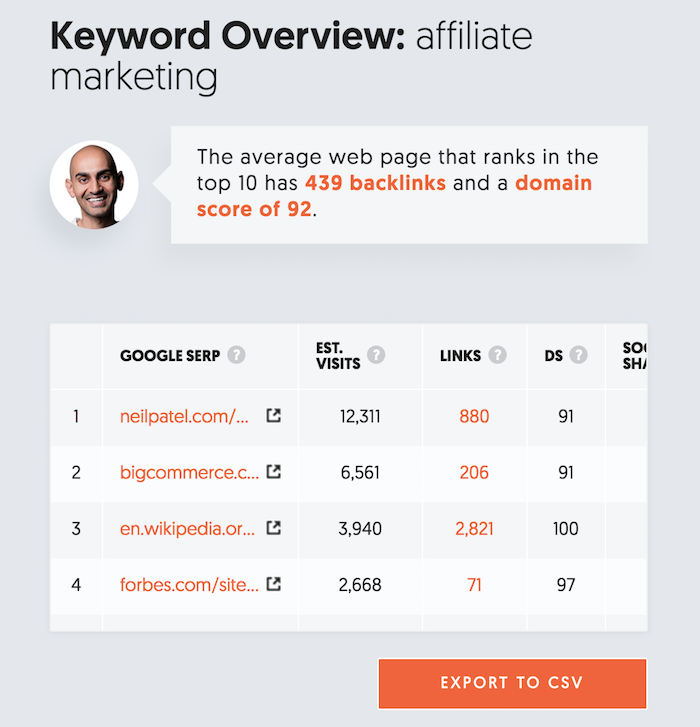
On the right side of the report, you’ll see a list of sites that rank and the number of backlinks that each of the ranking URLs has.
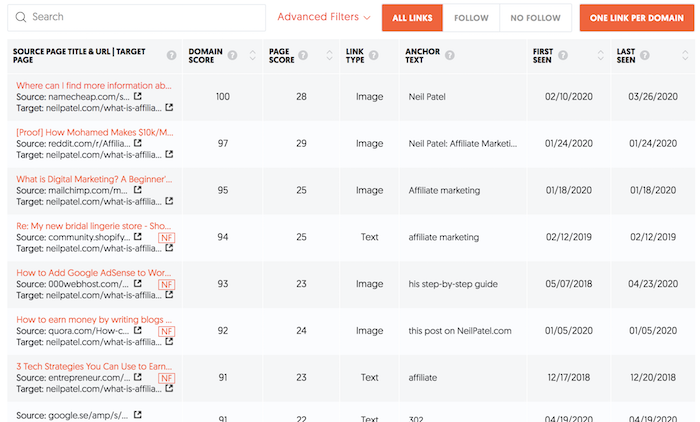
Click on the “Links” number. For each result, it will take you to the Backlinks report, which looks something like this:
This will give you a list of all the sites linking to your competitor’s article.
I want you to go to each of those URLs, find the site owner’s contact information, and shoot them an email that looks like this:
Subject: [name of their website]
Hey [insert their name],
I noticed something off with your website.
You linked to [insert your competitor that they linked to] on this page [insert the page on their site that they are linking to them from].
Now you may not see anything wrong with that, but the article you linked to isn’t helping out your website readers that much because it doesn’t cover:
[insert a few bullet points on how your article is better and different]
You should check out [insert your article] because it will provide a better experience for your readers.
If you enjoyed it, feel free to link to it.
Cheers,
[insert your name]
PS: If I can ever do anything to help you out, please let me know.
I want you to send out 100 of those emails for each article you write.
Conclusion
Yes, it takes work to get 10,000 visitors but once you do it you’ll continually generate traffic and, more importantly, sales.
To achieve 10,000 visitors, I want you to do the steps above five times. In other words, you will be writing five pieces of new content following the steps above.
It’s actually not that bad because you can just do 1 a week. So, within 5 weeks you would have done your job.
So, are you going to accept the challenge? If you do everything and don’t see the results over time, you can hit me up and I’ll help.
How do you leave the place that made you? You figure out what it made you for. TechCrunch made me a part of the startup ecosystem I love. Now it’s time to put that love into action to help a new generation of entrepreneurs build their dreams and tell their stories.
So it’s “TC to VC” for me. After 8.5 years at TechCrunch and 10 in tech journalism, I’m leaving today to join the venture team at VC fund SignalFire. I’m going to be a principal investor and their head of content.
I’ll be seeking out inspiring new companies, doing deals (when I’m eventually up to speed) and providing pitch workshops based on countless interviews for TechCrunch. Thankfully, I’ll also still get to write. We’re going to find out what founders really want to learn and produce that content to help them form, evolve and grow their companies. I’m doing my signature bounce & smile with excitement.
Where to follow my writing
You’ll still be able to follow my writing as well as my journey into VC on my newsletter Moving Product at constine.substack.com as well as on Twitter: @JoshConstine. No way I could just suddenly shut up about startups! If you’re building something, you can always reach me at joshsc [at] gmail.com
On the newsletter you can read a deeper explanation for why I picked SignalFire. I also just published the first real issue of Moving Product on how quarantine is “loaning” concurrent users to startups that will help the new wave of synchronous apps snowball to sustainability, plus commentary from top product thinkers on Facebook’s new Rooms.
Why I chose SignalFire?
I was drawn to SignalFire because it’s built like the startups I love writing about: to solve a need. Entrepreneurs need tactical advantages in areas like recruiting, where they spend most of their time, and expert advice on specific problems they’re facing.
SignalFire CEO and founder Chris Farmer
That’s why SignalFire spent six years in stealth building its recruitment prediction and market data analysis engine called Beacon. It can spot deal opportunities for SignalFire’s new $200 million seed and $300 million breakout funds while helping the portfolio hire smarter. Then SignalFire assembled more than 80 top experts, like Instagram’s founders, for its invested advisor network. Traditional funds need partners to exhaust their social capital asking for favors from friends to help their portfolio. SignalFire’s model sees its advisors share in the returns of the fund, so they’re sustainably motivated to assist.
SignalFire’s founder and CEO Chris Farmer was also willing to invest in me, figuratively. I’ve written about thousands of startups but I’ve never funded one. He and his team have offered to mentor me as I learn the art and science of investing. They also accept me for my opinionated, outspoken self. Instead of constricting my voice, the plan is to harness it to highlight new ideas and proven methods for building companies. I wrote this post on my newsletter with a deeper look at why I picked SignalFire and how its modernized approach to venture works.
What makes TechCrunch different
Of the 3,600 articles I’ve written for TechCrunch, this was the hardest.
TechCrunch gave me the platform to make an impact and the freedom to say what I believe. That’s a rare opportunity in journalism, but especially important for covering startups. TechCrunch writes about things that haven’t happened yet. There are often no objective facts by which to judge an early-stage company. Whether you decide to cover them or not, and the tone of your analysis, depends on having conviction about whether the world needs something or not, if the product is built right and if the team has what it takes.
If you rely on others’ signals about what matters, whether in the form of traction or investment, you’ll be late to the story. That means editors have to trust their writers’ intuition. At TechCrunch, that trust never wavered.
SAN FRANCISCO, CALIFORNIA – OCTOBER 04: (L-R) Snap Inc. Co-founder & CEO Evan Spiegel and TechCrunch editor-at-large Josh Constine speak onstage during TechCrunch Disrupt San Francisco 2019. (Photo by Steve Jennings/Getty Images for TechCrunch)
Eric Eldon, Alexia Tsotsis and Matthew Panzarino put their absolute faith in our team. That gave me a chance to write the first-ever coverage of startups like Robinhood before its seed round, and SnappyCam before it was acquired by Apple and turned into iPhone burst fire. My editors also never shied away from confrontations with the tech giants, like my investigation into Facebook paying teens for their data that caused it to shut down its Onavo tool, or my exposé on Bing suggesting child abuse imagery in search results that led it to overhaul its systems.
I met my wife Andee at a TechCrunch event. [Image Credit: Max Morse]
I’ll always be indebted to Eric Eldon, who gave a freshly graduated cybersociologist with no experience his first shot at blogging back at Inside Facebook. Editors like Alexia Tsotsis and Matthew Panzarino helped me develop a more critical voice without sterilizing my personality. And all my fellow writers over the years, including Zack Whittaker and Sarah Perez, pushed me to hustle, whether that meant pontificating on new product launches or exposing industry abuse. If my departure from journalism elicits a sigh of relief from the companies in my cross-hairs, I know I did my job. The TechCrunch business and events team have turned Disrupt into the tech industry’s reunion. I appreciate them giving me the chance to learn public speaking, from the most heartfelt moments to the cringiest. And really, I owe them the rest of my life, too, since I met my wife Andee at a Disrupt after-party.
Treating writing like a sport to be won kept me cranking all these years, and I’m grateful for Techmeme offeringa scoreboard for extra motivation. I’ll unhumbly admit it’s nice to hang up my jersey while ranked No. 1. My gratitude to Jane Manchun Wong for furnishing so many scoops over the years, and to all my other sources. It’s been fun competing and collaborating with my favorite other reporters, and I know Taylor Lorenz, Casey Newton and Mike Isaac will keep a close eye on tech’s trends and travesties.
But most of all, I want to extend an enormous thank you to…you. To everyone who has read or shared my articles over the years. I woke up each day with a sense of duty to you, and felt proud to say “I fight for the user” like Tron. What makes this industry special is how the community refuses to treat it as zero-sum. We grow the pie together, and everyone knows their competitor today could be their future co-founder. That makes us willing to share and learn together. I believe no recession, correction or bubble-burst will change that.
BERLIN, GERMANY – DECEMBER 12: Group Photo on stage at TechCrunch Disrupt Berlin 2019 at Arena Berlin on December 12, 2019 in Berlin, Germany. (Photo by Noam Galai/Getty Images for TechCrunch)
So I’ll leave you with a final thought that’s made my life so fulfilling: If you have the privilege or create the opportunity, turn your passion into your profession.
Specialize. Learn. Then make what you want. If you can find some niche you’re endlessly interested in, that’s growing in importance, and at least someone somewhere earns money from, you’ll become essential. Not necessarily today. But that’s the beauty of writing — it teaches you while proving to others what you’ve been taught. No matter what it is, blog about it once a week. In time you’ll become an expert, and be recognized as one. Then you’ll have the power to adapt to the future, however feels most graceful.
Personal news: It's TC to VC for me! I'm leaving TechCrunch to join SignalFire as a principal investor & head of content. I'm also launching my newsletter where I'm writing now: https://t.co/F7gvssC4Ky A "toast", to the future! pic.twitter.com/XRhDxdS5NF