Friday, 28 September 2018

Facebook hack could hasten regulation as Sen. Warner says Congress must “step up”

Senator Mark Warner has issued a stern reprimand to Facebook over today’s revelation that 50 million users had their access token stolen by a hacker. “This is another sobering indicator that Congress needs to step up and take action to protect the privacy and security of social media users” Warner writes. As I’ve said before – the era of the Wild West in social media is over.”

In July, Warner published an expansive policy paper outlining where he believes regulation is necessary for social media companies. He proposes that companies holding large data sets be regulated as “information fiduciaries” with additional consequences for improper security. He suggests requirements for data portability and interoperability that would allow users to export their personal information and use it elsewhere if they were unsatisfied with their treatment by a social media giant. He also suggests applying similar rules to Europe’s GDPR including a requirement that breaches be disclosed within 72 hours of discovery. Notably, Facebook did disclose this hack within that window.
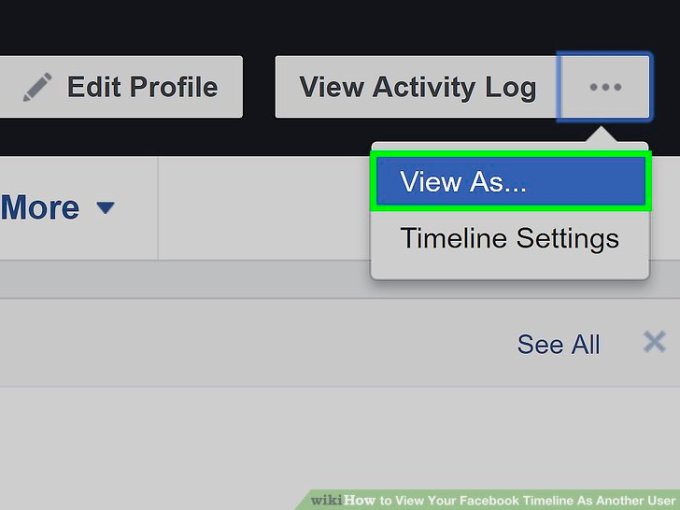
Facebook’s “View As” tool has been disabled following the hack. It let users see how their profile looked to a certain other user

The breach saw sophisticated hackers combine three Facebook bugs in its video uploader, user profile, and “view as” privacy feature to generate and steal the access tokens that allow users to stay logged into Facebook between sessions. These could be used to take over user accounts and take actions on their behalf. Facebook reset the access tokens of the 50 million users impacted and another 40 million who’d had their accounts viewed through the “view as” tool this year, which means they’ll have to log back into Facebook but won’t need to change their password.

The bugs stem from code pushed back in July, but Facebook only discovered the issue Tuesday afternoon as the hackers tried to scale up the attack to steal more tokens. Facebook patched the issue last night and this morning announced it was investigating, though it currently doesn’t have enough information to determine the source of the attack.. It’s already notifed the FBI, as well as the Irish Data Protection office since the breach has GDPR implications. On a call with reporters, CEO Mark Zuckerberg repeatedly called the problem “serious”. But beyond recounting the steps Facebook is taking to address this breach, he didn’t have a good answer for why users should still trust Facebook with their data.

Always quick to pounce on privacy issues, Warner has become one of the strongeest Democratic critics of the social network. He’s seemingly inherited the position of tech watchdog from former-Senator Al Franken. He’s weighed in on recent social media bias and election interference, Google’s plan to launch censored search in China, White House cybersecurity plans and more. With technology becoming an ever more important and dangerous part of people’s lives, Warner seems to see an opportunity to both protect his constituents and advance his career by demonstrating his expertise and ferocity.

This hack could be by Warner as strong evidence that social media companies like Facebook are not voluntarily doing enough to protect uses’ security and privacy. If regulation around security, portability, and interoperability is enacted, it could cost Facebook money for compliance, slow dow the pace of engineering innovation at the company, and make it more vulnerable to competitors. Right now, it’s tough for users to easily switch to another social network, which insulates Facebook from its PR problems becoming user growth problems. But if ditching Facebook for a competitor becomes simpler, it might force the company to treat its users better.

The Senator Mark Warner’s full statement can be found below:

STATEMENT OF U.S. SEN. MARK R. WARNER

~ On Facebook hack ~ 

WASHINGTON – U.S. Sen. Mark R. Warner (D-VA), Vice Chairman of the Senate Select Committee on Intelligence and co-chair of the Senate Cybersecurity Caucus, released the following statement on the announcement by Facebook that it discovered a security issue affecting almost 50 million accounts:

“The news that at least 50 million Facebook users had their accounts compromised is deeply concerning. A full investigation should be swiftly conducted and made public so that we can understand more about what happened.

“Today’s disclosure is a reminder about the dangers posed when a small number of companies like Facebook or the credit bureau Equifax are able to accumulate so much personal data about individual Americans without adequate security measures.

“This is another sobering indicator that Congress needs to step up and take action to protect the privacy and security of social media users. As I’ve said before – the era of the Wild West in social media is over.”

To kick start the debate around social media legislation, Sen. Warner in July released a white paper containing a suite of potential policy proposals for the regulation of social media.


source https://techcrunch.com/2018/09/28/facebook-breach-warner/

Surprising SEO A/B Test Results - Whiteboard Friday

Posted by willcritchlow

You can make all the tweaks and changes in the world, but how do you know they're the best choice for the site you're working on? Without data to support your hypotheses, it's hard to say. In this week's edition of Whiteboard Friday, Will Critchlow explains a bit about what A/B testing for SEO entails and describes some of the surprising results he's seen that prove you can't always trust your instinct in our industry.

Click on the whiteboard image above to open a high-resolution version in a new tab!

Video Transcription

Hi, everyone. Welcome to another British Whiteboard Friday. My name is Will Critchlow. I'm the founder and CEO at Distilled. At Distilled, one of the things that we've been working on recently is building an SEO A/B testing platform. It's called the ODN, the Optimization Delivery Network. We're now deployed on a bunch of big sites, and we've been running these SEO A/B tests for a little while. I want to tell you about some of the surprising results that we've seen.

What is SEO A/B testing?

We're going to link to some resources that will show you more about what SEO A/B testing is. But very quickly, the general principle is that you take a site section, so a bunch of pages that have a similar structure and layout and template and so forth, and you split those pages into control and variant, so a group of A pages and a group of B pages.

Then you make the change that you're hypothesizing is going to make a difference just to one of those groups of pages, and you leave the other set unchanged. Then, using your analytics data, you build a forecast of what would have happened to the variant pages if you hadn't made any changes to them, and you compare what actually happens to the forecast. Out of that you get some statistical confidence intervals, and you get to say, yes, this is an uplift, or there was no difference, or no, this hurt the performance of your site.

This is data that we've never really had in SEO before, because this is very different to running a controlled experiment in a kind of lab environment or on a test domain. This is in the wild, on real, actual, live websites. So let's get to the material. The first surprising result I want to talk about is based off some of the most basic advice that you've ever seen.

Result #1: Targeting higher-volume keywords can actually result in traffic drops

I've stood on stage and given this advice. I have recommended this stuff to clients. Probably you have too. You know that process where you do some keyword research and you find that there's one particular way of searching for whatever it is that you offer that has more search volume than the way that you're talking about it on your website right now, so higher search volume for a particular way of phrasing?

You make the recommendation, "Let's talk about this stuff on our website the way that people are searching for it. Let's put this kind of phrasing in our title and elsewhere on our pages." I've made those recommendations. You've probably made those recommendations. They don't always work. We've seen a few times now actually of testing this kind of process and seeing what are actually dramatic drops.

We saw up to 20-plus-percent drops in organic traffic after updating meta information in titles and so forth to target the more commonly-searched-for variant. Various different reasons for this. Maybe you end up with a worse click-through rate from the search results. So maybe you rank where you used to, but get a worse click-through rate. Maybe you improve your ranking for the higher volume target term and you move up a little bit, but you move down for the other one and the new one is more competitive.

So yes, you've moved up a little bit, but you're still out of the running, and so it's a net loss. Or maybe you end up ranking for fewer variations of key phrases on these pages. However it happens, you can't be certain that just putting the higher-volume keyword phrasing on your pages is going to perform better. So that's surprising result number one. Surprising result number two is possibly not that surprising, but pretty important I think.

Result #2: 30–40% of common tech audit recommendations make no difference

So this is that we see as many as 30% or 40% of the common recommendations in a classic tech audit make no difference. You do all of this work auditing the website. You follow SEO best practices. You find a thing that, in theory, makes the website better. You go and make the change. You test it.

Nothing, flatlines. You get the same performance as the forecast, as if you had made no change. This is a big deal because it's making these kinds of recommendations that damages trust with engineers and product teams. You're constantly asking them to do stuff. They feel like it's pointless. They do all this stuff, and there's no difference. That is what burns authority with engineering teams too often.

This is one of the reasons why we built the platform is that we can then take our 20 recommendations and hypotheses, test them all, find the 5 or 6 that move the needle, only go to the engineering team to build those ones, and that builds so much trust and relationship over time, and they get to work on stuff that moves the needle on the product side.

So the big deal there is really be a bit skeptical about some of this stuff. The best practices, at the limit, probably make a difference. If everything else is equal and you make that one tiny, little tweak to the alt attribute or a particular image somewhere deep on the page, if everything else had been equal, maybe that would have made the difference.

But is it going to move you up in a competitive ranking environment? That's what we need to be skeptical about.

Result #3: Many lessons don't generalize

So surprising result number three is: How many lessons do not generalize? We've seen this broadly across different sections on the same website, even different industries. Some of this is about the competitive dynamics of the industry.

Some of it is probably just the complexity of the ranking algorithm these days. But we see this in particular with things like this. Who's seen SEO text on a category page? Those kind of you've got all of your products, and then somebody says, "You know what? We need 200 or 250 words that mention our key phrase a bunch of times down at the bottom of the page." Sometimes, helpfully, your engineers will even put this in an SEO-text div for you.

So we see this pretty often, and we've tested removing it. We said, "You know what? No users are looking at this. We know that overstuffing the keyword on the page can be a negative ranking signal. I wonder if we'll do better if we just cut that div." So we remove it, and the first time we did it, plus 6% result. This was a good thing.

The pages are better without it. They're now ranking better. We're getting better performance. So we say, "You know what? We've learnt this lesson. You should remove this really low-quality text from the bottom of your category pages." But then we tested it on another site, and we see there's a drop, a small one admittedly, but it was helping on these particular pages.

So I think what that's just telling us is we need to be testing these recommendations every time. We need to be trying to build testing into our core methodologies, and I think this trend is only going to increase and continue, because the more complex the ranking algorithms get, the more machine learning is baked into it and it's not as deterministic as it used to be, and the more competitive the markets get, so the narrower the gap between you and your competitors, the less stable all this stuff is, the smaller differences there will be, and the bigger opportunity there will be for something that works in one place to be null or negative in another.

So I hope I have inspired you to check out some SEO A/B testing. We're going to link to some of the resources that describe how you do it, how you can do it yourself, and how you can build a program around this as well as some other of our case studies and lessons that we've learnt. But I hope you enjoyed this journey on surprising results from SEO A/B tests.

Resources:

Video transcription by Speechpad.com


Sign up for The Moz Top 10, a semimonthly mailer updating you on the top ten hottest pieces of SEO news, tips, and rad links uncovered by the Moz team. Think of it as your exclusive digest of stuff you don't have time to hunt down but want to read!


source https://moz.com/blog/surprising-seo-ab-test-results

Thursday, 27 September 2018

Facebook policy head makes a surprising cameo at the Kavanaugh hearing

Facebook might be doing its best to stay out of political scandals in the latter half of 2018, but the company had a presence, front and center, at one of the most contentious Senate hearings in modern history.

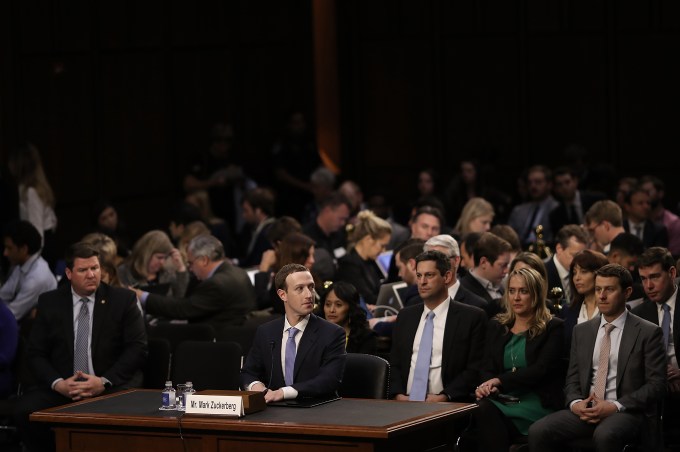
Facebook’s Vice President of Global Public Policy at Facebook, Joel Kaplan, was spotted sitting prominently alongside his wife, Laura Cox Kaplan, in the section for Brett Kavanaugh’s supporters. He is pictured in the far left of the header image and below, third from left, in front of the Senate Judiciary in April of this year.

WASHINGTON, DC – APRIL 10: Facebook co-founder, Chairman and CEO Mark Zuckerberg concludes his testimony before a combined Senate Judiciary and Commerce committee hearing in the Hart Senate Office Building on Capitol Hill April 10, 2018 in Washington, DC. (Photo by Win McNamee/Getty Images)

Kaplan has not made any public commentary on Twitter or Facebook about his support for the Supreme Court nominee, though through retweets, Kaplan’s wife appears to be of the mind that the hearing is part of a “smear campaign” against the family friend.

His appearance during the hearing is a show of personal support, though it still turns heads for such a prominent Facebook employee to be so visible during such a politically divisive event. Kaplan is not representing Facebook in a formal capacity.

Kaplan served as a policy adviser on George W. Bush’s 2000 election campaign and went on to serve as a policy assistant to the president and as the deputy director of the Office of Management and Budget (OMB) and a deputy chief of staff. Kavanaugh worked for the Bush administration during the same period, joining the former president’s legal team and going on to work on the nomination of Chief Justice John Roberts to the Supreme Court.

Kaplan joined Facebook in 2011 as its VP of U.S. public policy. Kaplan continues to serve in a heavily influential political role with the company today, leading its Washington D.C. office which serves as the company’s lobbying arm.


source https://techcrunch.com/2018/09/27/kavanaugh-facebook-joel-kaplan/

Mozilla pushes PayPal to make Venmo transactions private by default

Earlier this year, the FTC settled with PayPal over the company’s handling of privacy disclosures in its peer-to-peer payments app Venmo, but Mozilla doesn’t think the changes Venmo made as a result went far enough. This week, Mozilla says it delivered a petition signed by 25,000 Americans asking Venmo to set transactions shared in its app to private by default, instead of public.

As Mozilla explains, “millions of Venmo users’ spending habits are available for anyone to see. That’s because Venmo transactions are currently public by default — unless users manually update their settings, anyone, anywhere can see whom they’re sending money to, and why.”

Many Venmo users likely feel that it’s not very dangerous to share through Venmo’s feed – a key feature of its popular payments app – that they paid back a friend for part of the dinner, drinks or some concert tickets, for example.

But a Berlin-based researcher, Hang Do Thi Duc, recently studied the risks associated with this sort of over-sharing.

Do Thi Duc analyzed more than 200 million public Venmo transactions made in 2017 by accessing the data through a public API. This allowed her to see the names, dates, and transactions of Venmo users. She found that a lot could actually be gleaned from this data, including users’ drug habits in some cases, as well as their relationships, junk food habits, location, daily routines, personal finances, rent payments, and more.

In other words, while the individual transaction itself may seem harmless, in aggregate these transactions can be very revealing about the person in question.

Mozilla says it, along with Ipsos, also polled 1,009 Americans how they felt about Venmo’s “public by default” nature. 77% said they didn’t think that should be the case, and 92% said they don’t support Venmo’s justifications for making them public. (It thinks sharing is fun, basically.)

Venmo didn’t respond to Mozilla’s petition directly, but tells TechCrunch via a spokesperson that its takes its users’ trust seriously.

“Venmo was designed for sharing experiences with your friends in today’s social world, and the newsfeed has always been a big part of this,” the spokesperson said. “The safety and privacy of Venmo users and their information is always a top priority. Our users trust us with their money and personal information, and we take this responsibility and applicable privacy laws very seriously,” they added.

The company also pointed out it takes several steps to ensure some level of user protection, including not making sensitive transactions public, never publishing dollar amounts, and allowing users to control the publicity of the item, even after the fact.

As part of the FTC settlement, Venmo also had to make other changes, as well.

The company now has to explain to new and existing users how to limit the visibility of transactions through the use of privacy settings.

We recently saw this in the updated Venmo app, in fact.

Users are walked through a tutorial that spells out how you can change settings to make transactions private by default, or any time you choose.

[gallery ids="1721938,1721939,1721940,1721941"]

Mozilla’s petition comes at a time when PayPal has been weighing whether or not it should change the default in Venmo from public to private, according to a report from Bloomberg last month.

Thanks to large-scale scandals like Cambridge Analytica and others involving user data being overexposed, timed alongside the rollout of new privacy regulations like Europe’s GDPR, many companies are reviewing their data protection policies.

Venmo’s casual over-sharing now feels like a holdover from an earlier, more naive time on the web, and it wouldn’t be surprising if it decided to later adjust the app’s settings to match where consumer sentiment is headed today.


source https://techcrunch.com/2018/09/27/mozilla-pushes-paypal-to-make-venmo-transactions-private-by-default/

The E-Commerce Benchmark KPI Study: The Most Valuable Online Consumer Trend of 2018 Revealed [Video]

Posted by Alan_Coleman

The latest Wolfgang E-Commerce Report is now live. This study gives a comprehensive view of the state of digital marketing in retail and travel, allowing digital marketers to benchmark their 2018 performance and plan their 2019 strategy.

The study analyzes over 250 million website sessions and more than €500 million in online revenue. Google Analytics, new Facebook Analytics reports, and online surveys are used to glean insights.

Revenue volume correlations

One of the unique features of the study is its conversion correlation. All website metrics featured in the study are correlated with conversion success to reveal what the most successful websites do differently.

This year we've uncovered our strongest success correlation ever at 0.67! Just to give that figure context: normally, 0.2 is worth talking about and 0.3 is noteworthy. Not only is this correlation with success very strong, the insight itself is highly actionable and can become a pillar of your digital marketing strategy.

And the stand out metric is (drumroll, please!)...

Number of sessions per user.

To put it plainly, the websites that generate the most online revenue have the highest number of sessions per user over 12 months. Check out the video below to get a detailed explanation of this phenomenon:

Video transcript available below

These are the top factors that correlated with revenue volume. You can see the other correlations in the full study.

Click to see a bigger version

  • Average pages per session (.37)
  • Average session length (.49)
  • Conversion rate by users (.41)
  • Number of sessions per user (.67)
  • Percentage of sessions from paid search (.25)

Average website engagement metrics

Number of sessions per user Average pages per session Average session duration Bounce rate Average page load time Average server response time
Retail 1.58 6 3min 18sec 38.04% 6.84 1.02
Multi-channel 1.51 6 3min 17sec 35.27% 6.83 1.08
Online-only 1.52 5 3min 14sec 43.80% 6.84 0.89
Travel 1.57 3 2min 34sec 44.14% 6.76 0.94
Overall 1.58 5 3min 1sec 41.26% 6.80 0.97

Above are the average website engagement metrics. You can see the average number of sessions per user is very low at 1.5 over 12 months. Anything a digital marketer can do to get this to 2, to 3, and to 4 makes for about the best digital marketing they can do.

At Wolfgang Digital, we’ve been witnessing this phenomenon at a micro-level for some time now. Many of our most successful campaigns of late have been focused on presenting the user with an evolving message which matures with each interaction across multiple media touchpoints.

Click through to the Wolfgang E-Commerce KPI Report in full to uncover dozens more insights, including:

  • Is a social media engagement more valuable than a website visit?
  • What's the true value of a share?
  • What’s the average conversion rate for online-only vs multi-channel retailers?
  • What’s the average order value for a hotel vs. tour operator?

Video Transcript

Today I want to talk to you about the most important online consumer trend in 2018. The story starts in a client meeting about four years ago, and we were meeting with a travel client. We got into a discussion about bounce rate and its implication on conversion rate. The client was asking us, "could we optimize our search and social campaigns to reduce bounce rate?", which is a perfectly valid question.

But we were wondering: Will we lower the rate of conversions? Are all bounces bad? As a result of this meeting, we said, "You know, we need a really scientific answer to that question about any of the website engagement metrics or any of the website channels and their influence on conversion." Out of that conversation, our E-Commerce KPI Report was born. We're now four years into it. (See previous years on the Moz Blog: 2015, 2016, 2017.)

The metric with the strongest correlation to conversions: Number of sessions per user

We've just released the 2019 E-Commerce KPI Report, and we have a standout finding, probably the strongest correlation we've ever seen between a website engagement metric and a website conversion metric. This is beautiful because we're all always optimizing for conversion metrics. But if you can isolate the engagement metrics which deliver, which are the money-making metrics, then you can be much more intelligent about how you create digital marketing campaigns.

The strongest correlation we've ever seen in this study is number of sessions per user, and the metric simply tells us on average how many times did your users visit your website. What we're learning here is any digital marketing you can do which makes that number increase is going to dramatically increase your conversions, your revenue success.

Change the focus of your campaigns

It's a beautiful metric to plan campaigns with because it changes the focus. We're not looking for a campaign that's a one-click wonder campaign. We're not looking for a campaign that it's one message delivered multiple times to the same user. Much more so, we're trying to create a journey, multiple touchpoints which deliver a user from their initial interaction through the purchase funnel, right through to conversion.

Create an itinerary of touchpoints along the searcher's journey

1. Research via Google

Let me give you an example. We started this with a story about a travel company. I'm just back from a swimming holiday in the west of Ireland. So let's say I have a fictional travel company. We'll call them Wolfgang Wild Swimming. I'm going to be a person who's researching a swimming holiday. So I'm going to go to Google first, and I'm going to search for swimming holidays in Ireland.

2. E-book download via remarketing

I'm going to go to the Wolfgang Wild Swimming web page, where I'm going to read a little bit about their offering. In doing that, I'm going to enter their Facebook audience. The next time I go to Facebook, they're now remarketing to me, and they'll be encouraging me to download their e-book, which is a guide to the best swimming spots in the wild west of Ireland. I'm going to volunteer my email to them to get access to the book. Then I'm going to spend a bit more time consuming their content and reading their book.

3. Email about a local offline event

A week later, I get an email from them, and they're having an event in my area. They're going for a swim in Dublin, one of my local spots in The Forty Foot, for example. I'm saying, "Well, I was going to go for a swim this weekend anyway. I might as well go with this group." I go to the swim where I can meet the tour guides. I can meet people who have been on it before. I'm now really close to making a purchase.

4. YouTube video content consumed via remarketing

Again, a week later, they have my email address, so they're targeting me on YouTube with videos of previous holidays. Now I'm watching video content. All of a sudden, Wolfgang Wild Swimming comes up. I'm now watching a video of a previous holiday, and I'm recognizing the instructors and the participants in the previous holidays. I'm really, really close to pressing Purchase on a holiday here. I'm on the phone to my friend saying, "I found the one. Let's book this."

Each interaction moves the consumer closer to purchase

I hope what you're seeing there is with each interaction, the Google search, the Facebook ad which led to an e-book download, the offline event, back online to the YouTube video, with each interaction I'm getting closer to the purchase.

You can imagine the conversion rate and the return on ad spend on each interaction increasing as we go. This is a really powerful message for us as digital marketers. When we're planning a campaign, we think about ourselves as though we're in the travel business too, and we're actually creating an itinerary. We're simply trying to create an itinerary of touchpoints that guide a searcher through awareness, interest, right through to action and making that purchase.

I think it's not just our study that tells us this is the truth. A lot of the best-performing campaigns we've been running we've seen this anecdotally, that every extra touchpoint increases the conversion rate. Really powerful insight, really useful for digital marketers when planning campaigns. This is just one of the many insights from our E-Commerce KPI Report. If you found that interesting, I'd urge you to go read the full report today.


Sign up for The Moz Top 10, a semimonthly mailer updating you on the top ten hottest pieces of SEO news, tips, and rad links uncovered by the Moz team. Think of it as your exclusive digest of stuff you don't have time to hunt down but want to read!


source https://moz.com/blog/ecommerce-benchmark-kpi-study-2018

Pew: A majority of U.S. teens are bullied online

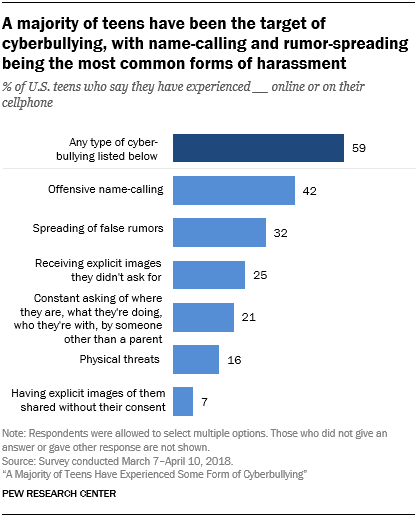
A majority of U.S. teens have been subject to online abuse, according to a new study from Pew Research Center, out this morning. Specifically, that means they’ve experienced at least one of a half-dozen types of online cyberbullying, including name-calling, being subject to false rumors, receiving explicit images they didn’t ask for, having explicit images of themselves shared without their consent, physical threats, or being constantly asked about their location and activities in a stalker-ish fashion by someone who is not their parents.

Of these, name-calling and being subject to false rumors were the top two categories of abuse teens were subject to, with 42% and 32% of teens reporting it had happened to them.


Pew says that texting and digital messaging has paved the way for these types of interactions, and parents and teens alike are both aware of the dangers and concerned.

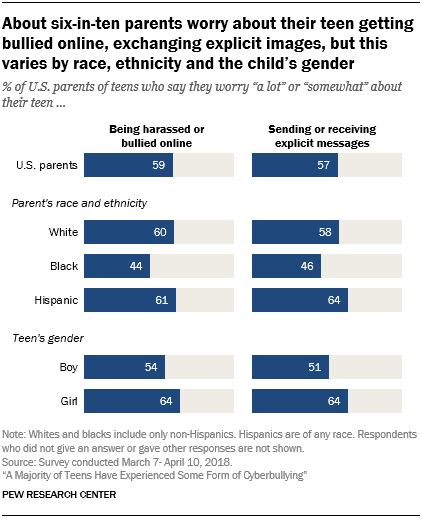
Parents, in particular, are worried about teens sending and receiving explicit images, with 57% saying that’s a concern, and a quarter who worry about this “a lot.” And parents of girls worry more. (64% do.)

Meanwhile, a large majority – 90% – of teens now believe that online harassment is a problem and 63% say it’s what they consider a “major” problem.

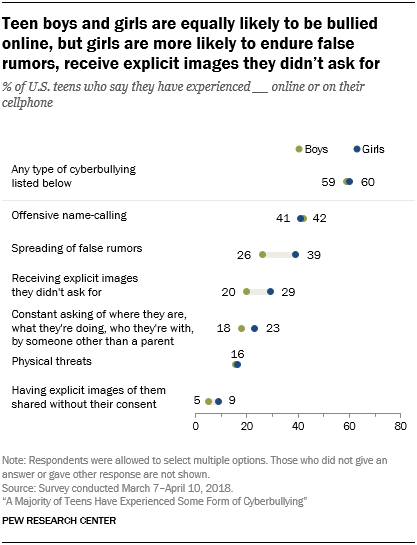
Pew also found that girls and boys are both harassed online in fairly equal measure, with 60% of girls and 59% of boys reporting having experienced some sort of online abuse. That’s a figure that may surprise some. However, it’s important to clarify that this finding is about whether or not the teen had ever had experienced online abuse – not how often or how much.

Not surprisingly, Pew found that girls are more likely than boys to have experienced two or more types of abuse, and 15% of girls have been the target of at least 4 types of abuse, compared with 6% of boys.

Girls are also more likely to be the recipient of explicit images they didn’t ask for, as 29% of teens girls reported this happened to them, versus 20% of boys.

And as the teen girls got older, they receive even more of these types of images, with 35% of girls ages 15 to 17 saying they received them, compared with only 1 out of 5 boys.

Several factors seem to play no role in how often the teens experience abuse, including race, ethnicity, or parents’ educational attainment, Pew noted. But having money does seem to matter somehow – as 24% of teens whose household income was less than $30K per year said they received online threats, compared with only 12% of those whose household incomes was greater than $75K per year. (Pew’s report doesn’t attempt to explain this finding.)

Beyond that factor, receiving or avoiding abuse is directly tied to how much screen time teens put in.

That is, the more teens go online, the more abuse they’ll receive.

45% of teens say they’re online almost constantly, and they are more likely to be harassed, as a result. 67% of them say they’ve been cyberbullied, compared with 53% who use the internet several times a day or less. And half the constantly online teens have been called offensive names, compared with just about a third (36%) who use the internet less often.

Major tech companies, including Apple, Google, and Facebook, have begun to address the issues around device addiction and screen time with software updates and parental controls.

Apple, in iOS 12, rolled out Screen Time controls that allows Apple device users to measure, monitor and restrict how often they’re on their phones, when, what type of content is blocked, and which apps they can use. In adults, the software can nudge them in the right direction, but parents also have the option of locking down their children’s phones using Screen Time controls. (Of course, savvy kids have already found the loopholes to avoid this, according to new reports.)

Google also introduced time management controls in the new version of Android, and offers parental controls around screen time through its Family Link software.

And both Google and Facebook have begun to introduce screen time reminders and settings for addictive apps like YouTube, Facebook and Instagram.

Teens seem to respect parents’ involvement in their digital lives, the report also found.

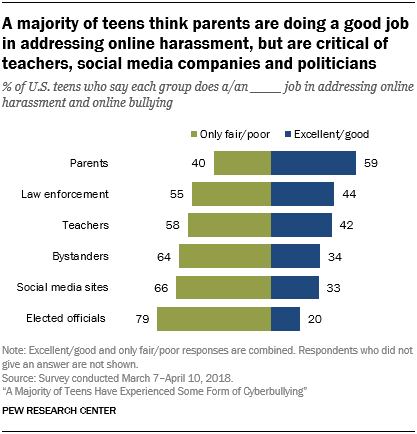
A majority – 59% – of U.S. teens say their parents are doing a good job with regard to addressing online harassment. However, 79% say elected officials are failing to protect them through legislation, 66% say social media sites are doing a poor job at stamping down abuse, and 58% of teachers are doing a poor job at handling abuse, as well.

Many of the top media sites were largely built by young people when they were first founded, and those people were often men. The sites were created in an almost naive fashion, with regard to online abuse. Protections – like muting, filters, blocking, and reporting, were generally introduced in a reactive fashion, not as proactive controls.

Instagram, for example – one of teens’ most-used apps – only introduced comment filters, blocklists, and comment blocking in 2016, and just four months ago added account muting. The app was launched in October 2010.

Pew’s findings indicate that parents would do well by their kids by using screen time management and control systems – not simply to stop their teenagers from being bullied and abused as often, but also to help the teens practice how to interact with the web in a less addictive fashion as they grow into adults.

After all, device addiction resulting in increased exposure to online abuse is not a plague that only affects teens.

Pew’s full study involves surveys of 743 teens and 1,058 parents living in the U.S. conducted March 7 to April 10, 2018. It counted “teens” as those ages 13 to 17, and “parents of teens” are those who are the parent or guardian of someone in that age range. The full report is here.


source https://techcrunch.com/2018/09/27/pew-a-majority-of-u-s-teens-are-bullied-online/

Facebook poisons the acquisition well

Who should you sell your startup to? Facebook and the founders of its former acquisitions are making a strong case against getting bought by Mark Zuckerberg and Co. After a half-decade of being seen as one of the most respectful and desired acquirers, a series of scandals has destroyed the image of Facebook’s M&A division. That could make it tougher to convince entrepreneurs to sell to Facebook, or force it to pay higher prices and put contractual guarantees of autonomy into the deals.

WhatsApp’s founders left amidst aggressive pushes to monetize. Instagram’s founders left as their independence was threatened. Oculus’ founders were demoted. And over the past few years, Facebook has also shut down acquisitions, including viral teen Q&A app TBH (though its founder says he recommended shutting it down), fitness tracker Moves, video advertising system LiveRail, voice control developer toolkit Wit.ai and still-popular mobile app developer platform Parse.

Facebook’s users might not know or care about much of this. But it could be a sticking point the next time Facebook tries to buy out a burgeoning competitor or complementary service.

Broken promises with WhatsApp

The real trouble started with WhatsApp co-founder Brian Acton’s departure from Facebook a year ago before he was fully vested from the $22 billion acquisition in 2014. He’d been adamant that Facebook not stick the targeted ads he hated inside WhatsApp, and Zuckerberg conceded not to. Acton even got a clause added to the deal that the co-founders’ remaining stock would vest instantly if Facebook implemented monetization schemes without their consent. Google was also interested in buying WhatsApp, but Facebook’s assurances of independence sealed the deal.

WhatsApp’s other co-founder, Jan Koum, left Facebook in April following tension about how Facebook would monetize his app and the impact of that on privacy. Acton’s departure saw him leave $850 million on the table. Captivity must have been pretty rough for freedom to be worth that much. Today in an interview with Forbes’s Parmy Olson, he detailed how Facebook got him to promise it wouldn’t integrate WhatsApp’s user data to get the deal approved by EU regulators. Facebook then broke that promise, paid the $122 million fine that amounted to a tiny speed bump for the money-printing corporation, and kept on hacking.

When Acton tried to enact the instant-vesting clause upon his departure, Facebook claimed it was still exploring, not “implementing,” monetization. Acton declined a legal fight and walked away, eventually tweeting “Delete Facebook.” Koum stayed to vest a little longer. But soon after they departed, WhatsApp started charging businesses for slow replies, and it will inject ads into the WhatsApp’s Stories product Status next year. With user growth slowing, users shifting to Stories, and News Feed out of ad space, Facebook’s revenue problem became WhatsApp’s monetization mandate.

The message was that Facebook would eventually break its agreements with acquired founders to prioritize its own needs.

Diminished autonomy for Instagram

Instagram’s co-founders Kevin Systrom and Mike Krieger announced they were resigning this week, which sources tell TechCrunch was because of mounting tensions with Zuckerberg over product direction. Zuckerberg himself negotiated the 2012 acquisition for $1 billion ($715 million when the deal closed with Facebook’s share price down, but later $4 billion as it massively climbed). That price was stipulated on Instagram remaining independent in both brand and product roadmap.

Zuckerberg upheld his end of the bargain for five years, and the Instagram co-founders stayed on past their original vesting dates — uncommon in Silicon Valley. Facebook pointed to Instagram’s autonomy when it was trying to secure the WhatsApp acquisition. And with the help of Facebook’s engineering, sales, recruiting, internationalization and anti-spam teams, Instagram grew into a 1 billion-user juggernaut.

But again, Facebook’s growth and financial woes led to a change of heart for Zuckerberg. Facebook’s popularity amongst teens was plummeting while Instagram remained cool. Facebook pushed to show its alerts and links back to the parent company inside of Instagram’s notifications and settings tabs. Meanwhile, it stripped out the Instagram attribution from cross-posted photos and deleted a shortcut to Instagram from the Facebook bookmarks menu.

Zuckerberg then installed a loyalist, his close friend and former News Feed VP Adam Mosseri, as Instagram’s new VP of Product mid-way through this year. The reorganization also saw Systrom start reporting to Facebook CPO Chris Cox. Previously the Instagram CEO had more direct contact with Zuckerberg despite technically reporting to CTO Mike Schroepfer, and the insertion of a layer of management between them frayed their connection. Six years after being acquired, Facebook started breaking its promises, Instagram felt less autonomous and the founders exited.

The message again was that Facebook expected to be able to exploit its acquisitions regardless of their previous agreements.

Reduced visibility for Oculus

Zuckerberg declared Oculus was the next great computing platform when Facebook acquired the virtual reality company in 2014. Adoption ended up slower than many expected, forcing Oculus to fund VR content creators since it’s still an unsustainable business. Oculus has likely been a major cash sink for Facebook it will have to hope pays off later.

But in the meantime, the co-founders of Oculus have faded into the background. Brendan Iribe and Nate Mitchell have gone from leading the company to focusing on the nerdiest part of its growing product lineup as VPs running the PC VR and Rift hardware teams, respectively. Former Xiaomi hardware leader Hugo Barra was brought in as VP of VR to oversee Oculus, and he reports to former Facebook VP of Ads Andrew “Boz” Bosworth — a longtime Zuckerberg confidant who TA’d one of his classes at Harvard who now runs all of Facebook’s hardware efforts.

Oculus’ original visionary inventor Palmer Luckey left Facebook last year following a schism with the company over him funding anti-Hillary Clinton memes and “sh*tposters.” He was pressed to apologize, saying “I am deeply sorry that my actions are negatively impacting the perception of Oculus and its partners.”

Lesser-known co-founder Jack McCauley left Facebook just a year after the acquisition to start his own VR lab. Sadly, Oculus co-founder Andrew Reisse died in 2013 when he was struck by a vehicle in a police chase just two months after the acquisition was announced. The final co-founder Michael Antonov was the chief software architect, but Facebook just confirmed to me he recently left the division to work on artificial intelligence infrastructure at Facebook.

Today for the first time, none of the Oculus co-founders appeared onstage at its annual Connect conference. Obviously the skills needed to scale and monetize a product are different from those needed to create. Still, going from running the company to being stuck in the audience doesn’t send a great signal about how Facebook treats acquired founders.

Course correction

Facebook needs to take action if it wants to reassure prospective acquisitions that it can be a good home for their startups. I think Zuckerberg or Mosseri (likely to be named Instagram’s new leader) should issue a statement that they understand people’s fears about what will happen to Instagram and WhatsApp since they’re such important parts of users’ lives, and establishing core tenets of the product’s identity they don’t want to change. Again, 15-year-old Instagrammers and WhatsAppers probably won’t care, but potential acquisitions would.

So far, Facebook has only managed to further inflame the founders versus Facebook divide. Today former VP of Messenger and now head of Facebook’s blockchain team David Marcus wrote a scathing note criticizing Acton for his Forbes interview and claiming that Zuckerberg tried to protect WhatsApp’s autonomy. “Call me old fashioned. But I find attacking the people and company that made you a billionaire, and went to an unprecedented extent to shield and accommodate you for years, low-class. It’s actually a whole new standard of low-class,” he wrote.

Posted by David Marcus on Wednesday, September 26, 2018

But this was a wasted opportunity for Facebook to discuss all the advantages it brings to its acquisitions. Marcus wrote, “As far as I’m concerned, and as a former lifelong entrepreneur and founder, there’s no other large company I’d work at, and no other leader I’d work for,” and noted the opportunity for impact and the relatively long amount of time acquired founders have stayed in the past. Still, it would have been more productive to focus on why’s it’s where he wants to work, how founders actually get to touch the lives of billions and how other acquirers like Twitter and Google frequently dissolve the companies they buy and often see their founders leave even sooner.

Acquisitions have protected Facebook from disruption. Now that strategy is in danger if it can’t change this narrative. Lots of zeros on a check might not be enough to convince the next great entrepreneur to sell Facebook their startup if they suspect they or their project will be steamrolled.


source https://techcrunch.com/2018/09/26/m-and-nay/